
Mindmap
Long-term psychological
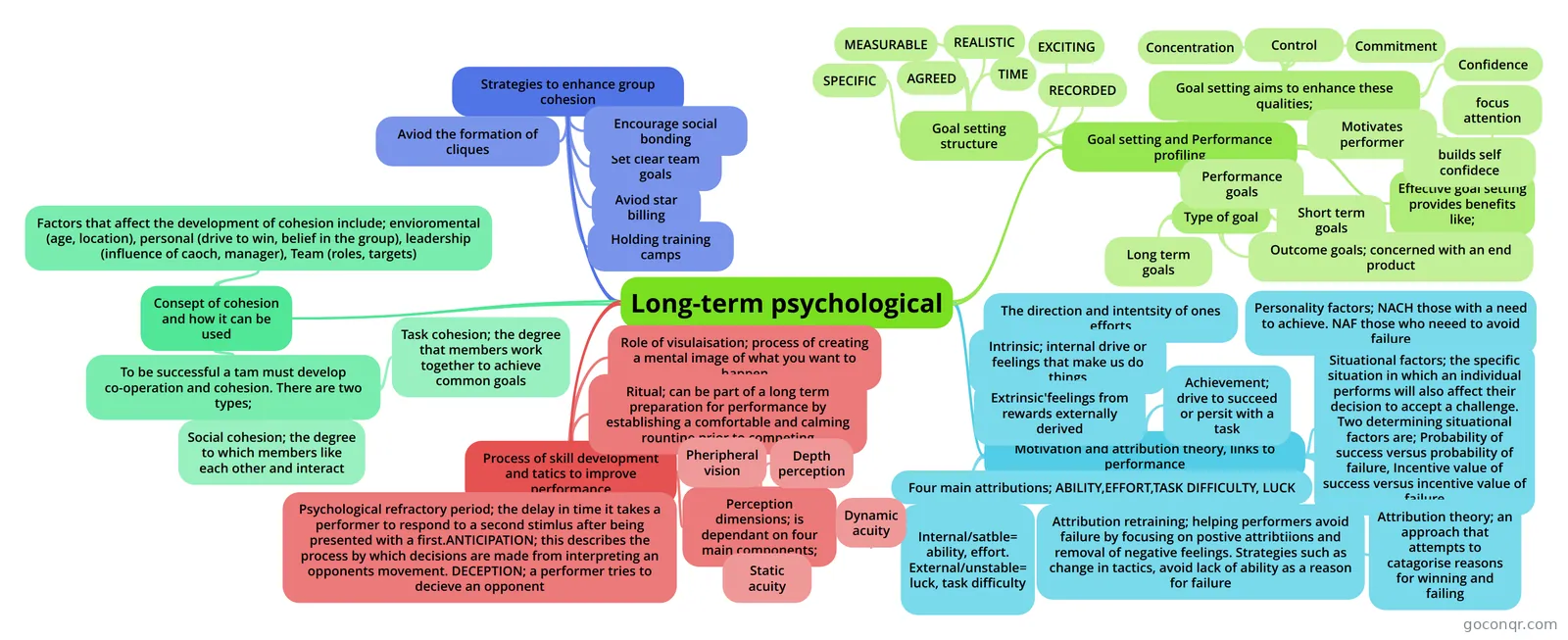
Mind map: Long-term psychological preparation in sport
Inhalt der Mindmap
Long-term psychological
Goal setting and Performance profiling
- Goal setting aims to enhance these qualities;
- Commitment
- Confidence
- Control
- Concentration
- Effective goal setting provides benefits like;
- Motivates performer
- focus attention
- builds self confidece
- Type of goal
- Outcome goals; concerned with an end product
- Short term goals
- Long term goals
- Performance goals
- Goal setting structure
- SPECIFIC
- MEASURABLE
- AGREED
- REALISTIC
- TIME
- EXCITING
- RECORDED
- Goal setting aims to enhance these qualities;
Motivation and attribution theory, links to performance
- The direction and intentsity of ones efforts
- Intrinsic; internal drive or feelings that make us do things
- Extrinsic'feelings from rewards externally derived
- Achievement; drive to succeed or persit with a task
- Personality factors; NACH those with a need to achieve. NAF those who neeed to avoid failure
- Situational factors; the specific situation in which an individual performs will also affect their decision to accept a challenge. Two determining situational factors are; Probability of success versus probability of failure, Incentive value of success versus incentive value of failure
- Attribution theory; an approach that attempts to catagorise reasons for winning and failing
- Four main attributions; ABILITY,EFFORT,TASK DIFFICULTY, LUCK
- Internal/satble= ability, effort. External/unstable= luck, task difficulty
- Attribution retraining; helping performers avoid failure by focusing on postive attribtiions and removal of negative feelings. Strategies such as change in tactics, avoid lack of ability as a reason for failure
Process of skill development and tatics to improve performance
- Role of visulaisation; process of creating a mental image of what you want to happen
- Ritual; can be part of a long term preparation for performance by establishing a comfortable and calming rountine prior to competing
- Perception dimensions; is dependant on four main components;
- Pheripheral vision
- Depth perception
- Dynamic acuity
- Static acuity
- Psychological refractory period; the delay in time it takes a performer to respond to a second stimlus after being presented with a first.ANTICIPATION; this describes the process by which decisions are made from interpreting an opponents movement. DECEPTION; a performer tries to decieve an opponent
Consept of cohesion and how it can be used
- To be successful a tam must develop co-operation and cohesion. There are two types;
- Task cohesion; the degree that members work together to achieve common goals
- Social cohesion; the degree to which members like each other and interact
- Factors that affect the development of cohesion include; envioromental (age, location), personal (drive to win, belief in the group), leadership (influence of caoch, manager), Team (roles, targets)
- To be successful a tam must develop co-operation and cohesion. There are two types;
Strategies to enhance group cohesion
- Holding training camps
- Aviod star billing
- Set clear team goals
- Encourage social bonding
- Aviod the formation of cliques
Informationen
- Beschreibung
- A-Levels P.E (Long term preparation) Mindmap am Long-term psychological, erstellt von harry_bygraves am 02/06/2013.
- Erstellt von
- harry_bygraves
- Aufrufe
- 104
- Tags
- Bewertung