
Mindmap
Developmental Psychology
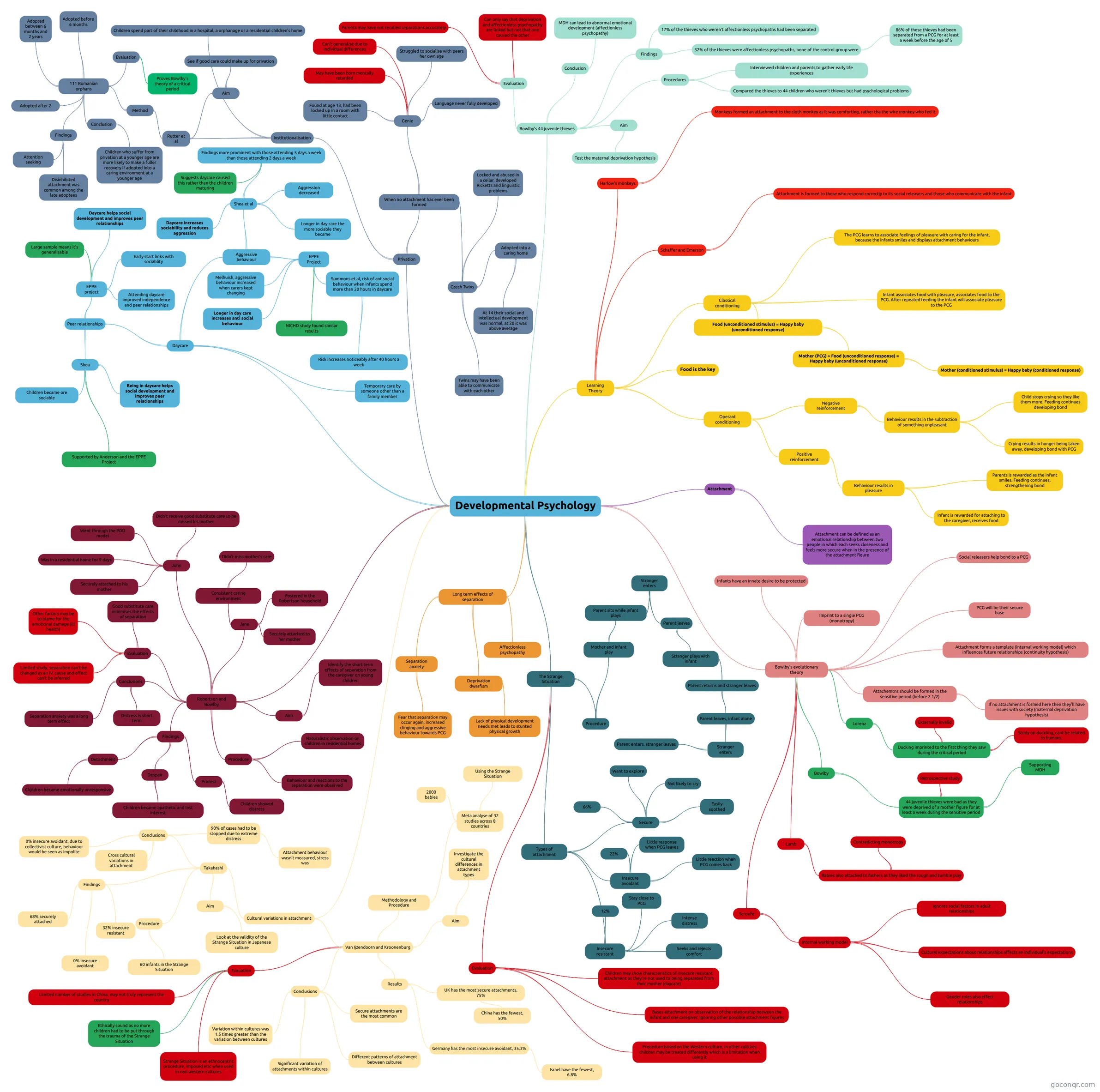
Mind map: Developmental psychology attachment
Inhalt der Mindmap
Developmental Psychology
Attachment
- Attachment can be defined as an emotional relationship between two people in which each seeks closeness and feels more secure when in the presence of the attachment figure
Learning Theory
- Operant conditioning
- Positive reinforcement
- Behaviour results in pleasure
- Infant is rewarded for attaching to the caregiver, receives food
- Parents is rewarded as the infant smiles. Feeding continues, strengthening bond
- Behaviour results in pleasure
- Negative reinforcement
- Behaviour results in the subtraction of something unpleasant
- Crying results in hunger being taken away, developing bond with PCG
- Child stops crying so they like them more. Feeding continues developing bond
- Behaviour results in the subtraction of something unpleasant
- Positive reinforcement
- Classical conditioning
- Food (unconditioned stimulus) = Happy baby (unconditioned response)
- Mother (PCG) + Food (unconditioned response) = Happy baby (unconditioned response)
- Mother (conditioned stimulus) = Happy baby (conditioned response)
- Mother (PCG) + Food (unconditioned response) = Happy baby (unconditioned response)
- Infant associates food with pleasure, associates food to the PCG. After repeated feeding the infant will associate pleasure to the PCG
- The PCG learns to associate feelings of pleasure with caring for the infant, because the infants smiles and displays attachment behaviours
- Food (unconditioned stimulus) = Happy baby (unconditioned response)
- Schaffer and Emerson
- Attachment is formed to those who respond correctly to its social releasers and those who communicate with the infant
- Food is the key
- Harlow's monkeys
- Monkeys formed an attachment to the cloth monkey as it was comforting, rather tha the wire monkey who fed it
- Operant conditioning
Bowlby's evolutionary theory
- Infants have an innate desire to be protected
- Imprint to a single PCG (monotropy)
- Social releasers help bond to a PCG
- PCG will be their secure base
- Attachemtns should be formed in the sensitive period (before 2 1/2)
- If no attachment is formed here then they'll have issues with society (maternal deprivation hypothesis)
- Attachment forms a template (internal working model) which influences future relationships (continuity hypothesis)
- Lorenz
- Ducking imprinted to the first thing they saw during the critical period
- Study on duckling, cant be related to humans.
- Externally invalid
- Ducking imprinted to the first thing they saw during the critical period
- Bowlby
- 44 juvenile thieves were bad as they were deprived of a mother figure for at least a week during the sensitive period
- Supporting MDH
- Retrospective study
- 44 juvenile thieves were bad as they were deprived of a mother figure for at least a week during the sensitive period
- Lamb
- Babies also attached to fathers as they liked the rough and tumble play
- Contradicting monotropy
- Babies also attached to fathers as they liked the rough and tumble play
- Scroufe
- Internal working model
- Ignores social factors in adult relationships
- Cultural expectations about relationships affects an individual's expectations
- Gender roles also effect relationships
- Internal working model
The Strange Situation
- Procedure
- Mother and infant play
- Parent sits while infant plays
- Stranger enters
- Parent leaves
- Stranger plays with infant
- Parent returns and stranger leaves
- Parent leaves, infant alone
- Stranger enters
- Parent enters, stranger leaves
- Stranger enters
- Parent leaves, infant alone
- Parent returns and stranger leaves
- Stranger plays with infant
- Parent leaves
- Stranger enters
- Parent sits while infant plays
- Mother and infant play
- Types of attachment
- Secure
- 66%
- Want to explore
- Not likely to cry
- Easily soothed
- Insecure avoidant
- 22%
- Little response when PCG leaves
- Little reaction when PCG comes back
- Insecure resistant
- 12%
- Stay close to PCG
- Intense distress
- Seeks and rejects comfort
- Secure
- Evaluation
- Children may show characteristics of insecure resistant attachment as they're not used to being separated from their mother (daycare)
- Bases attachment on observation of the relationship between the infant and one caregiver, ignoring other possible attachment figures
- Procedure based on the Western culture, in other cultures children may be treated differently which is a limitation when using it
- Procedure
Cultural variations in attachment
- Van Ijzendoorn and Kroonenburg
- Aim
- Investigate the cultural differences in attachment types
- Methodology and Procedure
- Meta analyse of 32 studies across 8 countries
- Using the Strange Situation
- 2000 babies
- Meta analyse of 32 studies across 8 countries
- Results
- UK has the most secure attachments, 75%
- China has the fewest, 50%
- Germany has the most insecure avoidant, 35.3%
- Israel have the fewest, 6.8%
- UK has the most secure attachments, 75%
- Conclusions
- Secure attachments are the most common
- Different patterns of attachment between cultures
- Significant variation of attachments within cultures
- Variation within cultures was 1.5 times greater than the variation between cultures
- Evauation
- Strange Situation is an ethnocentric procedure, imposed etic when used in non western cultures
- Ethically sound as no more children had to be put through the trauma of the Strange Situation
- Limited number of studies in China, may not truly represent the country
- Aim
- Takahashi
- Aim
- Look at the validity of the Strange Situation in Japanese culture
- Procedure
- 60 infants in the Strange Situation
- Findings
- 32% insecure resistant
- 0% insecure avoidant
- 68% securely attached
- Conclusions
- Cross cultural variations in attachment
- 0% insecure avoidant, due to collectivist culture, behaviour would be seen as impolite
- 90% of cases had to be stopped due to extreme distress
- Attachment behaviour wasn't measured, stress was
- Aim
- Van Ijzendoorn and Kroonenburg
Robertson and Bowlby
- Aim
- Identify the short term effects of separation from the caregiver on young children
- Procedure
- Naturalistic observation on children in residential homes
- Behaviour and reactions to the separation were observed
- Findings
- Protest
- Children showed distress
- Despair
- Children became apathetic and lost interest
- Detachment
- Chjildren became emotionally unresponsive
- Protest
- Conclusions
- Distress is short term
- Separation anxiety was a long term effect
- Evaluation
- Good substitute care minimises the effects of separation
- Limited study, separation can't be changed as an IV, cause and effect can't be inferred
- Other factors may be to blame for the emotional damage (ill health)
- John
- Securely attached to his mother
- Was in a residential home for 9 days
- Went through the PDD model
- Didn't receive good substitute care so he missed his mother
- Jane
- Securely attached to her mother
- Fostered in the Robertson household
- Consistent caring environment
- Didn't miss mother's care
- Aim
Long term effects of separation
- Separation anxiety
- Fear that separation may occur again, increased clinging and aggressive behaviour towards PCG
- Affectionless psychopathy
- Deprivation dwarfism
- Lack of physical development needs met leads to stunted physical growth
- Separation anxiety
Bowlby's 44 juvenile thieves
- Procedures
- Compared the thieves to 44 children who weren't thieves but had psychological problems
- Interviewed children and parents to gather early life experiences
- Aim
- Test the maternal deprivation hypothesis
- Findings
- 32% of the thieves were affectionless psychopaths, none of the control group were
- 86% of these thieves had been separated from a PCG for at least a week before the age of 5
- 17% of the thieves who weren't affectionless psychopaths had been separated
- 32% of the thieves were affectionless psychopaths, none of the control group were
- Conclusion
- MDH can lead to abnormal emotional development (affectionless psychopathy)
- Evaluation
- Can only say that deprivation and affectionless psychopathy are linked but not that one caused the other
- Parents may have not recalled separations accurately
- Procedures
Privation
- When no attachment has ever been formed
- Genie
- Found at age 13, had been locked up in a room with little contact
- Language never fully developed
- Struggled to socialise with peers her own age
- Can't generalise due to individual differences
- May have been born mentally retarded
- Czech Twins
- Locked and abused in a cellar, developed Ricketts and linguistic problems
- Adopted into a caring home
- At 14 their social and intellectual development was normal, at 20 it was above average
- Twins may have been able to communicate with each other
- Genie
- Institutionalisation
- Children spend part of their childhood in a hospital, a orphanage or a residential children's home
- Rutter et al
- Aim
- See if good care could make up for privation
- Method
- 111 Romanian orphans
- Adopted before 6 months
- Adopted between 6 months and 2 years
- Adopted after 2
- Findings
- Disinhibited attachment was common among the late adoptees
- Attention seeking
- Conclusion
- Children who suffer from privation at a younger age are more likely to make a fuller recovery if adopted into a caring environment at a younger age
- Evaluation
- Proves Bowlby's theory of a critical period
- 111 Romanian orphans
- Aim
- When no attachment has ever been formed
Daycare
- Temporary care by someone other than a family member
- Aggressive behaviour
- EPPE Project
- Summons et al, risk of ant social behaviour when infants spend more than 20 hours in daycare
- Risk increases noticeably after 40 hours a week
- Melhuish, aggressive behaviour increased when carers kept changing
- Longer in day care increases anti social behaviour
- NICHD study found similar results
- Summons et al, risk of ant social behaviour when infants spend more than 20 hours in daycare
- Shea et al
- Longer in day care the more sociable they became
- Aggression decreased
- Findings more prominent with those attending 5 days a week than those attending 2 days a week
- Suggests daycare caused this rather than the children maturing
- Daycare increases sociability and reduces aggression
- EPPE Project
- Peer relationships
- EPPE project
- Attending daycare improved independence and peer relationships
- Early start links with sociablity
- Daycare helps social development and improves peer relationships
- Large sample means it's generalisable
- Shea
- Children became ore sociable
- Being in daycare helps social development and improves peer relationships
- Supported by Anderson and the EPPE Project
- EPPE project
Informationen
- Beschreibung
- A level Psya1 Mindmap am Developmental Psychology, erstellt von Emma Robinson am 03/02/2015.
- Erstellt von
- Emma Robinson
- Aufrufe
- 0
- Bewertung
Mehr zu Attachment and Parenting