
Mindmap
stages of attachment
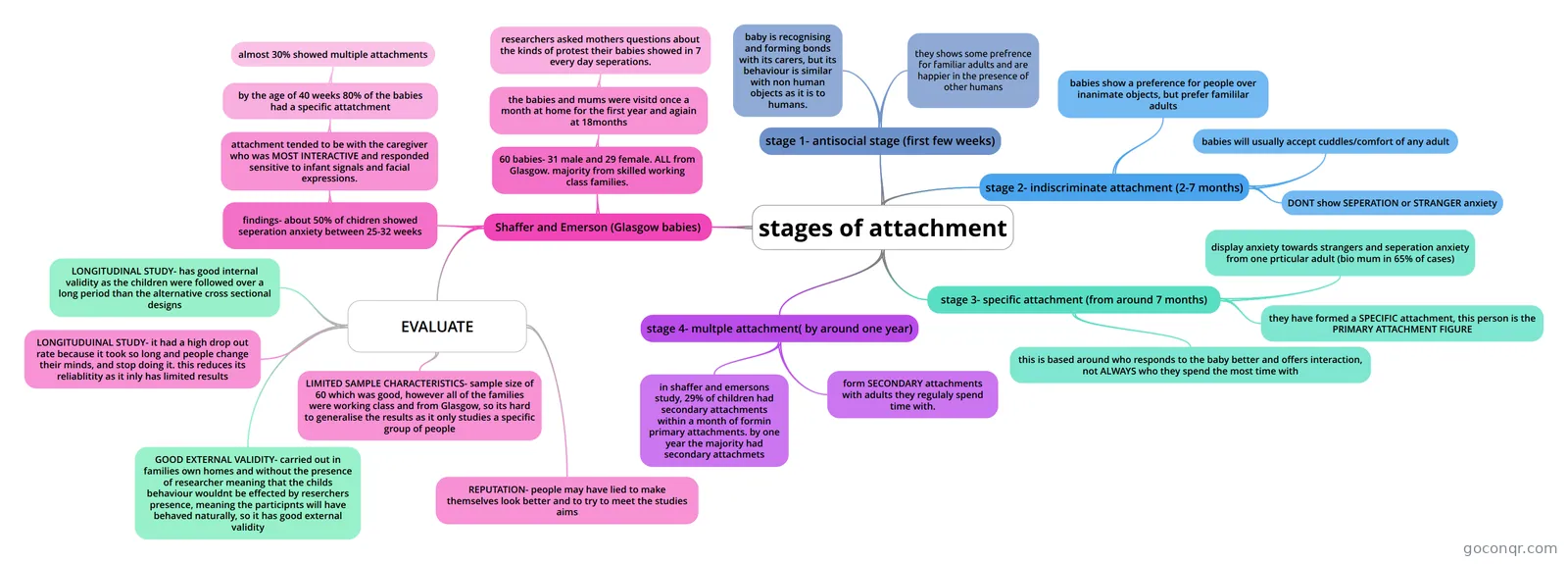
Mind map: stages of attachment
Inhalt der Mindmap
stages of attachment
stage 1- antisocial stage (first few weeks)
- baby is recognising and forming bonds with its carers, but its behaviour is similar with non human objects as it is to humans.
- they shows some prefrence for familiar adults and are happier in the presence of other humans
stage 2- indiscriminate attachment (2-7 months)
- babies show a preference for people over inanimate objects, but prefer famililar adults
- babies will usually accept cuddles/comfort of any adult
- DONT show SEPERATION or STRANGER anxiety
stage 3- specific attachment (from around 7 months)
- display anxiety towards strangers and seperation anxiety from one prticular adult (bio mum in 65% of cases)
- they have formed a SPECIFIC attachment, this person is the PRIMARY ATTACHMENT FIGURE
- this is based around who responds to the baby better and offers interaction, not ALWAYS who they spend the most time with
stage 4- multple attachment( by around one year)
- form SECONDARY attachments with adults they regulaly spend time with.
- in shaffer and emersons study, 29% of children had secondary attachments within a month of formin primary attachments. by one year the majority had secondary attachmets
Shaffer and Emerson (Glasgow babies)
- 60 babies- 31 male and 29 female. ALL from Glasgow. majority from skilled working class families.
- the babies and mums were visitd once a month at home for the first year and agiain at 18months
- researchers asked mothers questions about the kinds of protest their babies showed in 7 every day seperations.
- the babies and mums were visitd once a month at home for the first year and agiain at 18months
- findings- about 50% of chidren showed seperation anxiety between 25-32 weeks
- attachment tended to be with the caregiver who was MOST INTERACTIVE and responded sensitive to infant signals and facial expressions.
- by the age of 40 weeks 80% of the babies had a specific attatchment
- almost 30% showed multiple attachments
- by the age of 40 weeks 80% of the babies had a specific attatchment
- attachment tended to be with the caregiver who was MOST INTERACTIVE and responded sensitive to infant signals and facial expressions.
- EVALUATE
- LONGITUDINAL STUDY- has good internal validity as the children were followed over a long period than the alternative cross sectional designs
- LONGITUDUINAL STUDY- it had a high drop out rate because it took so long and people change their minds, and stop doing it. this reduces its reliablitity as it inly has limited results
- GOOD EXTERNAL VALIDITY- carried out in families own homes and without the presence of researcher meaning that the childs behaviour wouldnt be effected by reserchers presence, meaning the participnts will have behaved naturally, so it has good external validity
- LIMITED SAMPLE CHARACTERISTICS- sample size of 60 which was good, however all of the families were working class and from Glasgow, so its hard to generalise the results as it only studies a specific group of people
- REPUTATION- people may have lied to make themselves look better and to try to meet the studies aims
- 60 babies- 31 male and 29 female. ALL from Glasgow. majority from skilled working class families.
Informationen
- Beschreibung
- - A-level psychology (Attachments ) Mindmap am stages of attachment, erstellt von Gabi Wilson am 24/02/2017.
- Erstellt von
- Gabi Wilson
- Aufrufe
- 0
- Bewertung