
Flashcards
CHAPTER 1: BIOLOGICAL FOUNDATIONS OF BEHAVIOUR
Cards in this deck (95)
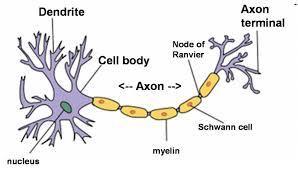
- 1What does this image represent?Neuron
- 2What is a neuron?A neuron is the basic building block of the nervous system .
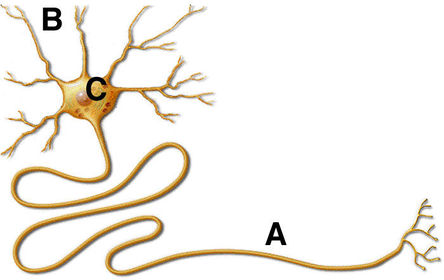
- 3What does C represent?The cell body (soma)
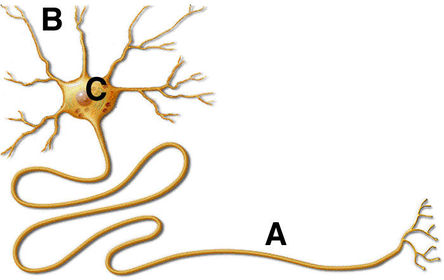
- 4What does B represent?The dendrites.
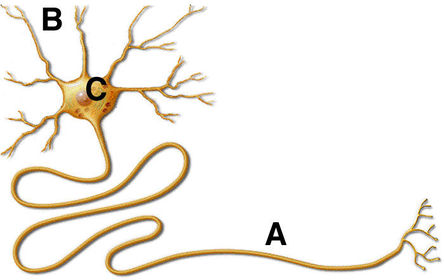
- 5What does A represent?The axon.
- 6The branchlike fibres that are like antennas that collect messages from neighbouring neurons and send them to the cell body are called?Dendrites
- 7Here neighbouring information from other neurons is collected and processed.The cell body
- 8This conducts electrical impulses away from the cell body and to other neurons, muscles, or glands.Axon
- 9-Surround the neurons and hold them in place - Manufacture nutrient chemicals that the neurons need - Form the myelin sheath around some axons - Absorb toxins and waste materials that might damage neurons.Glial cells
- 10Surround neurons and hold them in placeGlial cells
- 11Manufacture nutrient chemicals neurons needGlial cells
- 12Form myelin sheath around some axonsGlial cells
- 13Absorb toxins and waste materialsGlial cells
- 14Fatty insulating layer some neurons haveMyelin sheath
- 15Gaps in the myelin sheath that allows impulses to jump, and speeds up transmissionNodes of Ranvier
- 16Protect(s) the brain from toxins-Blood-brain barrier
-Glial cells - 17Nerve activation has how many basic steps?3
- 18What are the steps for basic nerve activation?1) The neuron is at resting potential
2) Stimulation' resting turns into action potential; nerve impulse generated
3) The neuron is again at rest. - 19What is depolarization and when does it occur?-The shift from negative to positive voltage
-Occurs during the action potential - 20Reversal in the membrane's voltage, from -70mV to +40mV (inside).Action potential
- 21The change in polarization in a neuron membrane that leads to a neural impulseAction potential
- 22The interior of the cell is negative. The exterior of the cell is positive. There is a high concentration of sodium ions outside the cell (in the liquid) and chloride ions (outside cell in the liquid). Negatively charged protein ions (A-) and + potassium ions are inside the neuron.Resting potential.
- 23The inside of the cell is positive; outside, negative. Sodium channels open up; flood into the axon, creating depolarizationAction potential
- 24Most sodium outside cell; chloride outside cell Potassium inside cell; negative anion proteins inside cell Gates closedResting potential
- 25Sodium channels open. Sodium floods into axon. K+ channels still closedAction potential generated
- 26Sodium channels close; potassium channels openRestoration of resting potential
- 27What is the voltage of the refractory period?Smaller than -70 mV
- 28Membrane cannot generate another action potential.Absolute refractory period
- 29All-or-none lawAction potentials occur at a maximum intensity or they do not occur at all.
- 30-50 mVAction potential threshold
- 31Graded potentialsOccur when the absolute threshold is not reached but an action potential occurs as a result of many neurons added up.
- 32Action potential travels down the axon like a burning fuseunmyelinated axons
- 33High conduction speeds generated from jumping of action potential from node to nodeMyelinated axons
- 34High conduction speeds generated from jumping of action potential from node to nodeMyelinated axons
- 35Satiago Ramon Y cajalProposed the idea of synapse.
- 36Otto LoewiProposed the idea of neurotransmitters
- 37Gap from the axon terminal of one neuron to the dendrites of anotherSynaptic cleft
- 38True or false: electrical impulses through a wire are faster than impulses through an axonTrue
- 39Damage to the myelin sheath can causeMS
Multiple Scorosis - 40When the immune system attacks the Myelin Sheath; impulses are slowed downMS
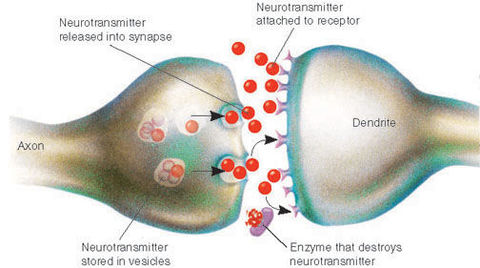
- 41Chemicals that carry messages across the synapseNeurotransmitters
- 42That excite other neurons OR inhibit their firingNeurotransmitters
- 43______Molecules stored within these _______chambers, within the axon terminalNeurotransmitters are stored within synaptic vesicles within the axon terminals.
- 44When the action potential reaches the end of the axon, the axon terminal releases ________ into the place between the end of the sending neuron( _______) and the membrane of the receiving neuron (______). The space is called _______.When an action potential reaches the end of the axon, vesicles bind to the membrane and release neurotransmitters into the synaptic space between the pre-synaptic (sending) neuron and the post-synaptic (receiving) neuron.
- 45When neurotransmitters cross the synaptic space, they bind to ______ which are?When neurotransmitters cross the synaptic space they bind to receptor sites, which are large protein molecules embedded in the membrane.
- 46Space between the pre-synapse and post-synapse?Synaptic cleft.
- 47Neurotransmitter activity moves from synthesis to deactivation. What is this process?1) Synthesis of neurotransmitter
2) Storage in synaptic vesicles
3) Release into synaptic space
4) Binding to receptor sites
5) Deactivation through reuptake or breakdown - 48_________ of neurotransmitter --> storage in ______--> Release into ______--> _________to receptor sites --> Deactivation through _______ or breakdownSynthesis of neurotransmitter --> Storage in synaptic vesicles--> Release into synaptic space--> Binding to receptor sites--> Deactivation through re-uptake or breakdown
- 49—Synapse
- 50What do A, B, C REPRESENT?A-Pre-synaptic neuron
B- Vesicle
C- Synaptic cleft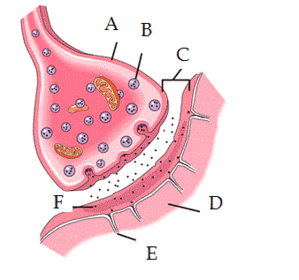
- 51What do D, E, F represent?D- Dendrite (Post-synaptic neuron)
E- Receptor (Collection of which: receptor site)
F--Neurotransmitter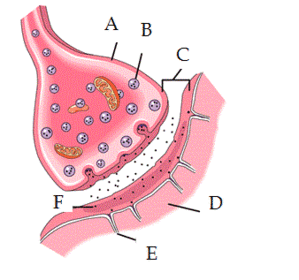
- 52Neurotransmitters that create depolarizationExcitatory transmitters
- 53TRasnmitters that create hyperpolarizationInhibitory
- 54Excitatory--> Depolarizes membrane--> _____likelihood of action potentialIncreases
- 55Inhibitory--> Hyperpolarizes membrane--> _______likelihood of action potentialDecreases
- 56Transmitters are reabsorbed into the pre-synapseRe-uptake
- 57Depression: undersupply Stress and panic disorders: oversupply Inhibitory and excitatory at various sites Involved in learning, memory, wakefulness and eatingNorepinephrine
- 58GlutamateHas powerful excitatory effect
- 59GABAInhibitory; motor control and control of anxiety; many drugs that help with anxiety disorders target______
- 60ACh_____; involved in muscle activity and memory; under[production: alzeimer's disease
Excitatory
Drugs that block _____ can result in muscular paralysis. - 61DopamineCan be inhibitory OR excitatory
Involved in pleasure, motivation, reward, voluntary movement control, through processes.
Parkinsons: not enough _____
LDOPA tries to increase ____production. - 62SerotoninOften inhibitory; influences mood, eating, sleep, and sexual behaviour
-Low levels cause depression
-Prozac prevents the reuptake of _____ - 63EndorphinsReduce pain and increase feelings of well-being; bind to same receptors as morphine and opium, therefore produce similar effects
- 64What does this represent?The main units of the nervous system
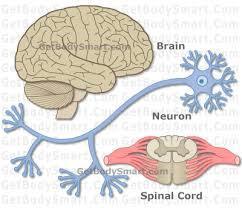
- 65What does this chart visualize?Components of the nervous system
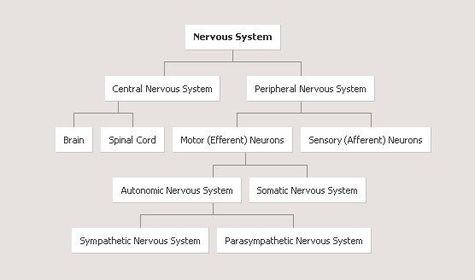
- 66The brain and spinal cord comprise what component of the nervous system?CNS: Central nervous system
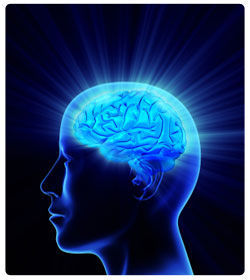
- 67Label the following components of the brainA-Forebrain B-midbrain C-hindbrain
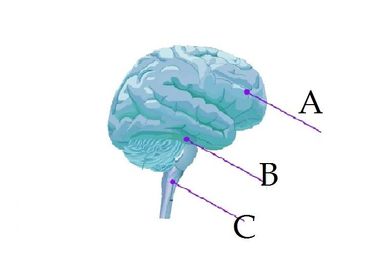
- 68Label the followingA- Frontal lobe
B- Parietal lobe
C- Occipital lobe
D- tEMPORAL LOBE
E-Brain stem
F-Cerebellum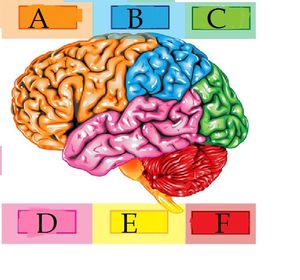
- 69Label the graphA--Repolarization
B--Resting potential
C--Hyperpolarization
D--Threshold potential
E--Resting potential
F--Depolarization
G--Repolarization
H-- Action potential period
I--Refractory period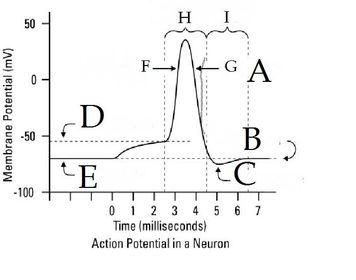
- 70Two major branches of the nervous systemCentral and peripheral
- 71The hindbrain is composed of the ______ and ______Cerebellum and brainstem
- 72The nervous system is composed of the _____ and the ______.Central NS and peripheral NS.
- 73The peripheral NS is composed of the ______ and the _______.Somatic system and autonomic system.
- 74The somatic system is a part of the _______nervous system. Its function is?The somatic system is part of the peripheral system. Its function is that it controls voluntary muscle activation.
- 75The autonomic system is part of ______. Its functions are?The autonomic system is part of the nervous system. Its functions are basically involuntary. It is involved with smooth muscles, cardiac muscle, and glands.
- 76The two branches of the autonomic system are?Sympathetic and parasympathetic.
- 77The somatic systemConsist of sensory and motor neurons. Sensory neurons transmit messages from eyes. ears, and other sensory receptors; motor neurons send signals from the brain and spinal cord to the muscles.
VOLUNTARY PATHWAY. - 78The autonomic system is involved in?Respiration, circulation, digestion, motivation, emotional behavior, and stress response.
Involuntary
Sympathetic and parasympathetic - 79Compare sympathetic and parasympathetic.Both are part of the peripheral--autonomic--nervous system.
Sympathetic: activation or arousal function
Parasympathetic: inhibitory, slowing down function - 80Function of the sympathetic system?-Activation/'arousal
- "Fight or flight"
- Speeds heart rate
-Dilation of pupils; slows digestive system so blood is transferred to muscles; increases rate of respiration - 81Parasympathetic systemLowers heart rate and respiration rate; constricts pupils; dilates blood vessels; stimulates digestive activity
- 82________ and _______ work together to ensure our body is at a state of equilibrium (homeostasis); coordinated sequence of these activitiesSympathetic "excite" and parasympathetic "relax".
- 83Connects spinal cord and brainCentral Nervous System
- 84Most nerves enter and leave the CNS through the ______ _______.Spinal cord
- 85______ _______ are fast responses that involve the senses and the spinal cord (not the brain).Spinal reflexes
- 86Grey matter is surrounded by white (myelinated) matter; this structure cross-section forms an "H". the neurons are protected by back bone vertebrae.Spinal Cord.
- 87The most active energy consumer of all your organsYour brain
- 88Rate of energy metabolism relatively constant throughout the day/night and even increases slightly as you sleep. 2% of body weight; 20 % oxygen consumption at rest.Your Brain
- 89_________tests measure verbal and non-verbal behaviours affected by areas of brain damage. Used in clinical evaluations of people who may have suffered BD through disease or accidents.Neuropsychological
- 90Specific nervous tissue is destroyed by chemicals, electricity, cold or heat; this produces brain damage (lesions). Or can surgically remove areas and study the consequences. Or can be stimulated--producing opposite effects--through electricity or chemicals. This can be constant if an electrode is implanted.How scientists can test brain damage using sections of the brain and causation
- 91PARTS AND FUNCTIONS OF THE BRAINSTUDY
- 92LOBES AND FUNCTIONS OF BRAIN STUDYSTUDY
- 93LEFT AND RIGHT HEMISPHERES OF BRAINSTUDY
- 94BRAIN SCANSSTUDY
- 95NEUROTRANSMITTERS AND FUNCTIONSSTUDY
Information
- Description
- iNFO FROM: Psychology Frontiers and Applications by Passer
- Created by
- Susannah Mackenz
- Views
- 32
- Rating