
Flashcards
The Respiratory System Syllabus Flashcards
Cards in this deck (12)
- 1Explain the body's need for a respiratory systemAll cells need oxygen for respiration and need carbon dioxide to be removed
Ensures that cells have a constant supply of oxygen and that carbon dioxide is continually removed from cells. - 2Label a diagram of the lungs and describe the function of each partSee page 99 of textbook
- 3Explain why the respiratory surfaces are suited to gas exchangeLungs are suited to gas exchange because:
Alveoli gives huge surface area
Each alveolus is well supplied with blood vessels. Continuous flow of blood helps to maintain a difference in concentration of oxygen and carbon dioxide.
Gas molecules don't have to travel far because of the thin walls of the alveolus membrane
Lungs are deep in the body so excessive evaporation of fluid does not occur. Important because gases can only diffuse into and out of the blood when they are dissolved in fluid.
Lung volume can be changed to ensure a difference in concentrations between oxygen and carbon dioxide in the air and blood - 4Describe the process of inspirationFor air to flow into the lungs, the pressure of air in the lungs must be less than the atmospheric pressure outside the body.
To decrease the pressure of air in the lungs, the volume of the lungs is increased.
To increase the volume of the lungs, the diaphragm and the intercostal muscles contract.
Air pressure in the lungs is slightly lower than the pressure outside.
Air flows though the nose and trachea until the pressure becomes equal. - 5Describe the process of expirationOpposite to inspiration
Diaphragm and intercostal muscles relax
Reduces volume of chest cavity and therefore volume of lungs.
Air pressure on lungs greater than outside.
Air flows out through trachea and nose until pressure is equal. - 6Describe the exchange between alveolar air and bloodArtery to lungs brings deoxygenated blood to the capillaries
Carbon dioxide diffuses from the higher concentration in the blood to the lower concentration in the air in the alveolus
Gases diffuse though capillaries easily because of the film of moisture and the thin walls between them
Oxygen diffuses from the higher concentration in the air in the alveolus to the lower concentration in the blood.
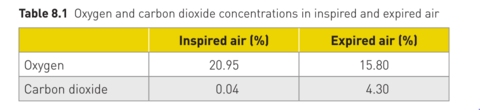
Oxygenated blood leaves capillaries of the alveoli and is taken to the heart in the veins from the lungs. - 7List the percentages of oxygen and carbon dioxide in inspired and expired air (table)
- 8Describe emphysemaCaused by long term exposure to irritating particles taken into lungs
Particles irritate and cause damage to alveoli. Alveoli lose elasticity and are replaced with fibrous tissue that can break down
Lungs constantly inflated due to inelasticity
Expiration no longer a passive process
Can't be treated once it starts
Difficulty ventilating
Stop smoking and reduce exposure to pollution and asbestos to prevent it - 9Describe lung cancerMass of cells that divides uncontrollably and causes tumour in the lungs.
Mucous membrane of bronchi is irritated by particles
Excess production of mucous cells begin to divide rapidly causing a tumour
Treated by chemotherapy, radiotherapy, surgery
Difficulty ventilating and Lung tumour cased
Less smoking and exposure to tobacco and asbestos reduces risk - 10Describe Pneumonia (lung infection)infection of the lungs from bacteria, virus, fungi etc.
Inflammation from infection causes secretion of fluids and mucous into alveoli.
Reduces amount of air and surface area they contain
Antibiotics and antiviral drugs can treat it
Causes breathing difficulty
Good hygiene reduces risk as when infected people cough or sneeze etc. droplets of moisture may be inhaled by others. - 11Describe tuberculosis (lung infection)Infection of the lung by Mycobacterium Tuberculosis
Droplets from mucous sneezing etc. of infected people causes it.
Medicine and drugs can treat it
Can cause breathing difficulty
Good hygiene reduces risk of getting it - 12Describe asthmaAllergic response to foreign substances that enter the body
Irritation of membrane causes secretion of excessive mucous. Mucous restricts movement of air and gas exchange can't take place to supply oxygen to the blood
Inhalers and Medicine can be used to treat it
Asthma attack and breathing difficulty are caused
Reduce the amount of asthma triggers (e.g. pollen etc.) to prevent it
Information
- Description
- Flashcards displaying answers to the bullet points on the syllabus outline for The Respiratory System unit 1.3
- Created by
- Hayden McElduff
- Views
- 61
- Tags
- Rating