Flowchart
Nutrients and trace elements
Flowchart content
Nutrients and minor elements
Non-conservative elements
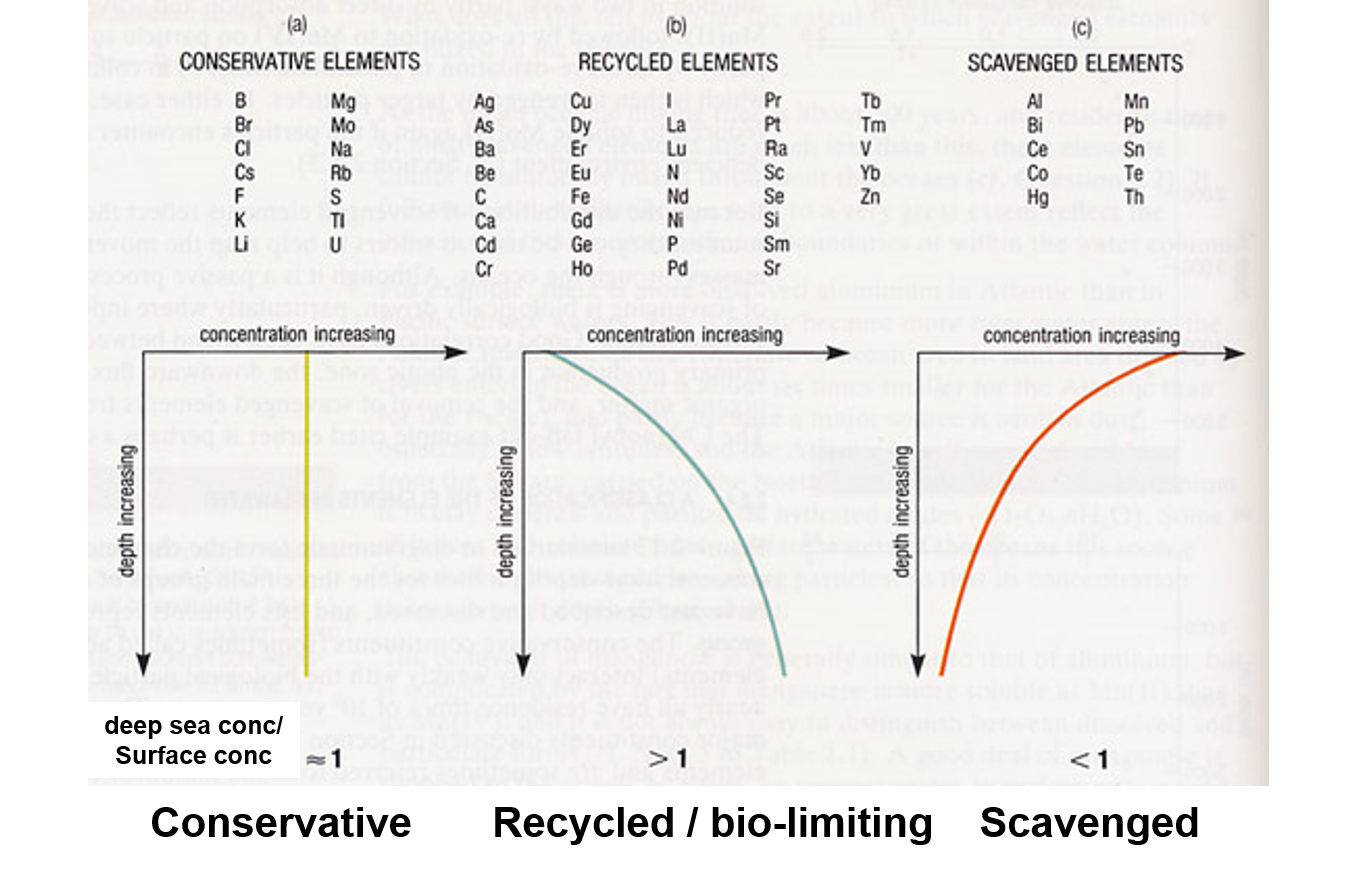
concentration change due to addition or removal processes
Abundance and residence times
removal reflected in low concentrations and short residence times - as they are corrlated
minor elements - intermediate levels, high variability
trace elements - trace levels, shortest RTs
Removal processes
- adsorption
-biological up take
remove dissolved substances and add this material to the particulate phase. subsequent settling leads to removal from water column via sedimentation dependent on partlcle size - larger = faster
Adsorption
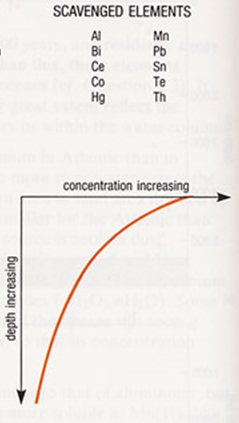
most important for traced metals
positive ions are attracted to the surface of partical and binds to it, then it is removed via sinking and more are added as it sinks = decreasing ions with depth
scavenger- type depth profiles
highest levels near surface amd dcreasing levels with increasing depth
Biological uptakes
Determins depth profile of nuitrients
they are taken up in euphotic zone into the algal biomass. detritus sinks from the zone into the deep - no nutrient uptake below euphotic zone. however bacterial breakdown realses nutirents at depth and recycles them
the two layered ocean
there is a vertical segregration of processes
- thermocline- prevents diff temperature water mixing
nutrient cycling
- uptake in mixed surface layer
-transder of deriral biomass from top to bottom
- gradual microbial degradation of biomass
- release nutrients at depth
also recycling via up welling
Nutrient type depth profiles
controlled by uptake and regeneration
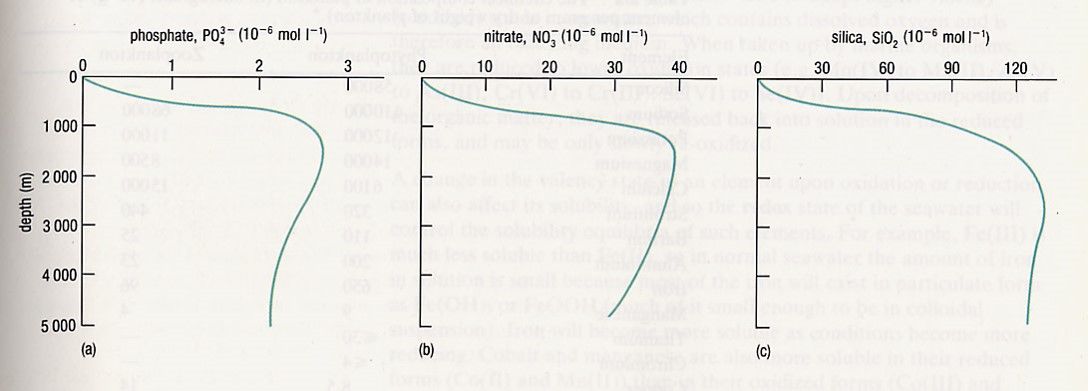
Nutrient-type elements
classification by biological requirements
-macronutrients - these are required in large amounts and are structural components of phytoplankton so can all limit growth
-micronutrients - these are required in small amounts and used in enzymes or photosynthetic apparatus
they are also called
- recycled elements
- biolimiting elements
Bio-limiting trace metal profiles
Zn
-near zero levels nar surface but highest in deep water
depth duration similiar to that of nitrate
zinc is used for enzyme carbonic anhydrase - uptake of carbon dioxide
Fe
essential for phtosynthetic apparatus, nitrate uptake and nitrogen fixing
it is supplied by aeolian transport - limitation may limit phytoplankton growth in remote open ocean areas with little duct deposition
conservative type depth profiles
concentration only varies with salinity - ratio of element over salinty constant depth
Depth profiles