
Mind map
Language & Thought
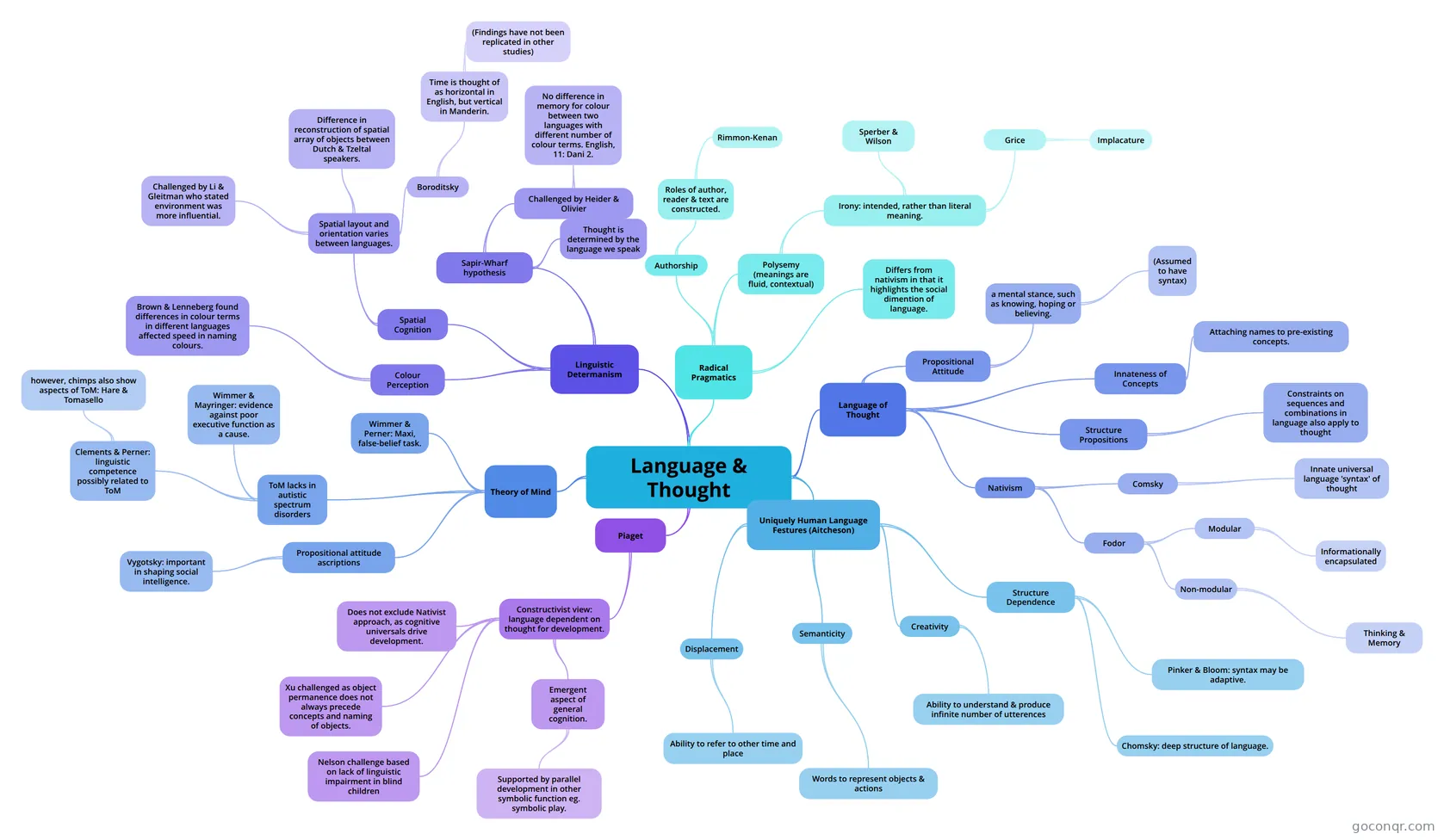
Mind map: Language and thought
Map content
Language & Thought
Uniquely Human Language Festures (Aitcheson)
- Semanticity
- Words to represent objects & actions
- Displacement
- Ability to refer to other time and place
- Structure Dependence
- Chomsky: deep structure of language.
- Pinker & Bloom: syntax may be adaptive.
- Creativity
- Ability to understand & produce infinite number of utterences
- Semanticity
Language of Thought
- Nativism
- Comsky
- Innate universal language 'syntax' of thought
- Fodor
- Modular
- Informationally encapsulated
- Non-modular
- Thinking & Memory
- Modular
- Comsky
- Structure Propositions
- Constraints on sequences and combinations in language also apply to thought
- Innateness of Concepts
- Attaching names to pre-existing concepts.
- Propositional Attitude
- a mental stance, such as knowing, hoping or believing.
- (Assumed to have syntax)
- a mental stance, such as knowing, hoping or believing.
- Nativism
Radical Pragmatics
- Differs from nativism in that it highlights the social dimention of language.
- Polysemy (meanings are fluid, contextual)
- Irony: intended, rather than literal meaning.
- Grice
- Implacature
- Sperber & Wilson
- Grice
- Irony: intended, rather than literal meaning.
- Authorship
- Roles of author, reader & text are constructed.
- Rimmon-Kenan
- Roles of author, reader & text are constructed.
Linguistic Determanism
- Sapir-Wharf hypothesis
- Thought is determined by the language we speak
- Challenged by Heider & Olivier
- No difference in memory for colour between two languages with different number of colour terms. English, 11: Dani 2.
- Spatial Cognition
- Spatial layout and orientation varies between languages.
- Boroditsky
- Time is thought of as horizontal in English, but vertical in Manderin.
- (Findings have not been replicated in other studies)
- Time is thought of as horizontal in English, but vertical in Manderin.
- Difference in reconstruction of spatial array of objects between Dutch & Tzeltal speakers.
- Challenged by Li & Gleitman who stated environment was more influential.
- Boroditsky
- Spatial layout and orientation varies between languages.
- Colour Perception
- Brown & Lenneberg found differences in colour terms in different languages affected speed in naming colours.
- Sapir-Wharf hypothesis
Theory of Mind
- Propositional attitude ascriptions
- Vygotsky: important in shaping social intelligence.
- Wimmer & Perner: Maxi, false-belief task.
- ToM lacks in autistic spectrum disorders
- Wimmer & Mayringer: evidence against poor executive function as a cause.
- Clements & Perner: linguistic competence possibly related to ToM
- however, chimps also show aspects of ToM: Hare & Tomasello
- Propositional attitude ascriptions
Piaget
- Constructivist view: language dependent on thought for development.
- Emergent aspect of general cognition.
- Supported by parallel development in other symbolic function eg. symbolic play.
- Nelson challenge based on lack of linguistic impairment in blind children
- Does not exclude Nativist approach, as cognitive universals drive development.
- Xu challenged as object permanence does not always precede concepts and naming of objects.
- Emergent aspect of general cognition.
- Constructivist view: language dependent on thought for development.
Information
- Description
- Bachelor's Degree Psychology Mind Map on Language & Thought, created by Kev Campbell on 03/08/2013.
- Created by
- Kev Campbell
- Views
- 77
- Tags
- Rating