
Mind map
Models of Addictive Behaviour - Gambling
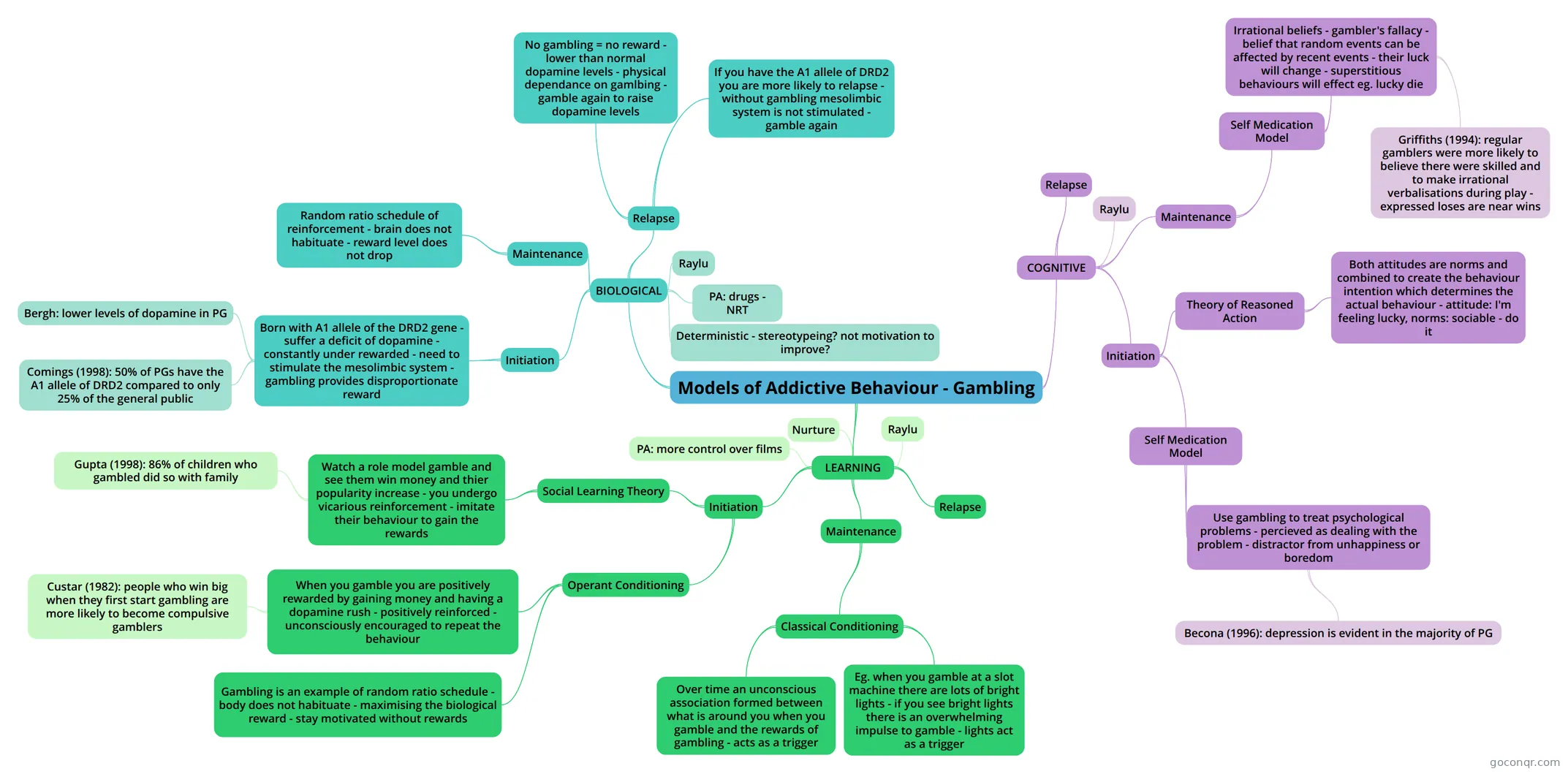
Mind map: Models of addictive behaviour gambling
Map content
Models of Addictive Behaviour - Gambling
LEARNING
- Initiation
- Operant Conditioning
- When you gamble you are positively rewarded by gaining money and having a dopamine rush - positively reinforced - unconsciously encouraged to repeat the behaviour
- Custar (1982): people who win big when they first start gambling are more likely to become compulsive gamblers
- Gambling is an example of random ratio schedule - body does not habituate - maximising the biological reward - stay motivated without rewards
- When you gamble you are positively rewarded by gaining money and having a dopamine rush - positively reinforced - unconsciously encouraged to repeat the behaviour
- Social Learning Theory
- Watch a role model gamble and see them win money and thier popularity increase - you undergo vicarious reinforcement - imitate their behaviour to gain the rewards
- Gupta (1998): 86% of children who gambled did so with family
- Watch a role model gamble and see them win money and thier popularity increase - you undergo vicarious reinforcement - imitate their behaviour to gain the rewards
- Operant Conditioning
- Maintenance
- Classical Conditioning
- Over time an unconscious association formed between what is around you when you gamble and the rewards of gambling - acts as a trigger
- Eg. when you gamble at a slot machine there are lots of bright lights - if you see bright lights there is an overwhelming impulse to gamble - lights act as a trigger
- Classical Conditioning
- Relapse
- Raylu
- PA: more control over films
- Nurture
- Initiation
COGNITIVE
- Initiation
- Self Medication Model
- Use gambling to treat psychological problems - percieved as dealing with the problem - distractor from unhappiness or boredom
- Becona (1996): depression is evident in the majority of PG
- Use gambling to treat psychological problems - percieved as dealing with the problem - distractor from unhappiness or boredom
- Theory of Reasoned Action
- Both attitudes are norms and combined to create the behaviour intention which determines the actual behaviour - attitude: I'm feeling lucky, norms: sociable - do it
- Self Medication Model
- Maintenance
- Self Medication Model
- Irrational beliefs - gambler's fallacy - belief that random events can be affected by recent events - their luck will change - superstitious behaviours will effect eg. lucky die
- Griffiths (1994): regular gamblers were more likely to believe there were skilled and to make irrational verbalisations during play - expressed loses are near wins
- Irrational beliefs - gambler's fallacy - belief that random events can be affected by recent events - their luck will change - superstitious behaviours will effect eg. lucky die
- Self Medication Model
- Relapse
- Raylu
- Initiation
BIOLOGICAL
- Initiation
- Born with A1 allele of the DRD2 gene - suffer a deficit of dopamine - constantly under rewarded - need to stimulate the mesolimbic system - gambling provides disproportionate reward
- Comings (1998): 50% of PGs have the A1 allele of DRD2 compared to only 25% of the general public
- Bergh: lower levels of dopamine in PG
- Born with A1 allele of the DRD2 gene - suffer a deficit of dopamine - constantly under rewarded - need to stimulate the mesolimbic system - gambling provides disproportionate reward
- Maintenance
- Random ratio schedule of reinforcement - brain does not habituate - reward level does not drop
- Relapse
- If you have the A1 allele of DRD2 you are more likely to relapse - without gambling mesolimbic system is not stimulated - gamble again
- No gambling = no reward - lower than normal dopamine levels - physical dependance on gamlbing - gamble again to raise dopamine levels
- Raylu
- Deterministic - stereotypeing? not motivation to improve?
- PA: drugs - NRT
- Initiation
Information
- Description
- AQA A2 Psychology - PSYA4 Section B - Addictive Behaviour
- Created by
- Sandie Garland
- Views
- 219
- Tags
- Rating