
Mind map
The Restless Earth
Map content
The Restless Earth
Plate Margins
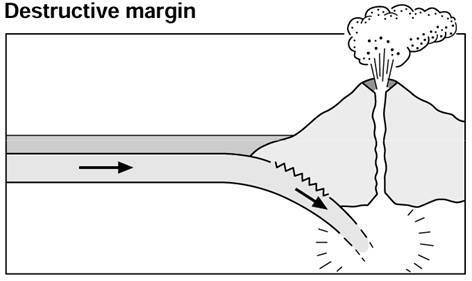
- Destructive
- Plates move towards each other.
- Oceanic crust forces underneath continental crust.
- This is called 'subduction' and it occurs are a 'subduction zone.'
- Oceanic melts into the mantle.
- As the crusts rub against each other they cause friction.
- Rock is destroyed.
- Collision Zone
- Two continental plates collide.
- Neither is forced under so they're forced uupwards.
- Two continental plates collide.
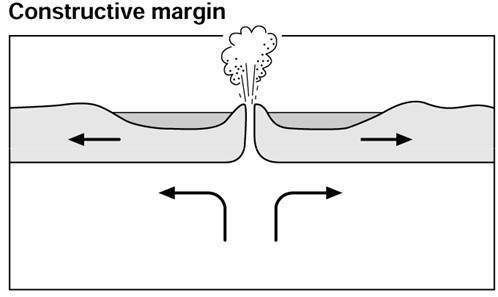
- Constructive
- Plates move away from each other.
- Happens between two pieces of continental crust.
- As they move apart due to the convection currents in the mantle, the gap is filled by magma.
- Magma then cools and solidifies.
- Can lead to the creation of ocean ridges.
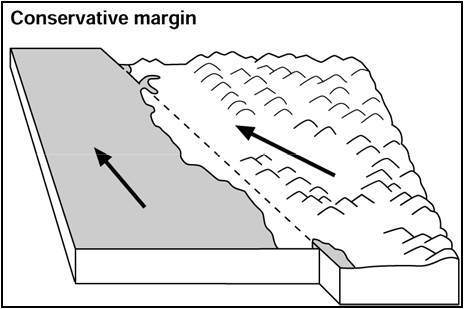
- Conservative
- Plates slide past each other.
- - At different speeds in the same direction.
- or - In opposite directions.
- - At different speeds in the same direction.
- Plates often get stuck, building up pressure that often causes powerful earthquakes.
- No rock is created or destroyed.
- Plates slide past each other.
- Destructive
Landforms
- Fold Mountains
- Occur at collision boundaries
- See notes page for formation and uses.
- Ocean Trenches
- Occur at destructive boundary at the subduction zone.
- Often near fold mountains.
- Widely found in the Pacific Ocean.
- Supervolcanoes
- Capacity to erupt x100 more material than normal volcano.
- Flat and wide.
- Often found under the ocean.
- Has a caldera instead of a crater.
- Depression in the top.
- Volcanoes
- Composite
- Alternating layers of lava and ash.
- Usually found at destructive boundaries.
- May erupt pyroclastic flow instead of regular lava flow.
- Tall and steep.
- Formed by thick, viscous lava.
- Shield
- Low, gentle sloping.
- Usually found at constructive boundaries.
- Frequent but gentle eruptions.
- Formed by thin, runny lava.
- Vents
- Main - main place for magma to escape.
- Secondary - this vent opens in the first becomes blocked.
- Can be:
- Dormant - temporarily inactive
- Extinct - Never likely to erupt again.
- Active - erupts frequently.
- Composite
- Fold Mountains
Earthquakes
- Can happen at any boundary, most common at conservative.
- Focus - point under the earth where the pressure is released.
- Epicentre - directly above focus on surface of the Earth.
- Seismic Waves - release of the energy.
- Richter Scale
- Uses information collected by seismometers which collect information on the amount of movement and the strength of the shock waves.
- 0 - Infinity
- No upper limit.
- 10 fold. Each number on the scale is x10 more powerful than the previous.
- eg. 2 is x10 more powerful than 1.
- Mercalli Scale
- Measures earthquake by damage.
- 1-12 / I-XII
- 1 - barely felt. 12 - total destruction.
- Can be represented as pictures/diagrams.
- Effects
- Aftershocks can cause more damage.
- Response
- Tsunami
- The entire depth of the sea is set in motion by an event, displacing the water above it and creating a wave.
- One plate is dragged under another, stress on the boundary causes the edges to flex and deform.
- The plates flex back into their original place, displacing all the water above.
Crusts
- Oceanic
- 5-10km thick.
- More dense.
- Continental
- 25-100km thick.
- Less dense.
- Oceanic
Images and files in the map
Information
- Description
- Mind Map on The Restless Earth, created by 10jgorman on 18/02/2015.
- Created by
- 10jgorman
- Views
- 52
- Tags
- Rating