
Mind map
GENDER DEVELOPMENT
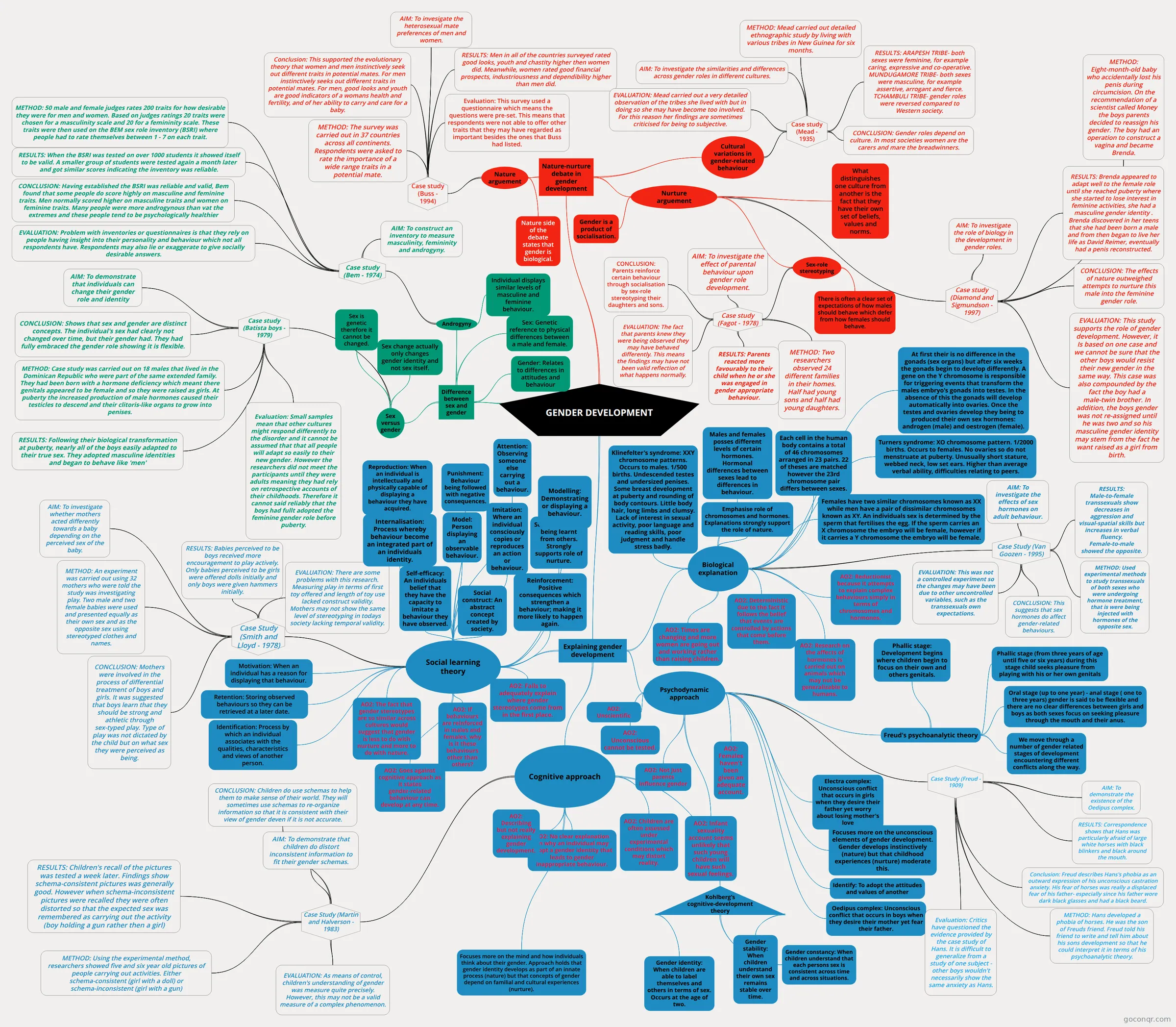
Mind map: Gender development
Map content
GENDER DEVELOPMENT
Difference between sex and gender
- Sex: Genetic reference to physical differences between a male and female.
- Gender: Relates to differences in attitudes and behaviour
- Androgyny
- Individual displays similar levels of masculine and feminine behaviour.
- Case study (Bem - 1974)
- AIM: To construct an inventory to measure masculinity, femininity and androgyny.
- METHOD: 50 male and female judges rates 200 traits for how desirable they were for men and women. Based on judges ratings 20 traits were chosen for a masculinity scale and 20 for a femininity scale. These traits were then used on the BEM sex role inventory (BSRI) where people had to rate themselves between 1 - 7 on each trait.
- RESULTS: When the BSRI was tested on over 1000 students it showed itself to be valid. A smaller group of students were tested again a month later and got similar scores indicating the inventory was reliable.
- CONCLUSION: Having established the BSRI was reliable and valid, Bem found that some people do score highly on masculine and feminine traits. Men normally scored higher on masculine traits and women on feminine traits. Many people were more androgynous than vat the extremes and these people tend to be psychologically healthier
- EVALUATION: Problem with inventories or questionnaires is that they rely on people having insight into their personality and behaviour which not all respondents have. Respondents may also lie or exaggerate to give socially desirable answers.
- Sex versus gender
- Sex is genetic therefore it cannot be changed.
- Sex change actually only changes gender identity and not sex itself.
- Case study (Batista boys - 1979)
- AIM: To demonstrate that individuals can change their gender role and identity
- METHOD: Case study was carried out on 18 males that lived in the Dominican Republic who were part of the same extended family. They had been born with a hormone deficiency which meant there genitals appeared to be female and so they were raised as girls. At puberty the increased production of male hormones caused their testicles to descend and their clitoris-like organs to grow into penises.
- RESULTS: Following their biological transformation at puberty, nearly all of the boys easily adapted to their true sex. They adopted masculine identities and began to behave like 'men'
- CONCLUSION: Shows that sex and gender are distinct concepts. The individual's sex had clearly not changed over time, but their gender had. They had fully embraced the gender role showing it is flexible.
- Evaluation: Small samples mean that other cultures might respond differently to the disorder and it cannot be assumed that that all people will adapt so easily to their new gender. However the researchers did not meet the participants until they were adults meaning they had rely on retrospective accounts of their childhoods. Therefore it cannot said reliably that the boys had fullt adopted the feminine gender role before puberty.
Nature-nurture debate in gender development
- Nature arguement
- Nature side of the debate states that gender is biological.
- Case study (Buss - 1994)
- AIM: To invesigate the heterosexual mate preferences of men and women.
- METHOD: The survey was carried out in 37 countries across all continents. Respondents were asked to rate the importance of a wide range traits in a potential mate.
- RESULTS: Men in all of the countries surveyed rated good looks, youth and chastity higher then women did. Meanwhile, women rated good financial prospects, industriousness and dependibility higher than men did.
- Conclusion: This supported the evolutionary theory that women and men instinctively seek out different traits in potential mates. For men instinctively seeks out different traits in potential mates. For men, good looks and youth are good indicators of a womans health and fertility, and of her ability to carry and care for a baby.
- Evaluation: This survey used a questionnaire which means the questions were pre-set. This means that respondents were not able to offer other traits that they may have regarded as important besides the ones that Buss had listed.
- Cultural variations in gender-related behaviour
- Case study (Mead - 1935)
- AIM: To investigate the similarities and differences across gender roles in different cultures.
- METHOD: Mead carried out detailed ethnographic study by living with various tribes in New Guinea for six months.
- RESULTS: ARAPESH TRIBE- both sexes were feminine, for example caring, expressive and co-operative. MUNDUGAMORE TRIBE- both sexes were masculine, for example assertive, arrogant and fierce. TCHAMBULI TRIBE- gender roles were reversed compared to Western society.
- CONCLUSION: Gender roles depend on culture. In most societies women are the carers and mare the breadwinners.
- EVALUATION: Mead carried out a very detailed observation of the tribes she lived with but in doing so she may have become too involved. For this reason her findings are sometimes criticised for being to subjective.
- Case study (Mead - 1935)
- Nurture arguement
- Gender is a product of socialisation.
- What distinguishes one culture from another is the fact that they have their own set of beliefs, values and norms.
- Sex-role stereotyping
- There is often a clear set of expectations of how males should behave which defer from how females should behave.
- Case study (Fagot - 1978)
- AIM: To investigate the effect of parental behaviour upon gender role development.
- METHOD: Two researchers observed 24 different families in their homes. Half had young sons and half had young daughters.
- RESULTS: Parents reacted more favourably to their child when he or she was engaged in gender appropriate behaviour.
- CONCLUSION: Parents reinforce certain behaviour through socialisation by sex-role stereotyping their daughters and sons.
- EVALUATION: The fact that parents knew they were being observed they may have behaved differently. This means the findings may have not been valid reflection of what happens normally.
- Case study (Diamond and Sigmundson - 1997)
- AIM: To investigate the role of biology in the development in gender roles.
- METHOD: Eight-month-old baby who accidentally lost his penis during circumcision. On the recommendation of a scientist called Money the boys parents decided to reassign his gender. The boy had an operation to construct a vagina and became Brenda.
- RESULTS: Brenda appeared to adapt well to the female role until she reached puberty where she started to lose interest in feminine activities, she had a masculine gender identity . Brenda discovered in her teens that she had been born a male and from then began to live her life as David Reimer, eventually had a penis reconstructed.
- CONCLUSION: The effects of nature outweighed attempts to nurture this male into the feminine gender role.
- EVALUATION: This study supports the role of gender development. However, it Is based on one case and we cannot be sure that the other boys would resist their new gender in the same way. This case was also compounded by the fact the boy had a male-twin brother. In addition, the boys gender was not re-assigned until he was two and so his masculine gender identity may stem from the fact he want raised as a girl from birth.
- Nature arguement
Explaining gender development
- Biological explanation
- Emphasise role of chromosomes and hormones. Explanations strongly support the role of nature.
- Males and females posses different levels of certain hormones. Hormonal differences between sexes lead to differences in behaviour.
- Each cell in the human body contains a total of 46 chromosomes arranged in 23 pairs. 22 of theses are matched however the 23rd chromosome pair differs between sexes.
- Females have two similar chromosomes known as XX while men have a pair of dissimilar chromosomes known as XY. An individuals sex is determined by the sperm that fertilises the egg. If the sperm carries an X chromosome the embryo will be female, however if it carries a Y chromosome the embryo will be female.
- At first their is no difference in the gonads (sex organs) but after six weeks the gonads begin to develop differently. A gene on the Y chromosome is responsible for triggering events that transform the males embryo's gonads into testes. In the absence of this the gonads will develop automatically into ovaries. Once the testes and ovaries develop they being to produced their own sex hormones: androgen (male) and oestrogen (female).
- Case Study (Van Goozen - 1995)
- AIM: To investigate the effects of sex hormones on adult behaviour.
- METHOD: Used experimental methods to study transsexuals of both sexes who were undergoing hormone treatment, that is were being injected with hormones of the opposite sex.
- RESULTS: Male-to-female transsexuals show decreases in aggression and visual-spatial skills but increases in verbal fluency. Female-to-male showed the opposite.
- CONCLUSION: This suggests that sex hormones do affect gender-related behaviours.
- EVALUATION: This was not a controlled experiment so the changes may have been due to other uncontrolled variables, such as the transsexuals own expectations.
- Klinefelter's syndrome: XXY chromosome patterns. Occurs to males. 1/500 births. Undescended testes and undersized penises. Some breast development at puberty and rounding of body contours. Little body hair, long limbs and clumsy. Lack of interest in sexual activity, poor language and reading skills, poor judgment and handle stress badly.
- Turners syndrome: XO chromosome pattern. 1/2000 births. Occurs to females. No ovaries so do not menstruate at puberty. Unusually short stature, webbed neck, low set ears. Higher than average verbal ability, difficulties relating to peers.
- AO2: Reductionist because it attempts to explain complex behaviours simply in terms of chromosomes and hormones.
- AO2: Deterministic due to the fact it follows the belief that events are controlled by actions that come before them.
- AO2: Research on the affects of hormones is carried out on animals which may not be generalizable to humans.
- AO2: Times are changing and more women are going out and working rather than raising children.
- Social learning theory
- Sees gender role being learnt from others. Strongly supports role of nurture.
- Case Study (Smith and Lloyd - 1978)
- AIM: To investigate whether mothers acted differently towards a baby depending on the perceived sex of the baby.
- METHOD: An experiment was carried out using 32 mothers who were told the study was investigating play. Two male and two female babies were used and presented equally as their own sex and as the opposite sex using stereotyped clothes and names.
- RESULTS: Babies perceived to be boys received more encouragement to play actively. Only babies perceived to be girls were offered dolls initially and only boys were given hammers initially.
- CONCLUSION: Mothers were involved in the process of differential treatment of boys and girls. It was suggested that boys learn that they should be strong and athletic through sex-typed play. Type of play was not dictated by the child but on what sex they were perceived as being.
- EVALUATION: There are some problems with this research. Measuring play in terms of first toy offered and length of toy use lacked construct validity. Mothers may not show the same level of stereotyping in todays society lacking temporal validity.
- Attention: Observing someone else carrying out a behaviour.
- Retention: Storing observed behaviours so they can be retrieved at a later date.
- Model: Person displaying an observable behaviour.
- Modelling: Demonstrating or displaying a behaviour.
- Identification: Process by which an individual associates with the qualities, characteristics and views of another person.
- Reproduction: When an individual is intellectually and physically capable of displaying a behaviour they have acquired.
- Motivation: When an individual has a reason for displaying that behaviour.
- Imitation: Where an individual consciously copies or reproduces an action or behaviour.
- Self-efficacy: An individuals belief that they have the capacity to imitate a behaviour they have observed.
- Reinforcement: Positive consequences which strengthen a behaviour; making it more likely to happen again.
- Punishment: Behaviour being followed with negative consequences.
- Internalisation: Process whereby behaviour become an integrated part of an individuals identity.
- Social construct: An abstract concept created by society.
- AO2: Goes against cognitive approach as it states gender-related behaviour can develop at any time.
- AO2: Fails to adequately explain where gender stereotypes come from in the first place.
- AO2: If behaviours are reinforced in males and females, why is it these behaviours other than others?
- AO2: The fact that gender stereotypes are so similar across cultures would suggest that gender is less to do with nurture and more to do with nature.
- Cognitive approach
- Focuses more on the mind and how individuals think about their gender. Approach holds that gender identity develops as part of an innate process (nature) but that concepts of gender depend on familial and cultural experiences (nurture).
- Kohlberg's cognitive-development theory
- Gender identity: When children are able to label themselves and others in terms of sex. Occurs at the age of two.
- Gender stability: When children understand their own sex remains stable over time.
- Gender constancy: When children understand that each persons sex is consistent across time and across situations.
- Case Study (Martin and Halverson - 1983)
- AIM: To demonstrate that children do distort inconsistent information to fit their gender schemas.
- METHOD: Using the experimental method, researchers showed five and six year old pictures of people carrying out activities. Either schema-consistent (girl with a doll) or schema-inconsistent (girl with a gun)
- RESULTS: Children's recall of the pictures was tested a week later. Findings show schema-consistent pictures was generally good. However when schema-inconsistent pictures were recalled they were often distorted so that the expected sex was remembered as carrying out the activity (boy holding a gun rather then a girl)
- CONCLUSION: Children do use schemas to help them to make sense of their world. They will sometimes use schemas to re-organize information so that it is consistent with their view of gender deven if it is not accurate.
- EVALUATION: As means of control, children's understanding of gender was measure quite precisely. However, this may not be a valid measure of a complex phenomenon.
- AO2: Children are often assessed under experimental conditions which may distort reality.
- AO2: No clear explanation on why an individual may adopt a gender identity that leads to gender inappropriate behaviour.
- AO2: Describing but not really explaining gender development.
- Psychodynamic approach
- Focuses more on the unconscious elements of gender development. Gender develops instinctively (nature) but that childhood experiences (nurture) moderate this.
- Freud's psychoanalytic theory
- We move through a number of gender related stages of development encountering different conflicts along the way.
- Oral stage (up to one year) - anal stage ( one to three years) gender is said to be flexible and there are no clear differences between girls and boys as both sexes focus on seeking pleasure through the mouth and their anus.
- Phallic stage: Development begins where children begin to focus on their own and others genitals.
- Phallic stage (from three years of age until five or six years) during this stage child seeks pleasure from playing with his or her own genitals
- Oedipus complex: Unconscious conflict that occurs in boys when they desire their mother yet fear their father.
- Electra complex: Unconscious conflict that occurs in girls when they desire their father yet worry about losing mother's love
- Identify: To adopt the attitudes and values of another
- Case Study (Freud - 1909)
- AIM: To demonstrate the existence of the Oedipus complex.
- METHOD: Hans developed a phobia of horses. He was the son of Freuds friend. Freud told his friend to write and tell him about his sons development so that he could interpret it in terms of his psychoanalytic theory.
- RESULTS: Correspondence shows that Hans was particularly afraid of large white horses with black blinkers and black around the mouth.
- Conclusion: Freud describes Hans's phobia as an outward expression of his unconscious castration anxiety. His fear of horses was really a displaced fear of his father- especially since his father wore dark black glasses and had a black beard.
- Evaluation: Critics have questioned the evidence provided by the case study of Hans. It is difficult to generalize from a study of one subject - other boys wouldn't necessarily show the same anxiety as Hans.
- AO2: Females haven't been given an adequate account.
- AO2: Infant sexuality account seems unlikely that such young children will have such sexual feelings.
- AO2: Unconscious cannot be tested.
- AO2: Not just parents influence gender
- AO2: Unscientific
- Biological explanation
Information
- Description
- A-Level Psychology Mind Map on GENDER DEVELOPMENT, created by arshadgani on 14/04/2015.
- Created by
- arshadgani
- Views
- 4
- Rating