
Mind map
Relationship Formation
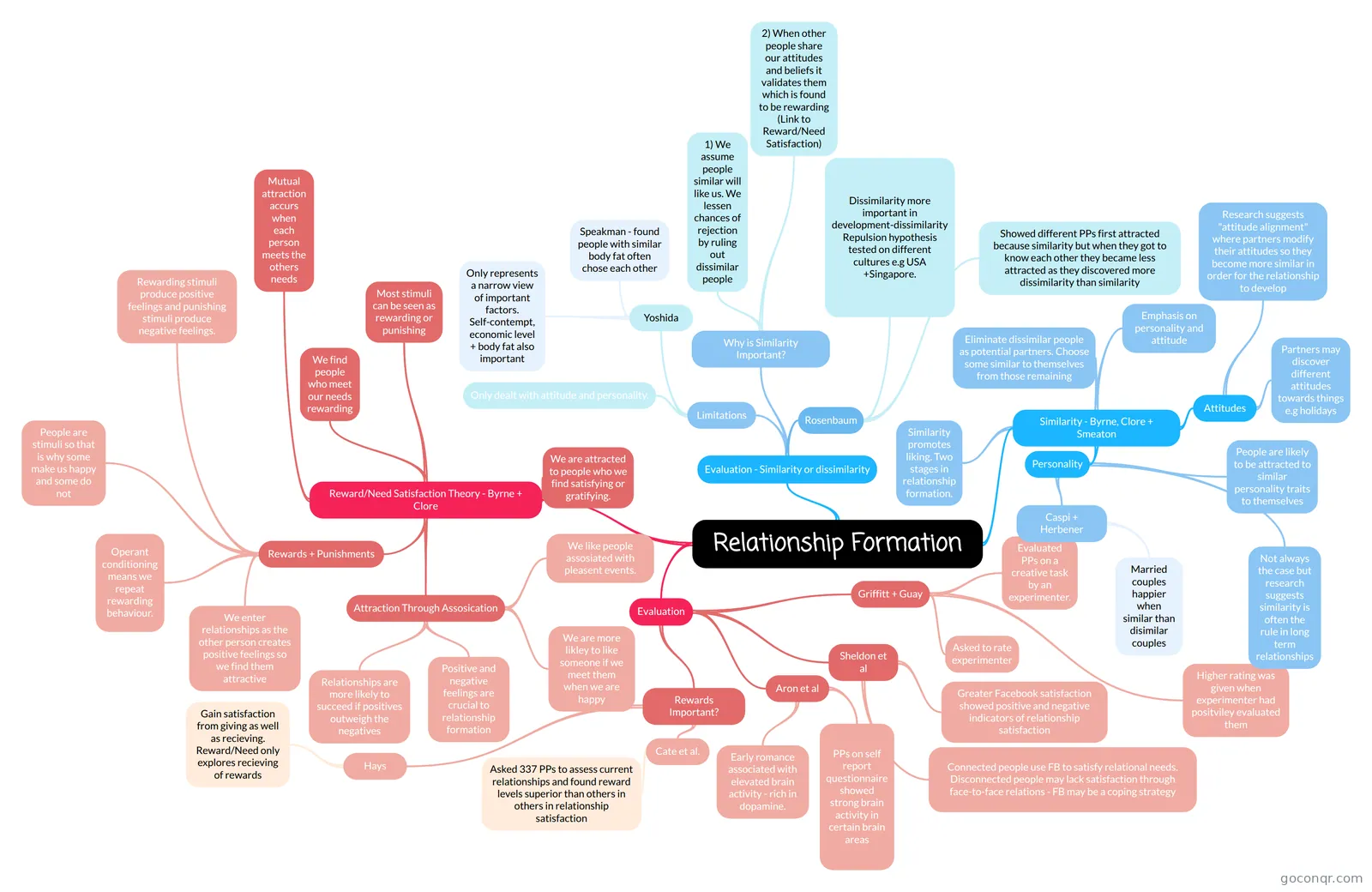
Mind map: Relationship formation psychology
Map content
Relationship Formation
Reward/Need Satisfaction Theory - Byrne + Clore
- We are attracted to people who we find satisfying or gratifying.
- Most stimuli can be seen as rewarding or punishing
- We find people who meet our needs rewarding
- Mutual attraction accurs when each person meets the others needs
- Rewards + Punishments
- Rewarding stimuli produce positive feelings and punishing stimuli produce negative feelings.
- People are stimuli so that is why some make us happy and some do not
- Operant conditioning means we repeat rewarding behaviour.
- We enter relationships as the other person creates positive feelings so we find them attractive
- Attraction Through Assosication
- We like people assosiated with pleasent events.
- We are more likley to like someone if we meet them when we are happy
- Positive and negative feelings are crucial to relationship formation
- Relationships are more likely to succeed if positives outweigh the negatives
Evaluation
- Griffitt + Guay
- Evaluated PPs on a creative task by an experimenter.
- Asked to rate experimenter
- Higher rating was given when experimenter had positviley evaluated them
- Sheldon et al
- Greater Facebook satisfaction showed positive and negative indicators of relationship satisfaction
- Connected people use FB to satisfy relational needs. Disconnected people may lack satisfaction through face-to-face relations - FB may be a coping strategy
- Aron et al
- PPs on self report questionnaire showed strong brain activity in certain brain areas
- Early romance associated with elevated brain activity - rich in dopamine.
- Rewards Important?
- Cate et al.
- Asked 337 PPs to assess current relationships and found reward levels superior than others in others in relationship satisfaction
- Hays
- Gain satisfaction from giving as well as recieving. Reward/Need only explores recieving of rewards
- Cate et al.
- Griffitt + Guay
Similarity - Byrne, Clore + Smeaton
- Similarity promotes liking. Two stages in relationship formation.
- Eliminate dissimilar people as potential partners. Choose some similar to themselves from those remaining
- Emphasis on personality and attitude
- Personality
- People are likely to be attracted to similar personality traits to themselves
- Not always the case but research suggests similarity is often the rule in long term relationships
- Caspi + Herbener
- Married couples happier when similar than disimilar couples
- Attitudes
- Partners may discover different attitudes towards things e.g holidays
- Research suggests "attitude alignment" where partners modify their attitudes so they become more similar in order for the relationship to develop
Evaluation - Similarity or dissimilarity
- Rosenbaum
- Dissimilarity more important in development-dissimilarity Repulsion hypothesis tested on different cultures e.g USA +Singapore.
- Showed different PPs first attracted because similarity but when they got to know each other they became less attracted as they discovered more dissimilarity than similarity
- Limitations
- Only dealt with attitude and personality.
- Yoshida
- Only represents a narrow view of important factors. Self-contempt, economic level + body fat also important
- Speakman - found people with similar body fat often chose each other
- Why is Similarity Important?
- 1) We assume people similar will like us. We lessen chances of rejection by ruling out dissimilar people
- 2) When other people share our attitudes and beliefs it validates them which is found to be rewarding (Link to Reward/Need Satisfaction)
- Rosenbaum
Information
- Description
- Relationship Formation
- Created by
- jessclarke
- Views
- 60
- Tags
- Rating
More on Relationship formation and attraction