
Mind map
Evolution
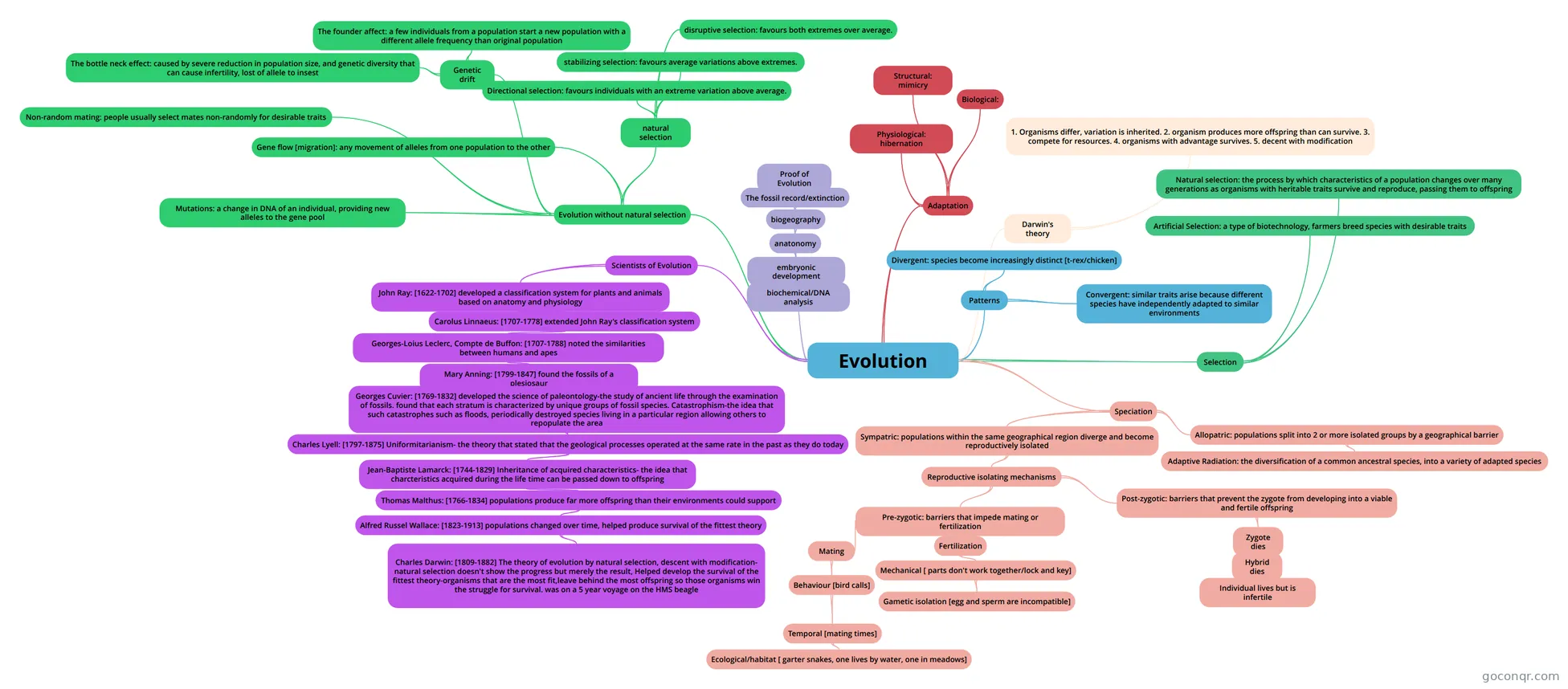
Mind map: Evolution
Map content
Evolution
Scientists of Evolution
- John Ray: [1622-1702] developed a classification system for plants and animals based on anatomy and physiology
- Carolus Linnaeus: [1707-1778] extended John Ray's classification system
- Georges-Loius Leclerc, Compte de Buffon: [1707-1788] noted the similarities between humans and apes
- Mary Anning: [1799-1847] found the fossils of a plesiosaur
- Georges Cuvier: [1769-1832] developed the science of paleontology-the study of ancient life through the examination of fossils. found that each stratum is characterized by unique groups of fossil species. Catastrophism-the idea that such catastrophes such as floods, periodically destroyed species living in a particular region allowing others to repopulate the area
- Charles Lyell: [1797-1875] Uniformitarianism- the theory that stated that the geological processes operated at the same rate in the past as they do today
- Jean-Baptiste Lamarck: [1744-1829] Inheritance of acquired characteristics- the idea that charcteristics acquired during the life time can be passed down to offspring
- Thomas Malthus: [1766-1834] populations produce far more offspring than their environments could support
- Alfred Russel Wallace: [1823-1913] populations changed over time, helped produce survival of the fittest theory
- Charles Darwin: [1809-1882] The theory of evolution by natural selection, descent with modification- natural selection doesn't show the progress but merely the result, Helped develop the survival of the fittest theory-organisms that are the most fit,leave behind the most offspring so those organisms win the struggle for survival. was on a 5 year voyage on the HMS beagle
- Alfred Russel Wallace: [1823-1913] populations changed over time, helped produce survival of the fittest theory
- Thomas Malthus: [1766-1834] populations produce far more offspring than their environments could support
- Jean-Baptiste Lamarck: [1744-1829] Inheritance of acquired characteristics- the idea that charcteristics acquired during the life time can be passed down to offspring
- Charles Lyell: [1797-1875] Uniformitarianism- the theory that stated that the geological processes operated at the same rate in the past as they do today
- Georges Cuvier: [1769-1832] developed the science of paleontology-the study of ancient life through the examination of fossils. found that each stratum is characterized by unique groups of fossil species. Catastrophism-the idea that such catastrophes such as floods, periodically destroyed species living in a particular region allowing others to repopulate the area
- Mary Anning: [1799-1847] found the fossils of a plesiosaur
- Georges-Loius Leclerc, Compte de Buffon: [1707-1788] noted the similarities between humans and apes
- Carolus Linnaeus: [1707-1778] extended John Ray's classification system
- John Ray: [1622-1702] developed a classification system for plants and animals based on anatomy and physiology
Proof of Evolution
- The fossil record/extinction
- biogeography
- anatonomy
- embryonic development
- biochemical/DNA analysis
- embryonic development
- anatonomy
- biogeography
- The fossil record/extinction
Speciation
- Allopatric: populations split into 2 or more isolated groups by a geographical barrier
- Adaptive Radiation: the diversification of a common ancestral species, into a variety of adapted species
- Sympatric: populations within the same geographical region diverge and become reproductively isolated
- Reproductive isolating mechanisms
- Pre-zygotic: barriers that impede mating or fertilization
- Mating
- Behaviour [bird calls]
- Temporal [mating times]
- Ecological/habitat [ garter snakes, one lives by water, one in meadows]
- Temporal [mating times]
- Behaviour [bird calls]
- Fertilization
- Mechanical [ parts don't work together/lock and key]
- Gametic isolation [egg and sperm are incompatible]
- Mechanical [ parts don't work together/lock and key]
- Mating
- Post-zygotic: barriers that prevent the zygote from developing into a viable and fertile offspring
- Zygote dies
- Hybrid dies
- Individual lives but is infertile
- Hybrid dies
- Zygote dies
- Pre-zygotic: barriers that impede mating or fertilization
- Reproductive isolating mechanisms
- Allopatric: populations split into 2 or more isolated groups by a geographical barrier
Patterns
- Divergent: species become increasingly distinct [t-rex/chicken]
- Convergent: similar traits arise because different species have independently adapted to similar environments
Selection
- Natural selection: the process by which characteristics of a population changes over many generations as organisms with heritable traits survive and reproduce, passing them to offspring
- Artificial Selection: a type of biotechnology, farmers breed species with desirable traits
Adaptation
- Physiological: hibernation
- Structural: mimicry
- Biological:
Darwin's theory
- 1. Organisms differ, variation is inherited. 2. organism produces more offspring than can survive. 3. compete for resources. 4. organisms with advantage survives. 5. decent with modification
Evolution without natural selection
- Mutations: a change in DNA of an individual, providing new alleles to the gene pool
- Gene flow [migration]: any movement of alleles from one population to the other
- Non-random mating: people usually select mates non-randomly for desirable traits
- Genetic drift
- The founder affect: a few individuals from a population start a new population with a different allele frequency than original population
- The bottle neck effect: caused by severe reduction in population size, and genetic diversity that can cause infertility, lost of allele to insest
- natural selection
- Directional selection: favours individuals with an extreme variation above average.
- stabilizing selection: favours average variations above extremes.
- disruptive selection: favours both extremes over average.
Information
- Description
- grade 11 DIVERSITY Mind Map on Evolution, created by olivia young on 17/06/2015.
- Created by
- olivia young
- Views
- 1
- Rating