Mind map
Research Methods

Map content
Research Methods
Theories
- tentative explanations of facts and relationships
Hypothesis
- A prediction based on theory
Basis of Scientific Method
- Follow strict rules of evidence
- Critical thinking of Evidence
- Making observations in a systematic way
5 Steps in Scientific Investigation
- 1) Formulate a testable hypothesis
- 2) Select the research method and design
- 3) Collect the data
- 4) Analyze the data & draw the conclusions
- 5) Report findings
Experimental Method
- Independent Variable (Manipulated)
- A factor that's intentionally varied by the experimenter
- Dependent Variable (Responding)
- A factor that may change as a result of changes made in the independent variable
- Experimental Group
- consists of subjects who receive some special treatment in regard to the independent variable
- Control Group
- Serves as standard of comparison - no independent variable
- Extraneous Variable
- Other than the independent variable that seems likely to influence the dependent variable in a specific study
- Advantages
- Experiments done under very controlled conditions, therefore it allows results about cause and effect relationships
- Disadvantages
- Artificial, it makes one wonder if the conclusions do apply to everyday behaviour outside the lab
- Independent Variable (Manipulated)
Three descriptive Methods
- Naturalistic Observation
- Observation of behaviour without intervening directly with the subjects
- Advantage
- Less Artificial
- Disadvantage
- To not be unobtrusive
- Advantage
- Observation of behaviour without intervening directly with the subjects
- Case Studies
- In-depth investigation of an individual subject(s) with various data collection
- Surveys
- Questionnaires / Interviews used to gather information about specific aspects of subjects behaviour
- Advantage
- Explore questions that could not be examined with experimental procedures / Broadens area of study
- Disadvantage
- Cannot demonstrate conclusively that two variables are casually related ( no cause / effect)
- Naturalistic Observation
Central Tendency
- Median
- arranging all numbers numericall order to find the central figure
- Mean (Average)
- Add up the value of each measurement and divide by the number of observations
- Mode
- Number that occurs most frequently in the data
- Median
Variability
- Standard Deviation
- The more different the numbers are from each other the larger the standard deviation
- Standard Deviation
Correlation
- Discovering a strong association between two variables both of which are measured
- Positive Correlation
- High values on one measure are related to high values on another measure (low to low)
- Ex. More hours studying ; Higher grades
- High values on one measure are related to high values on another measure (low to low)
- Negative Correlation
- High values on one measure are related to low values on another measure
- Ex. Large consumption of alcohol ; Lower grades
- High values on one measure are related to low values on another measure
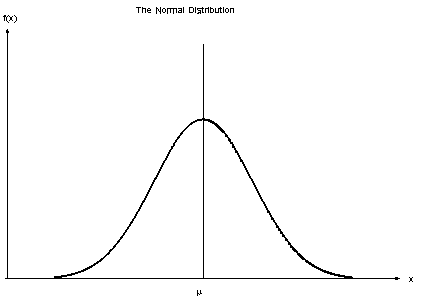
Normal Distribution
- A function that represents the distribution of multiple variables as a symmetrical bell-shaped graph
Causation
- provides a means connecting conduct with a concluding effect
Sample Representative
- Group of subjects selected for a study from a large population
- Sample Bias
- When sample does not have same components as the population
Placebo Effects
- Refers to change that occurs because people expect change
- Problem : If one expects a negative effect
- Refers to change that occurs because people expect change
Distortion in Self-Report Data
- Self-Report Data
- Information given by the subject about the subject
- Social Desirability Bias
- tendency to give socially approved answers when questioned about oneself
- Implicit Measures
- can provide self-report data that bypasses one's consciousness
- Self-Report Data
Rosenthal's Research on Experimental Bias
- " Quite unconsciously, a psychologist interacts in subtle ways with the people he is studying so that he may get the response he expects to get"
Principles of Ethical Research
- Respect for the dignity of Persons
- Protect rights and privacy, no discrimination, protect the vulnerable
- Responsible Caring
- activities should benefit not harm others
- Integrity in Relationships
- includes clients, students, research participants
- Responsibility to Society
- To increase knowledge and benefit people
- Respect for the dignity of Persons