
Mind map
Lateralisation and split brain research
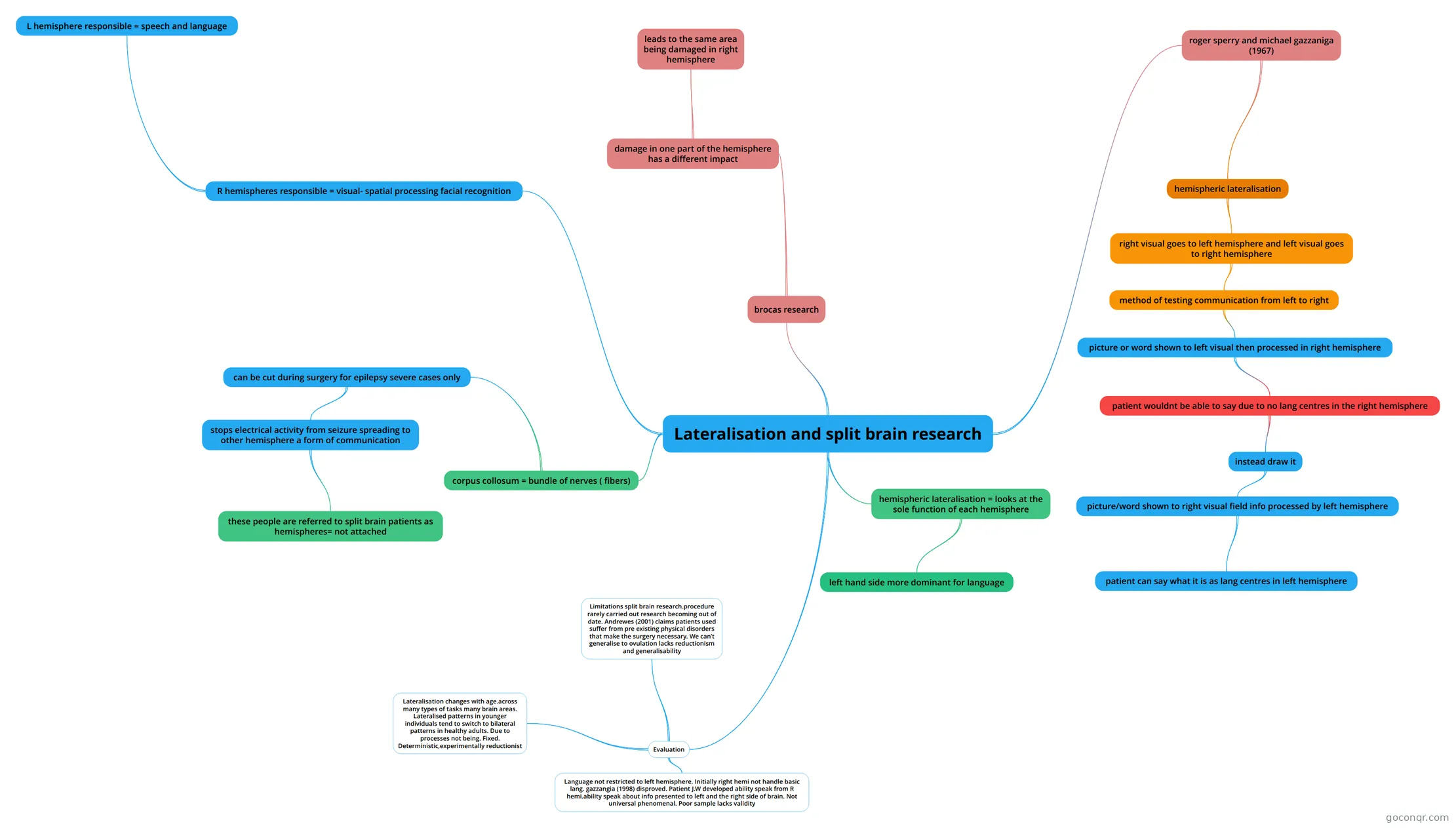
Mind map: lateralisation and split brain research
Map content
Lateralisation and split brain research
hemispheric lateralisation = looks at the sole function of each hemisphere
- left hand side more dominant for language
brocas research
- damage in one part of the hemisphere has a different impact
- leads to the same area being damaged in right hemisphere
- damage in one part of the hemisphere has a different impact
corpus collosum = bundle of nerves ( fibers)
- can be cut during surgery for epilepsy severe cases only
- stops electrical activity from seizure spreading to other hemisphere a form of communication
- these people are referred to split brain patients as hemispheres= not attached
- stops electrical activity from seizure spreading to other hemisphere a form of communication
- can be cut during surgery for epilepsy severe cases only
roger sperry and michael gazzaniga (1967)
- hemispheric lateralisation
- right visual goes to left hemisphere and left visual goes to right hemisphere
- method of testing communication from left to right
- picture or word shown to left visual then processed in right hemisphere
- patient wouldnt be able to say due to no lang centres in the right hemisphere
- instead draw it
- picture/word shown to right visual field info processed by left hemisphere
- patient can say what it is as lang centres in left hemisphere
- picture/word shown to right visual field info processed by left hemisphere
- instead draw it
- patient wouldnt be able to say due to no lang centres in the right hemisphere
- picture or word shown to left visual then processed in right hemisphere
- method of testing communication from left to right
- right visual goes to left hemisphere and left visual goes to right hemisphere
- hemispheric lateralisation
R hemispheres responsible = visual- spatial processing facial recognition
- L hemisphere responsible = speech and language
Evaluation
- Language not restricted to left hemisphere. Initially right hemi not handle basic lang. gazzangia (1998) disproved. Patient J.W developed ability speak from R hemi.ability speak about info presented to left and the right side of brain. Not universal phenomenal. Poor sample lacks validity
- Lateralisation changes with age.across many types of tasks many brain areas. Lateralised patterns in younger individuals tend to switch to bilateral patterns in healthy adults. Due to processes not being. Fixed. Deterministic,experimentally reductionist
- Limitations split brain research.procedure rarely carried out research becoming out of date. Andrewes (2001) claims patients used suffer from pre existing physical disorders that make the surgery necessary. We can’t generalise to ovulation lacks reductionism and generalisability
Information
- Description
- includes the examples of the epilepsy case study and surgeries
- Created by
- Amelia Lane
- Views
- 9
- Rating