
Mind map
Enzymes
Map content
Enzymes
Biological catalysts
- 'Biological' because they are made by living cells
- 'Catalysts' because they speed up reactions without being changed/used up in the reaction
- Types of Reactions
- Anabolic
- Building up molecules
- E.g protein synthesis
- Building up molecules
- Catabolic
- Breaking down molecules
- Digestion
- Breaking down molecules
- Anabolic
- Metabolic pathways
- A sequence of enzyme controlled reactions in which the product of one reaction becomes the reactant in the next
- They lower the amount of activation energy needed to make a reaction happen
Structure
- Tertiary Structure proteins
- Have:
- Hydrogen bonds
- Ionic Bonds
- Disulphide Bridges
- Hydrophobic interactions
- If any of the bonds are broken the shape of the active site will change
- 3d Shape
- Have:
- Globular (Metabolically active)
- Soluble because hydrophilic R groups are on the outside of the structure
- Sites of enzyme action
- Extracellular
- Enzymes are secreted from cell via exocytosis
- E.g Amylase & Saprotrophic Fungi
- Amylase made in salivary glands and released into mouth to act on food. Saprotrphic Fungi- secretes amylase,lipase and proteases on their food to be digested
- E.g Amylase & Saprotrophic Fungi
- Enzymes are secreted from cell via exocytosis
- Intracellular, in solution
- E.g the enzymes that catalyse glucose breakdown in glycosis
- Intracellular, Membrane bound
- Attached to the membrane
- E.G cristae in mitochondria
- Attached to the membrane
- Extracellular
- Tertiary Structure proteins
Active site models
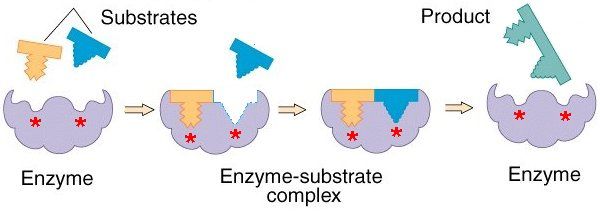
- Temporary bonding creates an enzyme-substrate complex which allows for the reaction
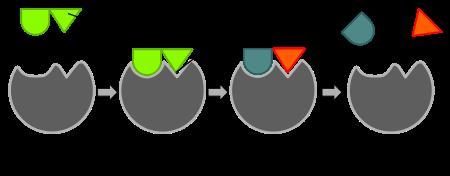
- Lock & Key Model
- Emil Fischer-1894
- Each enzyme is substrate-specific
- Enzymes can only catalyse 1 type of reaction
- Needs to be a successful collision between the enzyme & substrate
- Enzymes can only catalyse 1 type of reaction
- Induced Fit model
- Where the active site changes shape to accommodate the substrate
- E.g Lysozymes
General Process
- Enzyme & Substrate mixed together
- Enzymes & Substrate in constant motion & collide
- Substrate binds w/active site (in a successful collision)
- Substrate is modified & then released
- Active sites refill w/more substrate
- The rate of reaction depends on No. of free enzymes
- if all other conditions are optimal The enzyme concentration becomes the limiting factor in the above scenario
- As reaction proceeds there is less substrate & more product
- The the substrate concentration will become the limiting factor
- Eventually, all substrate used up & graph line flattens out
- The rate of reaction depends on No. of free enzymes
- Active sites refill w/more substrate
- Substrate is modified & then released
- Substrate binds w/active site (in a successful collision)
- Enzymes & Substrate in constant motion & collide
- Enzyme & Substrate mixed together
Factors affecting enzyme action
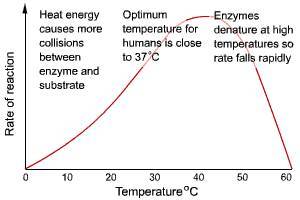
- Tempurature
- Increasing temp will increase K.E of enzyme & substrate
- Leading to more successful collisions
- This can increase the rate of reaction
- The optimum for most enzymes is roughly 37'c
- Above this temp the increasing vibrations break the weak hydrogen bonds
- Causing the enzymes to denature
- At Low temps the enzyme is inactivated
- Above this temp the increasing vibrations break the weak hydrogen bonds
- The optimum for most enzymes is roughly 37'c
- This can increase the rate of reaction
- Leading to more successful collisions
- Increasing temp will increase K.E of enzyme & substrate
- pH
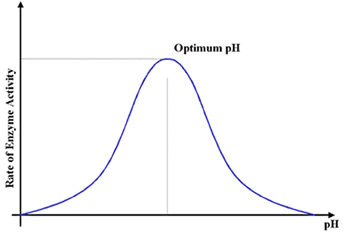
- Range of optimum pH is small
- Changes affect the ionic & hydrogen bonds
- Small deviations cause minor changes which are reversible & only inactivate the enzyme
- Large Deviations cause denaturation
- Small deviations cause minor changes which are reversible & only inactivate the enzyme
- Changes affect the ionic & hydrogen bonds
- Range of optimum pH is small
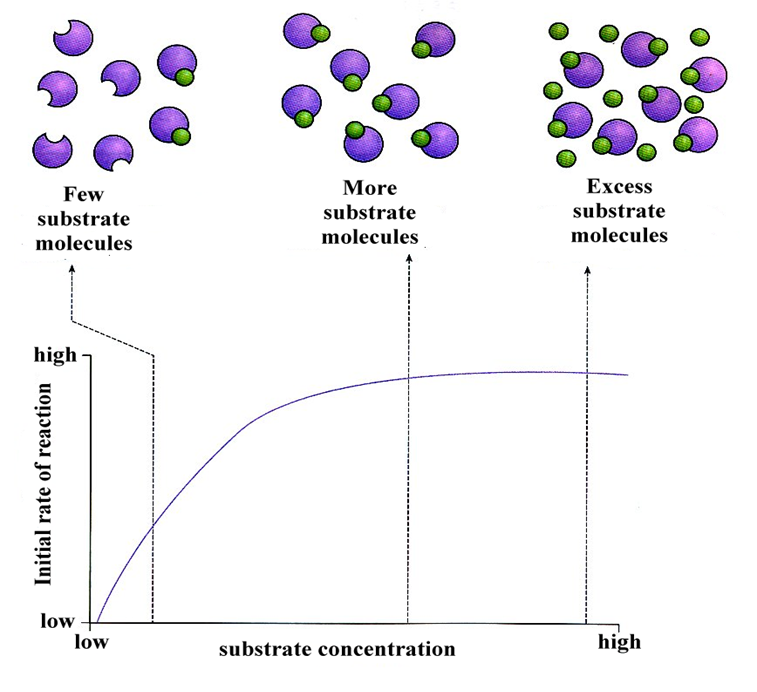
- Substrate Concentration
- IF ENZYME CONCENTRATION IS CONSTANT
- It is a key limiting factor
- Higher concentrations means quicker rate of reaction until a point
- As all the active sites are saturated adding more substrate will not increase the rate
- Higher concentrations means quicker rate of reaction until a point
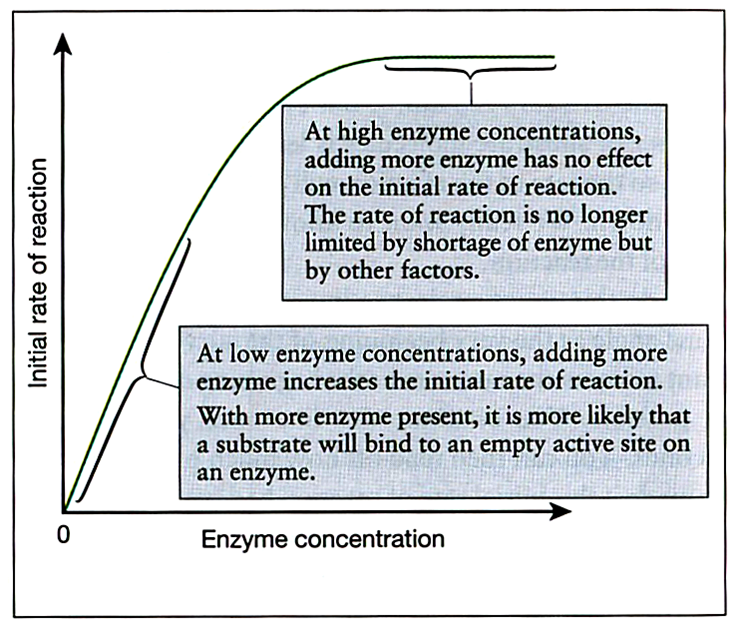
- Enzyme Concentration
- As the enzyme concentration increases the rate of reaction increases
- Tempurature
Enzyme Inhibition
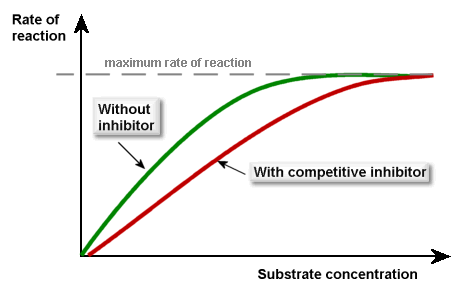
- Competitive
- Have a molecular shape complementary to the active site
- Temporarily taking the position of the substrate
- The effect of the inhibitor can be overcome by increasing the substrate concentration
- Temporarily taking the position of the substrate
- Have a molecular shape complementary to the active site
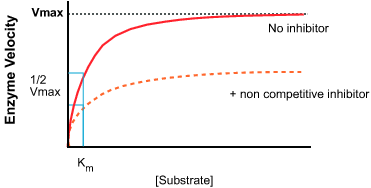
- Non-competitive
- Bind to the allosteric site of enzymes (i.e a site other than the active site)
- Therefore they do not compete w/the substrate
- They affect bonds and alter the overall shape of the enzyme
- Meaning the substrate cannot bind with active site
- As the inhibitor concentration increases, more enzymes denature
- Leading to a slower rate & less product produced
- E.g Heavy metal ions (Pb lead, arsenic As)/Cyanide
- Some non-competitive inhibitors bind reversibly & irreversibly
- E.g Heavy metal ions (Pb lead, arsenic As)/Cyanide
- Leading to a slower rate & less product produced
- As the inhibitor concentration increases, more enzymes denature
- Meaning the substrate cannot bind with active site
- They affect bonds and alter the overall shape of the enzyme
- Therefore they do not compete w/the substrate
- Bind to the allosteric site of enzymes (i.e a site other than the active site)
- Competitive
Immobilised Enzymes
- Are enzymes that are trapped on an inert matrix
- E.g a gel capsule or in alginate beads
- Example of reactions
- Fermentation
- Making lactose-free milk
- In washing powders
- Some people are allergic to biological washing powders. By encapsulating the enzymes. These are released only when being washed
- Making Baby food
- Pectinases break down pectin in cell walls releasing the fruit juice etc
- In Biosensers
- Advantages
- Products can be easily recovered without contaminating the enzyme
- The immobilised enzymes can be reused (lowering costs)
- They can tolerate a wider range of conditions enzymes are more stable when immobilised
- E.g temp and pH
- Enzymes can be removed & added which means that there is more control over the rate of reaction
- Can be used in a continuous production systems
- Disadvantages
- Works more slowly than free enzymes
- If encapsulated in beads- Substrate has to penetrate beads to contact enzyme: meaning sometimes only surface enzymes catalyse reactions
- Are enzymes that are trapped on an inert matrix
Biosensors
- Devices which measure the concentration of a specific metabolite in a mixture
- When the mixture passes over the enzyme, a reaction occurs
- The energy released is proportional to the concentration of the substrate
- This is converted into an electrical impulse
- An accurate digital display is shown
- Because enzymes are specific to a given substrate the results are highly accurate even at low concentrations
- This can be used to diagnose & monitor those w/diabetes
- Because enzymes are specific to a given substrate the results are highly accurate even at low concentrations
- An accurate digital display is shown
- This is converted into an electrical impulse
- The energy released is proportional to the concentration of the substrate
- When the mixture passes over the enzyme, a reaction occurs
- Advantages
- Can be quantitive
- Can detect very small amounts of molecules
- Detects only a specific product
- Accurate
- Devices which measure the concentration of a specific metabolite in a mixture
Images and files in the map
Information
- Description
- as BY1 Mind Map on Enzymes, created by Shehzeb basharat on 28/10/2015.
- Created by
- Shehzeb basharat
- Views
- 5
- Rating