
Mind map
Research Methods
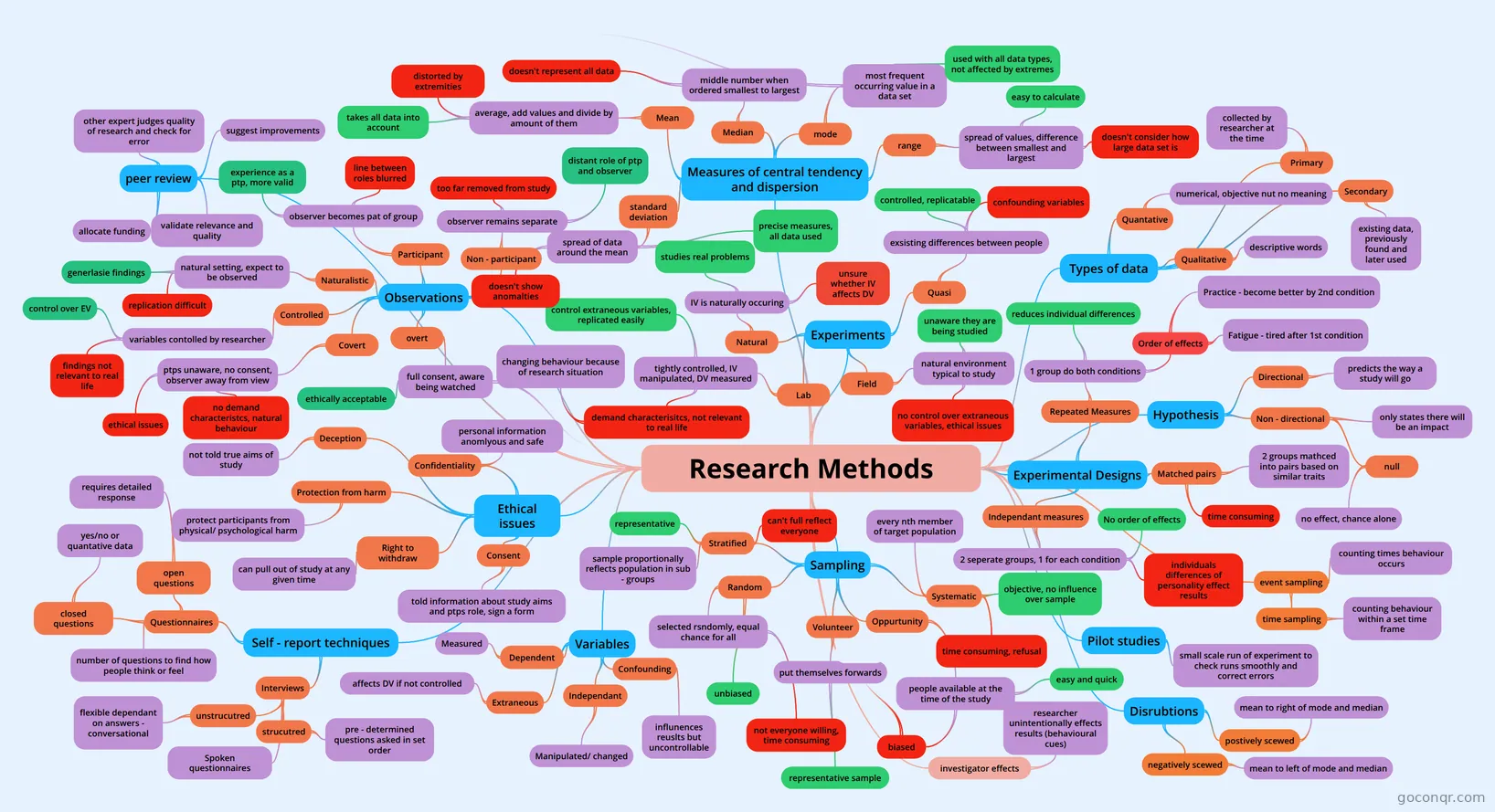
Mind map: Research methods
Map content
Research Methods
Sampling
- Volunteer
- put themselves forwards
- representative sample
- put themselves forwards
- Stratified
- sample proportionally reflects population in sub - groups
- representative
- can't full reflect everyone
- Oppurtunity
- people available at the time of the study
- easy and quick
- biased
- people available at the time of the study
- Random
- selected rsndomly, equal chance for all
- not everyone willing, time consuming
- unbiased
- selected rsndomly, equal chance for all
- Systematic
- every nth member of target population
- objective, no influence over sample
- time consuming, refusal
- Volunteer
Experiments
- Quasi
- exsisting differences between people
- controlled, replicatable
- confounding variables
- exsisting differences between people
- Lab
- tightly controlled, IV manipulated, DV measured
- control extraneous variables, replicated easily
- demand characterisitcs, not relevant to real life
- changing behaviour because of research situation
- tightly controlled, IV manipulated, DV measured
- Field
- natural environment typical to study
- unaware they are being studied
- no control over extraneous variables, ethical issues
- natural environment typical to study
- Natural
- IV is naturally occuring
- studies real problems
- unsure whether IV affects DV
- IV is naturally occuring
- Quasi
Experimental Designs
- Independant measures
- 2 seperate groups, 1 for each condition
- individuals differences of personality effect results
- No order of effects
- 2 seperate groups, 1 for each condition
- Repeated Measures
- 1 group do both conditions
- reduces individual differences
- Order of effects
- Practice - become better by 2nd condition
- Fatigue - tired after 1st condition
- 1 group do both conditions
- Matched pairs
- 2 groups mathced into pairs based on similar traits
- time consuming
- Independant measures
Ethical issues
- Consent
- told information about study aims and ptps role, sign a form
- Confidentiality
- personal information anomlyous and safe
- Deception
- not told true aims of study
- Protection from harm
- protect participants from physical/ psychological harm
- Right to withdraw
- can pull out of study at any given time
- Consent
Variables
- Independant
- Manipulated/ changed
- Dependent
- Measured
- Extraneous
- affects DV if not controlled
- Confounding
- influnences reuslts but uncontrollable
- Independant
Observations
- Naturalistic
- natural setting, expect to be observed
- generlasie findings
- replication difficult
- natural setting, expect to be observed
- Participant
- observer becomes pat of group
- experience as a ptp, more valid
- line between roles blurred
- observer becomes pat of group
- Controlled
- variables contolled by researcher
- control over EV
- findings not relevant to real life
- variables contolled by researcher
- Covert
- ptps unaware, no consent, observer away from view
- ethical issues
- no demand characteristcs, natural behaviour
- ptps unaware, no consent, observer away from view
- overt
- full consent, aware being watched
- ethically acceptable
- full consent, aware being watched
- Non - participant
- observer remains separate
- too far removed from study
- distant role of ptp and observer
- observer remains separate
- Naturalistic
Measures of central tendency and dispersion
- Mean
- average, add values and divide by amount of them
- takes all data into account
- distorted by extremities
- average, add values and divide by amount of them
- Median
- middle number when ordered smallest to largest
- doesn't represent all data
- middle number when ordered smallest to largest
- range
- spread of values, difference between smallest and largest
- easy to calculate
- doesn't consider how large data set is
- spread of values, difference between smallest and largest
- mode
- most frequent occurring value in a data set
- used with all data types, not affected by extremes
- most frequent occurring value in a data set
- standard deviation
- spread of data around the mean
- precise measures, all data used
- doesn't show anomalties
- spread of data around the mean
- Mean
Self - report techniques
- Questionnaires
- number of questions to find how people think or feel
- open questions
- requires detailed response
- closed questions
- yes/no or quantative data
- Interviews
- Spoken questionnaires
- strucutred
- pre - determined questions asked in set order
- unstrucutred
- flexible dependant on answers - conversational
- Questionnaires
Hypothesis
- Directional
- predicts the way a study will go
- Non - directional
- only states there will be an impact
- null
- no effect, chance alone
- Directional
Types of data
- Primary
- collected by researcher at the time
- Secondary
- existing data, previously found and later used
- Quantative
- numerical, objective nut no meaning
- Qualitative
- descriptive words
- Primary
Pilot studies
- small scale run of experiment to check runs smoothly and correct errors
investigator effects
- researcher unintentionally effects results (behavioural cues)
event sampling
- time sampling
- counting behaviour within a set time frame
- counting times behaviour occurs
- time sampling
Disrubtions
- postively scewed
- mean to right of mode and median
- negatively scewed
- mean to left of mode and median
- postively scewed
peer review
- other expert judges quality of research and check for error
- allocate funding
- validate relevance and quality
- suggest improvements
Information
- Description
- Research methods mind map for chapter 6, year 12, AQA A- level Psychology
- Created by
- Isabelle Carroll
- Views
- 27
- Tags
- Rating