
Mind map
Group Performance
Map content
Group Performance
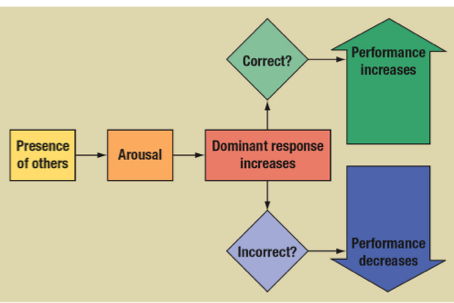
Zajonc Solution (1980)
- Presence of others can lead to:
- Improvement on easy/or well earned tasks
- Impairment on difficult tasks which have not yet been learned
- Increases arousal
- Strengthens dominant response to a stimulus
- On easy tasks, the dominant presence will be correct
- On difficult tasks, the dominant response will be incorrect
- Strengthens dominant response to a stimulus
- Improvement on easy/or well earned tasks
- Social Facilitation
- Presence of others enhances the performance on easy tasks but impairs on difficult tasks
- Presence of others can lead to:
Steiner (1972)
- 4 tasks:
- Additive task
- Group product is a result of everyone's contributions
- Rope pulling task
- Compensatory task
- The group product is the average judgement
- Eg. Estimating temperature
- Disjunctive tasks
- Group product is determined by the individual with the greatest performance
- Eg. Horse trading problem
- Conjunctive tasks
- The groups product is determined by the individual with the poorest performance
- Eg. Cycling with a group
- Additive task
- 4 tasks:
Social loafing
- Reduction in individual output on easy tasks where the a whole groups contributions matter.
- In other words, exerting less effort to achieve a goal when working in a group compared to working alone
- Results of social loafing:
- Loss of motivation
- Loss of co-ordination
- Preventing social loafing
- Make members contributions identifiable
- The task is important to those who perform it
- When people believe their efforts are necessary to succeed
- Group expects to be punished for poor performance
- Group is small
- Group is cohesive
- Knowing ones work would be individually identified
- If the individual believed their work towards the task was unique and necessary towards groups performance
- Reduction in individual output on easy tasks where the a whole groups contributions matter.
Group polarisation
- When simple minded people discuss a topic, it often becomes more exaggerated
- Informational influence
- Discussion generates arguments that mostly favour the position already taken
- Social comparison
- Desire to make a positive impression by being 'better' than the others
- Causes
- Isolation
- Similar backgrounds
- Group cohesion
- Unsystematic review procedure
- Symptoms
- Overestimation of the group
- Poor information search
- No risk assessment
- No alternative plan
- How to prevent
- Consult widely with others
- Typically the weakest point of a group
Baumeister Et al (2015)
- Groups function better when members have differentiated identities than when individuality is lost as people blend into a group
- How groups form
- Shared group identity, motivates individuals to work on behalf of the group
- A vast increase in performance and efficiency when different members use different skills to perform different roles in an interlocking, interactive system
- People contributed better when identified individually and did worse when their individual identity was downplayed or lost
- Groups benefit when members participate as seperate, autonomous indivuduals
Images and files in the map

Information
- Description
- Degree Psychology (Social) Mind Map on Group Performance, created by up723339 on 18/01/2016.
- Created by
- up723339
- Views
- 210
- Rating