
Mind map
research methods
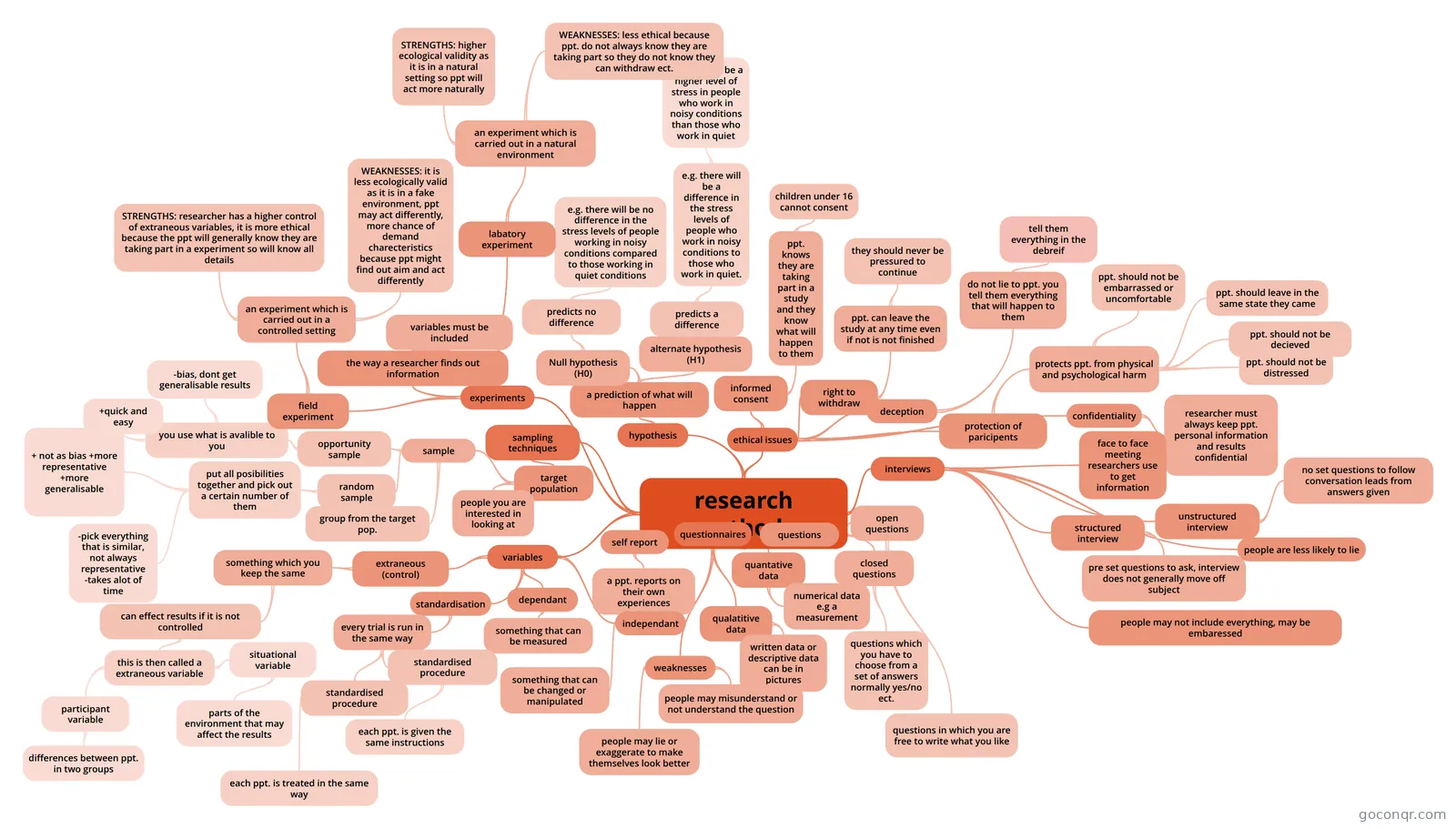
Mind map: research methods
Map content
research methods
questionnaires
- quantative data
- numerical data e.g a measurement
- qualatitive data
- written data or descriptive data can be in pictures
- self report
- a ppt. reports on their own experiences
- questions
- closed questions
- questions which you have to choose from a set of answers normally yes/no ect.
- open questions
- questions in which you are free to write what you like
- closed questions
- weaknesses
- people may lie or exaggerate to make themselves look better
- people may misunderstand or not understand the question
- quantative data
ethical issues
- informed consent
- ppt. knows they are taking part in a study and they know what will happen to them
- children under 16 cannot consent
- ppt. knows they are taking part in a study and they know what will happen to them
- right to withdraw
- ppt. can leave the study at any time even if not is not finished
- they should never be pressured to continue
- ppt. can leave the study at any time even if not is not finished
- confidentiality
- researcher must always keep ppt. personal information and results confidential
- protection of paricipents
- protects ppt. from physical and psychological harm
- ppt. should not be decieved
- ppt. should not be distressed
- ppt. should leave in the same state they came
- ppt. should not be embarrassed or uncomfortable
- protects ppt. from physical and psychological harm
- deception
- do not lie to ppt. you tell them everything that will happen to them
- tell them everything in the debreif
- do not lie to ppt. you tell them everything that will happen to them
- informed consent
hypothesis
- a prediction of what will happen
- Null hypothesis (H0)
- predicts no difference
- e.g. there will be no difference in the stress levels of people working in noisy conditions compared to those working in quiet conditions
- predicts no difference
- alternate hypothesis (H1)
- predicts a difference
- e.g. there will be a difference in the stress levels of people who work in noisy conditions to those who work in quiet.
- or there will be a higher level of stress in people who work in noisy conditions than those who work in quiet
- e.g. there will be a difference in the stress levels of people who work in noisy conditions to those who work in quiet.
- predicts a difference
- Null hypothesis (H0)
- a prediction of what will happen
variables
- independant
- something that can be changed or manipulated
- dependant
- something that can be measured
- extraneous (control)
- something which you keep the same
- can effect results if it is not controlled
- this is then called a extraneous variable
- participant variable
- differences between ppt. in two groups
- situational variable
- parts of the environment that may affect the results
- participant variable
- this is then called a extraneous variable
- can effect results if it is not controlled
- something which you keep the same
- standardisation
- every trial is run in the same way
- standardised procedure
- each ppt. is treated in the same way
- standardised procedure
- each ppt. is given the same instructions
- standardised procedure
- every trial is run in the same way
- independant
sampling techniques
- target population
- people you are interested in looking at
- sample
- group from the target pop.
- random sample
- put all posibilities together and pick out a certain number of them
- + not as bias +more representative +more generalisable
- -pick everything that is similar, not always representative -takes alot of time
- put all posibilities together and pick out a certain number of them
- opportunity sample
- you use what is avalible to you
- +quick and easy
- -bias, dont get generalisable results
- you use what is avalible to you
- target population
experiments
- the way a researcher finds out information
- variables must be included
- field experiment
- an experiment which is carried out in a controlled setting
- STRENGTHS: researcher has a higher control of extraneous variables, it is more ethical because the ppt will generally know they are taking part in a experiment so will know all details
- WEAKNESSES: it is less ecologically valid as it is in a fake environment, ppt may act differently, more chance of demand charecteristics because ppt might find out aim and act differently
- an experiment which is carried out in a controlled setting
- labatory experiment
- an experiment which is carried out in a natural environment
- STRENGTHS: higher ecological validity as it is in a natural setting so ppt will act more naturally
- WEAKNESSES: less ethical because ppt. do not always know they are taking part so they do not know they can withdraw ect.
- an experiment which is carried out in a natural environment
- the way a researcher finds out information
interviews
- face to face meeting researchers use to get information
- structured interview
- pre set questions to ask, interview does not generally move off subject
- unstructured interview
- no set questions to follow conversation leads from answers given
- people are less likely to lie
- people may not include everything, may be embaressed
Information
- Description
- A Levels PSYCHOLOGY (Research methods) Mind Map on research methods, created by jadeharmar on 10/03/2014.
- Created by
- jadeharmar
- Views
- 56
- Tags
- Rating