
Mind map
AS Psychology Unit 1 & 2 (Edexcel)
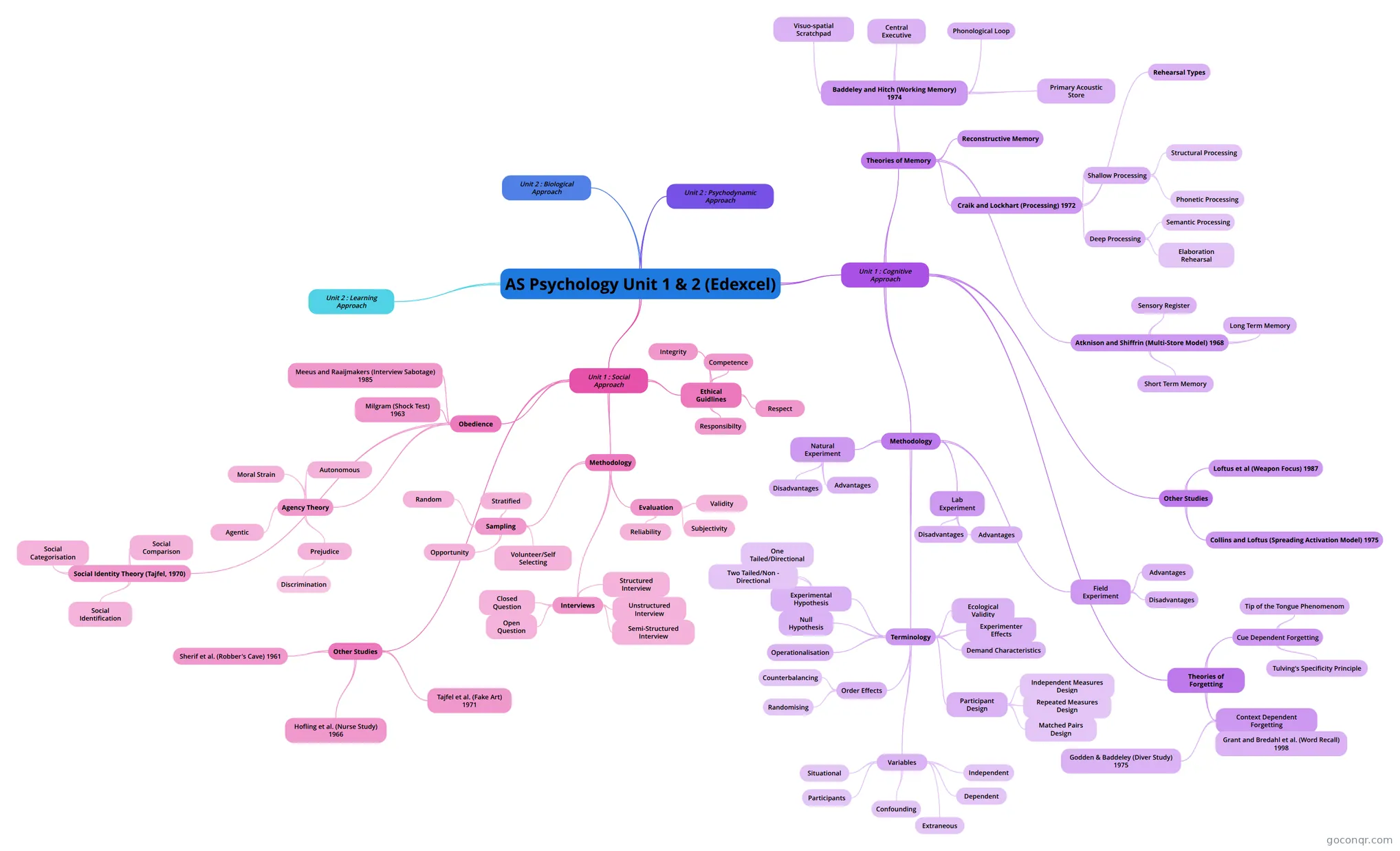
Mind map: AS Psychology Unit 1 & 2 (Edexcel)
Map content
AS Psychology Unit 1 & 2 (Edexcel)
Unit 1 : Social Approach
- Ethical Guidlines
- The 4 areas of the Ethical Guidelines. Remember these for Ethical Discussion.
- Respect
- Competence
- Integrity
- Responsibilty
- Methodology
- Interviews
- Know the difference between types of interviews. Difference between Question Types.
- Structured Interview
- Pre-set Order of Questions Quantitative Data
- Unstructured Interview
- Questions are open Interview Structure is flexible Qualitative data
- Semi-Structured Interview
- Schedule of questions Researcher has freedom to follow up on some responses.
- Open Question
- Qualitative data Consists of words Opinion-based
- Closed Question
- Limits possible responses Quantitative Data Reduced to numbers/quantities
- Sampling
- Random
- Equal chance to be selected Unbiased Difficult in large numbers
- Stratified
- Break population into groups Very representative Time consuming Difficult
- Opportunity
- Whoever is available. Easy & Quick Not very representative
- Volunteer/Self Selecting
- Participants select themselves Access a wide variety of people Motivation may make behaviour different. May have 'special' qualities.
- Random
- Evaluation
- Reliability
- Subjectivity
- Validity
- Interviews
- Obedience
- Following an order given by a person with RECOGNISED AUTHORITY over you.
- Milgram (Shock Test) 1963
- Behavioural Study of Obedience to Malevolent Authority. The aim was to measure how obedient 'naive' participants would be when ordered to give intense electric shocks. 40 Volunteers Selected by advertising Not in College/High School Rigged draw made sure participant was always given the role of 'teacher' 'Teacher' gives shocks for every incorrect answer to the 'actor' 'Actor' goes silent after '315v' after complaining about pain/heart problems Measured by how far they went up the generator before refusing to go further.
- Every participant went to at least 300v. 26 went all the way to 450v. Variations conducted include: Learner in the same room (40% went to the end) When teacher had to hold learners hand (30%)
- Meeus and Raaijmakers (Interview Sabotage) 1985
- Administrative Obedience : Carrying Out Orders to use Psychological-Administrative Violence To test obedience where harm would be done Participants ordered to harass a job applicant to make him nervous while sitting a test. 92% of Participants obeyed Variatons involved removing researcher presence and having two rebellious peers. Obedience dropped HUGELY in both.
- Agency Theory
- Human behaviour evolved to include the tendency to obey because rule-based behaviour enables stability in a complex human society.
- Autonomous
- Using our free will and take responsibility for our actions.
- Agentic
- Where we act on behalf on another
- Moral Strain
- Doing something that goes against our principles but seems to be for the greater good.
- Prejudice
- An attitude towards another person based on little or no knowledge.
- Discrimination
- Behaviour towards another person based on prejudice.
- Social Identity Theory (Tajfel, 1970)
- Social Categorisation
- The automatic act of putting yourself and others into groups along with stereotypical beliefs. In group - Groups you belong to Out group - Outside your in group
- Social Identification
- Absorbing the culture of your group Associate with your group's values and norms Differentiate between out groups
- Social Comparison
- To boost your own self-esteem, you need your group to appear 'better' by making other groups look bad in comparison.
- Social Categorisation
- Other Studies
- Hofling et al. (Nurse Study) 1966
- Investigate aspects of the nurse-physician relationship. 3 hospitals. One as control. 12 nurses and 21 students nurses asked to fill a questionnaire. Nurse is asked to give an overdose of a drug to a patient. Medication order given by phone. Drug is unauthorised. Unfamiliar voice.
- Questionnaire: 10/12 nurses and 21/21 students said they would have given the medication. Experiment: 21/22 nurses started to give the medication. Nearly all said they shouldn't have.
- Tajfel et al. (Fake Art) 1971
- Aim was to test whether grouping was enough to produce prejudice. Schoolboys split into two groups Klee & Kandinsky Asked to award poins to two other boys (one from each group) at a time. Boys typically awarded more points to members of their in group.
- Sherif et al. (Robber's Cave) 1961
- 2 groups of Boys. Field study. Unaware of each others existence. When introduced, strong in group prejudice was shown.
- Hofling et al. (Nurse Study) 1966
- Ethical Guidlines
Unit 1 : Cognitive Approach
- Methodology
- Lab Experiment
- Advantages
- Extraneous Variables can be controlled Can be certain the independent variable did have an effect on the measured dependent variable
- Disadvantages
- Artificial Environment May not apply to real situations Often aware of being part of research Experimenter Effects
- Advantages
- Field Experiment
- Advantages
- Participants may not be aware of research Ecological Validity
- Disadvantages
- No control over setting More time-consuming Ethical Problems
- Advantages
- Natural Experiment
- Field experiment but the independent variable is not manipulated by the researcher.
- Advantages
- Ecological Validity More ethical
- Disadvantages
- Lack of control over participants Extraneous Variables affecting results
- Terminology
- Experimental Hypothesis
- Prediction of study outcome.
- One Tailed/Directional
- Direction of results can be predicted
- Two Tailed/Non - Directional
- A change or difference can be predicted, but not the direction.
- Null Hypothesis
- Statement that the results will be due to chance not to what was predicted.
- Variables
- Independent
- Manipulated or changed in order to demonstrate a difference between the experimental conditions.
- Dependent
- Variable that is measured or the result of the experiment.
- Extraneous
- Any variable, except the IV that can influence findings.
- Confounding
- A factor that has not been controlled and that has a direct impact on findings.
- Situational
- Things such as environment.
- Participants
- For example in a driving test one's driving skills gives them an advantage.
- Independent
- Operationalisation
- Defining how you intend to measure the DV and alter conditions for the IV.
- Participant Design
- Describes how the participants are distributed.
- Independent Measures Design
- When one of the conditions is tested on a group
- Repeated Measures Design
- The same participants used in all experimental conditions
- Matched Pairs Design
- Same as IM design, but all participants matched on a quality.
- Order Effects
- Occur when they're in all conditions of experiment. Become practiced at the test or becoming tired from the test.
- Counterbalancing
- Participants divided equally between conditions to experience them in different order.
- Randomising
- Purely random counterbalancing.
- Ecological Validity
- How well a study represents a natural situation
- Experimenter Effects
- Things that may influence the way a participant responds because of the experimenter.
- Demand Characteristics
- Changing behaviour due to knowledge of experiment
- Experimental Hypothesis
- Lab Experiment
- Theories of Memory
- Craik and Lockhart (Processing) 1972
- Investigating how deep and shallow processing affects memory recall. Participants presented with 60 words answering 1 of 3 questions. 1 of each type of processing. They recalled more words that were semantically processed.
- Shallow Processing
- Structural Processing
- Using the physical qualities of something to encode it.
- Phonetic Processing
- Using sound to encode something
- Structural Processing
- Deep Processing
- Semantic Processing
- Encoding the meaning of a word relating to similar words.
- Elaboration Rehearsal
- Having a more meaningful analysis of information
- Semantic Processing
- Rehearsal Types
- Atknison and Shiffrin (Multi-Store Model) 1968
- Sensory Register
- Information enters, lasting around 2 seconds. If not attended to, lost immediately.
- Short Term Memory
- Lost if not rehearsed e.g Phone Number
- Long Term Memory
- Information is stored from STM. Lasts for years Infinite Storage
- Sensory Register
- Baddeley and Hitch (Working Memory) 1974
- Phonological Loop
- Deals with verbal information. 'Inner voice'
- Primary Acoustic Store
- Holds acoustic information
- Visuo-spatial Scratchpad
- Deals with visual and spatial information
- Central Executive
- Directs the flow of information
- Phonological Loop
- Reconstructive Memory
- Using imagination and best guesses to complete the memory.
- Craik and Lockhart (Processing) 1972
- Theories of Forgetting
- Cue Dependent Forgetting
- Failure to remember as an accessibility problem. If we don't remember it's because we're not in a similar situation.
- Tip of the Tongue Phenomenom
- Knowing the memory exists but being temporarily unable to recall it.
- Tulving's Specificity Principle
- The greater the similarity between the encoding event and retrieval event, the greater the likelihood of recalling the original memory.
- Context Dependent Forgetting
- Being in the same environment as a memory can aid recall of the memory
- Godden & Baddeley (Diver Study) 1975
- Were asked to recall words in a different environment (under water and on land). Without the same conditions, divers forgot the words.
- Grant and Bredahl et al. (Word Recall) 1998
- Memory for unrelated words where low when learned in noisy conditions and testing in quiet conditions. Opposite for quiet learning and quiet testing.
- Cue Dependent Forgetting
- Other Studies
- Collins and Loftus (Spreading Activation Model) 1975
- Loftus et al (Weapon Focus) 1987
- Methodology
Unit 2 : Psychodynamic Approach
Unit 2 : Biological Approach
Unit 2 : Learning Approach