
Mind map
Goldstein vs. Rogers
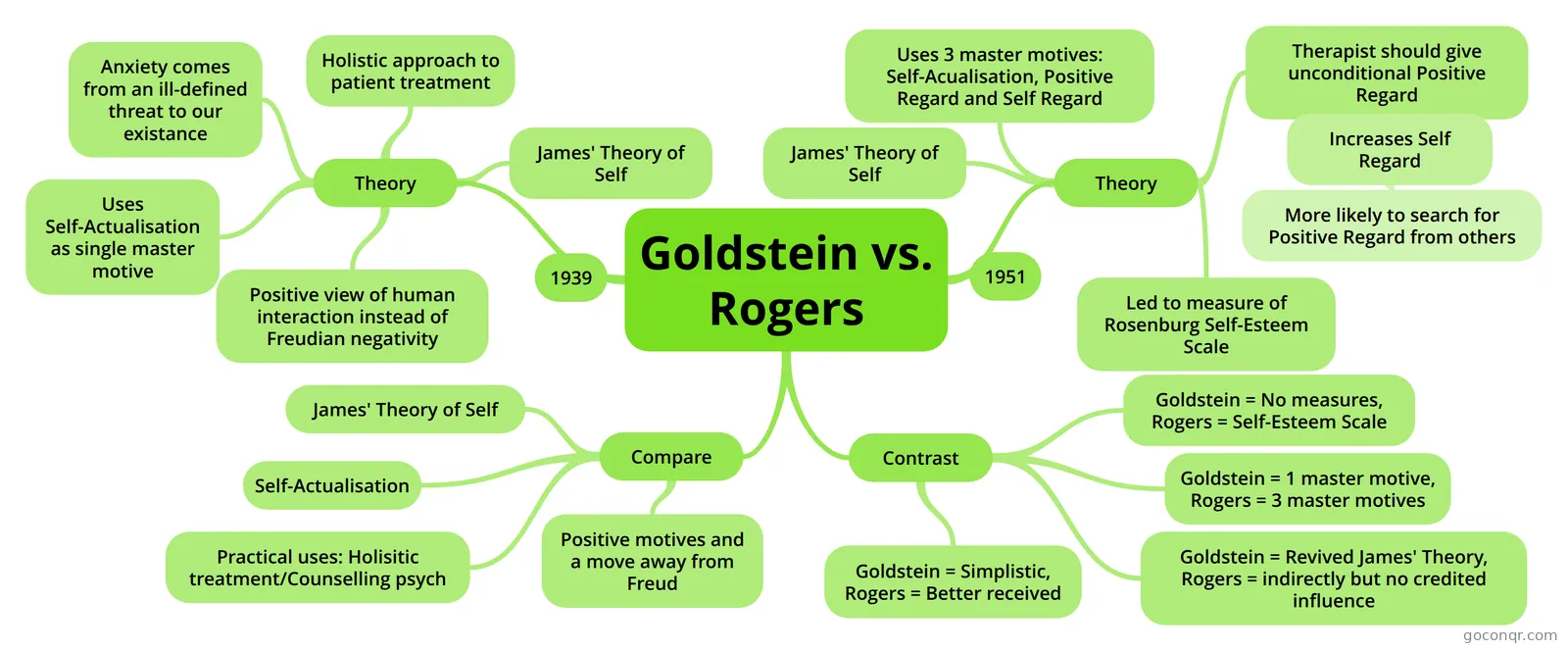
Mind map: Goldstein vs. Rogers
Map content
Goldstein vs. Rogers
1939
Theory
- James' Theory of Self
- Holistic approach to patient treatment
- Anxiety comes from an ill-defined threat to our existance
- Uses Self-Actualisation as single master motive
- Positive view of human interaction instead of Freudian negativity
1951
Theory
- Uses 3 master motives: Self-Acualisation, Positive Regard and Self Regard
- Therapist should give unconditional Positive Regard
- Increases Self Regard
- More likely to search for Positive Regard from others
- Increases Self Regard
- Led to measure of Rosenburg Self-Esteem Scale
- James' Theory of Self
Compare
- James' Theory of Self
- Self-Actualisation
- Positive motives and a move away from Freud
- Practical uses: Holisitic treatment/Counselling psych
Contrast
- Goldstein = No measures, Rogers = Self-Esteem Scale
- Goldstein = 1 master motive, Rogers = 3 master motives
- Goldstein = Simplistic, Rogers = Better received
- Goldstein = Revived James' Theory, Rogers = indirectly but no credited influence
Information
- Description
- Individual Differences Mind Map on Goldstein vs. Rogers, created by MeganBrianna on 02/05/2013.
- Created by
- MeganBrianna
- Views
- 100
- Tags
- Rating