
Mind map
Deng Xiaoping
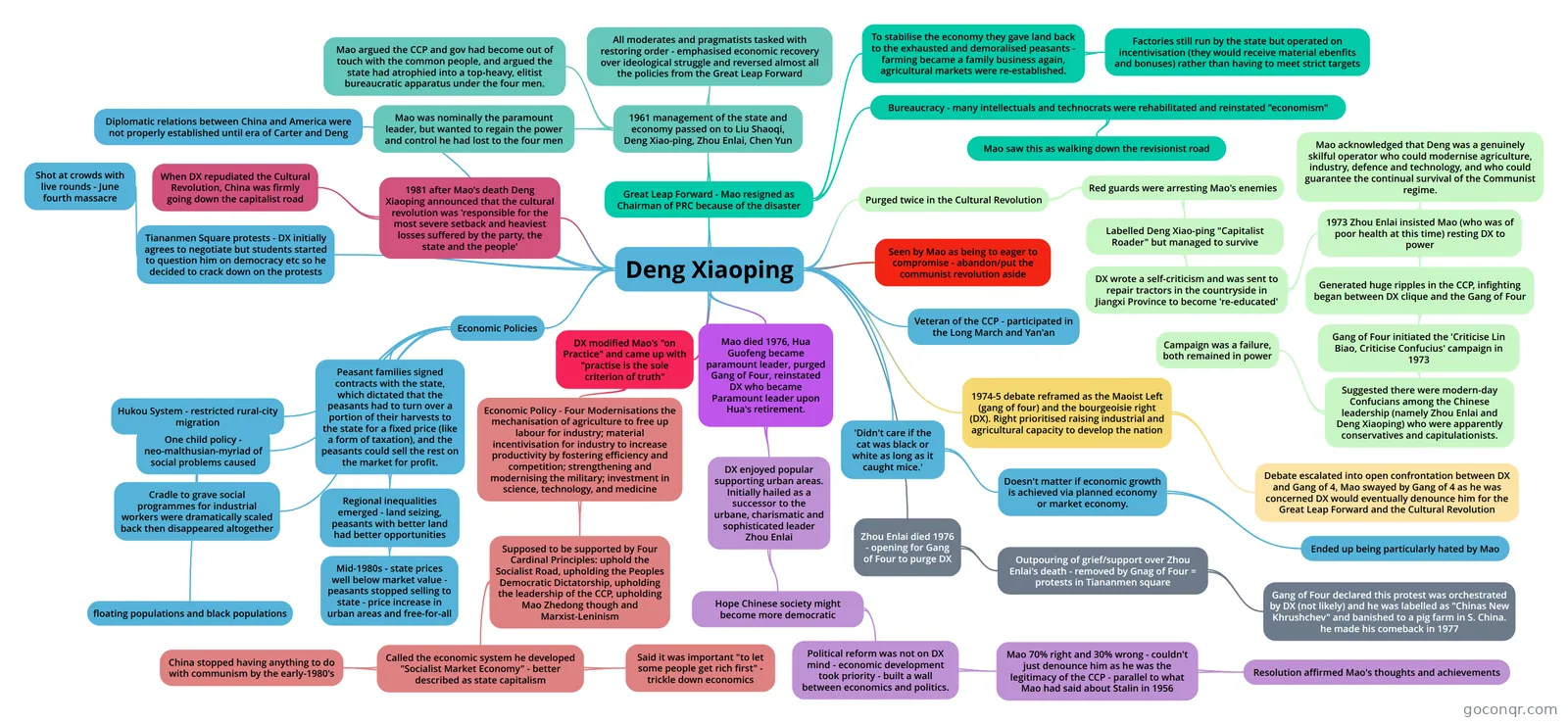
Mind map: Deng Xiaoping
Map content
Deng Xiaoping
'Didn't care if the cat was black or white as long as it caught mice.'
- Doesn't matter if economic growth is achieved via planned economy or market economy.
- Ended up being particularly hated by Mao
- Doesn't matter if economic growth is achieved via planned economy or market economy.
Seen by Mao as being to eager to compromise - abandon/put the communist revolution aside
Great Leap Forward - Mao resigned as Chairman of PRC because of the disaster
- 1961 management of the state and economy passed on to Liu Shaoqi, Deng Xiao-ping, Zhou Enlai, Chen Yun
- All moderates and pragmatists tasked with restoring order - emphasised economic recovery over ideological struggle and reversed almost all the policies from the Great Leap Forward
- Mao was nominally the paramount leader, but wanted to regain the power and control he had lost to the four men
- Mao argued the CCP and gov had become out of touch with the common people, and argued the state had atrophied into a top-heavy, elitist bureaucratic apparatus under the four men.
- To stabilise the economy they gave land back to the exhausted and demoralised peasants - farming became a family business again, agricultural markets were re-established.
- Factories still run by the state but operated on incentivisation (they would receive material ebenfits and bonuses) rather than having to meet strict targets
- Bureaucracy - many intellectuals and technocrats were rehabilitated and reinstated "economism"
- Mao saw this as walking down the revisionist road
- 1961 management of the state and economy passed on to Liu Shaoqi, Deng Xiao-ping, Zhou Enlai, Chen Yun
Veteran of the CCP - participated in the Long March and Yan'an
Purged twice in the Cultural Revolution
- Red guards were arresting Mao's enemies
- Labelled Deng Xiao-ping "Capitalist Roader" but managed to survive
- DX wrote a self-criticism and was sent to repair tractors in the countryside in Jiangxi Province to become 're-educated'
- 1973 Zhou Enlai insisted Mao (who was of poor health at this time) resting DX to power
- Mao acknowledged that Deng was a genuinely skilful operator who could modernise agriculture, industry, defence and technology, and who could guarantee the continual survival of the Communist regime.
- Generated huge ripples in the CCP, infighting began between DX clique and the Gang of Four
- Gang of Four initiated the 'Criticise Lin Biao, Criticise Confucius' campaign in 1973
- Suggested there were modern-day Confucians among the Chinese leadership (namely Zhou Enlai and Deng Xiaoping) who were apparently conservatives and capitulationists.
- Campaign was a failure, both remained in power
- Suggested there were modern-day Confucians among the Chinese leadership (namely Zhou Enlai and Deng Xiaoping) who were apparently conservatives and capitulationists.
- Gang of Four initiated the 'Criticise Lin Biao, Criticise Confucius' campaign in 1973
- 1973 Zhou Enlai insisted Mao (who was of poor health at this time) resting DX to power
- DX wrote a self-criticism and was sent to repair tractors in the countryside in Jiangxi Province to become 're-educated'
- Labelled Deng Xiao-ping "Capitalist Roader" but managed to survive
- Red guards were arresting Mao's enemies
1981 after Mao's death Deng Xiaoping announced that the cultural revolution was 'responsible for the most severe setback and heaviest losses suffered by the party, the state and the people'
- When DX repudiated the Cultural Revolution, China was firmly going down the capitalist road
Diplomatic relations between China and America were not properly established until era of Carter and Deng
1974-5 debate reframed as the Maoist Left (gang of four) and the bourgeoisie right (DX). Right prioritised raising industrial and agricultural capacity to develop the nation
- Debate escalated into open confrontation between DX and Gang of 4, Mao swayed by Gang of 4 as he was concerned DX would eventually denounce him for the Great Leap Forward and the Cultural Revolution
Zhou Enlai died 1976 - opening for Gang of Four to purge DX
- Outpouring of grief/support over Zhou Enlai's death - removed by Gnag of Four = protests in Tiananmen square
- Gang of Four declared this protest was orchestrated by DX (not likely) and he was labelled as "Chinas New Khrushchev" and banished to a pig farm in S. China. he made his comeback in 1977
- Outpouring of grief/support over Zhou Enlai's death - removed by Gnag of Four = protests in Tiananmen square
Mao died 1976, Hua Guofeng became paramount leader, purged Gang of Four, reinstated DX who became Paramount leader upon Hua's retirement.
- DX enjoyed popular supporting urban areas. Initially hailed as a successor to the urbane, charismatic and sophisticated leader Zhou Enlai
- Hope Chinese society might become more democratic
- Political reform was not on DX mind - economic development took priority - built a wall between economics and politics.
- Mao 70% right and 30% wrong - couldn't just denounce him as he was the legitimacy of the CCP - parallel to what Mao had said about Stalin in 1956
- Resolution affirmed Mao's thoughts and achievements
- Mao 70% right and 30% wrong - couldn't just denounce him as he was the legitimacy of the CCP - parallel to what Mao had said about Stalin in 1956
- Political reform was not on DX mind - economic development took priority - built a wall between economics and politics.
- Hope Chinese society might become more democratic
- DX enjoyed popular supporting urban areas. Initially hailed as a successor to the urbane, charismatic and sophisticated leader Zhou Enlai
DX modified Mao's "on Practice" and came up with "practise is the sole criterion of truth"
- Economic Policy - Four Modernisations the mechanisation of agriculture to free up labour for industry; material incentivisation for industry to increase productivity by fostering efficiency and competition; strengthening and modernising the military; investment in science, technology, and medicine
- Supposed to be supported by Four Cardinal Principles: uphold the Socialist Road, upholding the Peoples Democratic Dictatorship, upholding the leadership of the CCP, upholding Mao Zhedong though and Marxist-Leninism
- Called the economic system he developed "Socialist Market Economy" - better described as state capitalism
- Said it was important "to let some people get rich first" - trickle down economics
- China stopped having anything to do with communism by the early-1980's
- Called the economic system he developed "Socialist Market Economy" - better described as state capitalism
- Supposed to be supported by Four Cardinal Principles: uphold the Socialist Road, upholding the Peoples Democratic Dictatorship, upholding the leadership of the CCP, upholding Mao Zhedong though and Marxist-Leninism
- Economic Policy - Four Modernisations the mechanisation of agriculture to free up labour for industry; material incentivisation for industry to increase productivity by fostering efficiency and competition; strengthening and modernising the military; investment in science, technology, and medicine
Economic Policies
- Peasant families signed contracts with the state, which dictated that the peasants had to turn over a portion of their harvests to the state for a fixed price (like a form of taxation), and the peasants could sell the rest on the market for profit.
- Regional inequalities emerged - land seizing, peasants with better land had better opportunities
- Mid-1980s - state prices well below market value - peasants stopped selling to state - price increase in urban areas and free-for-all
- Regional inequalities emerged - land seizing, peasants with better land had better opportunities
- One child policy - neo-malthusian-myriad of social problems caused
- Cradle to grave social programmes for industrial workers were dramatically scaled back then disappeared altogether
- Hukou System - restricted rural-city migration
- floating populations and black populations
- Peasant families signed contracts with the state, which dictated that the peasants had to turn over a portion of their harvests to the state for a fixed price (like a form of taxation), and the peasants could sell the rest on the market for profit.
Tiananmen Square protests - DX initially agrees to negotiate but students started to question him on democracy etc so he decided to crack down on the protests
- Shot at crowds with live rounds - June fourth massacre
Information
- Description
- History Mind Map on Deng Xiaoping, created by Hannah Wood on 18/01/2017.
- Created by
- Hannah Wood
- Views
- 33
- Rating