
Mind map
Encoding STM, LTM
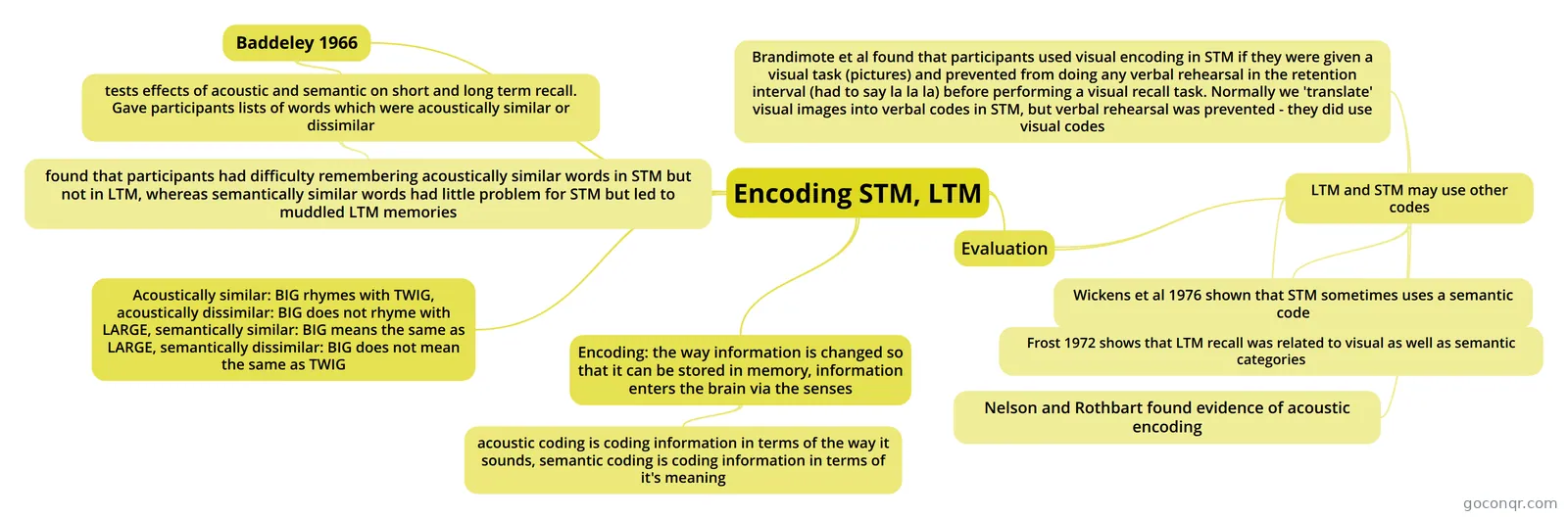
Mind map: Encoding STM, LTM
Map content
Encoding STM, LTM
Encoding: the way information is changed so that it can be stored in memory, information enters the brain via the senses
- acoustic coding is coding information in terms of the way it sounds, semantic coding is coding information in terms of it's meaning
Baddeley 1966
- tests effects of acoustic and semantic on short and long term recall. Gave participants lists of words which were acoustically similar or dissimilar
- found that participants had difficulty remembering acoustically similar words in STM but not in LTM, whereas semantically similar words had little problem for STM but led to muddled LTM memories
- tests effects of acoustic and semantic on short and long term recall. Gave participants lists of words which were acoustically similar or dissimilar
Evaluation
- LTM and STM may use other codes
- Brandimote et al found that participants used visual encoding in STM if they were given a visual task (pictures) and prevented from doing any verbal rehearsal in the retention interval (had to say la la la) before performing a visual recall task. Normally we 'translate' visual images into verbal codes in STM, but verbal rehearsal was prevented - they did use visual codes
- Wickens et al 1976 shown that STM sometimes uses a semantic code
- Frost 1972 shows that LTM recall was related to visual as well as semantic categories
- Nelson and Rothbart found evidence of acoustic encoding
- LTM and STM may use other codes
Acoustically similar: BIG rhymes with TWIG, acoustically dissimilar: BIG does not rhyme with LARGE, semantically similar: BIG means the same as LARGE, semantically dissimilar: BIG does not mean the same as TWIG
Information
- Description
- Psychology Mind Map on Encoding STM, LTM, created by samantha_x on 22/04/2014.
- Created by
- samantha_x
- Views
- 907
- Rating