
Mind map
Ageing Cognitive Development
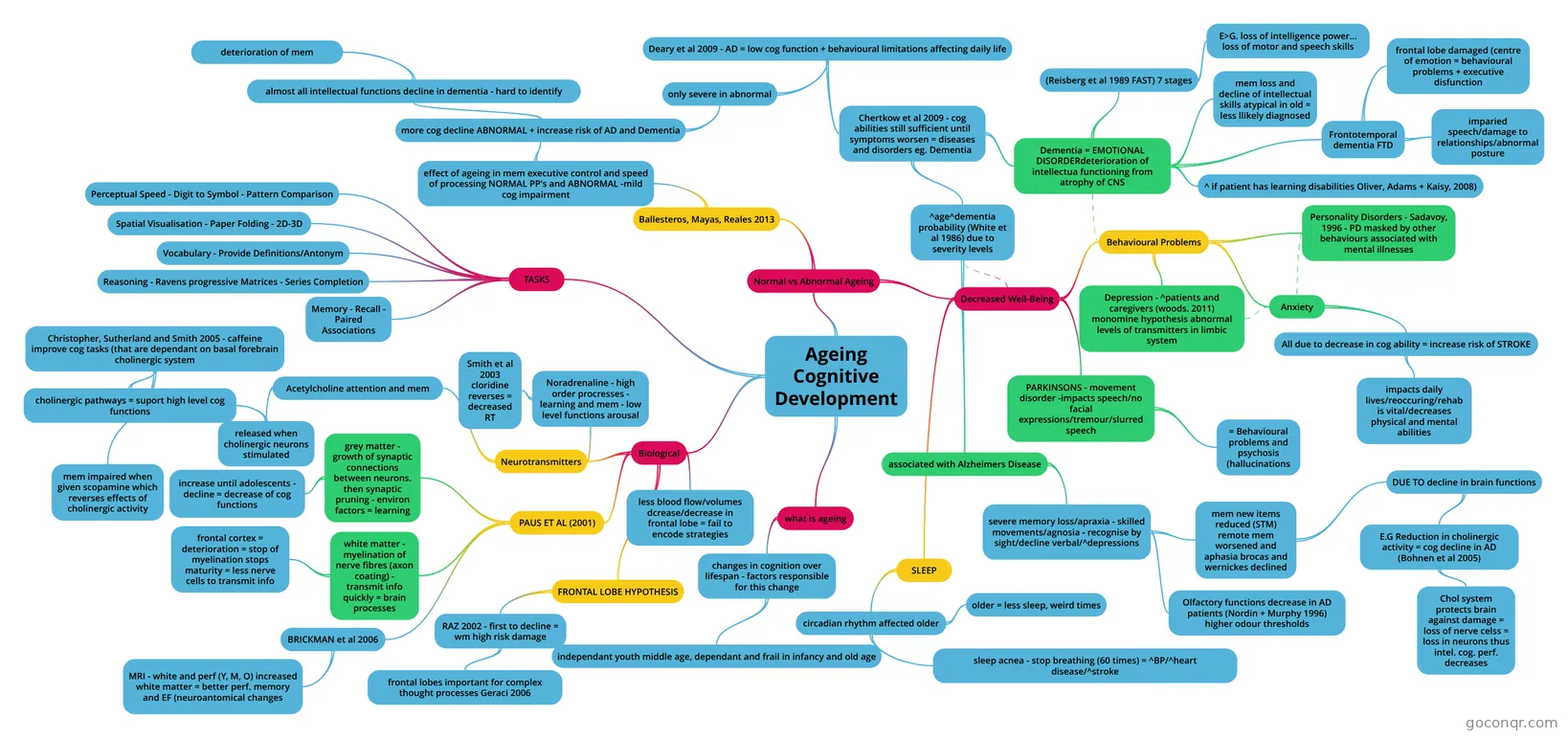
Mind map: Ageing cognitive development
Map content
Ageing Cognitive Development
Biological
- PAUS ET AL (2001)
- grey matter - growth of synaptic connections between neurons. then synaptic pruning - environ factors = learning
- increase until adolescents - decline = decrease of cog functions
- white matter - myelination of nerve fibres (axon coating) - transmit info quickly = brain processes
- frontal cortex = deterioration = stop of myelination stops maturity = less nerve cells to transmit info
- BRICKMAN et al 2006
- MRI - white and perf (Y, M, O) increased white matter = better perf. memory and EF (neuroantomical changes
- grey matter - growth of synaptic connections between neurons. then synaptic pruning - environ factors = learning
- FRONTAL LOBE HYPOTHESIS
- RAZ 2002 - first to decline = wm high risk damage
- frontal lobes important for complex thought processes Geraci 2006
- RAZ 2002 - first to decline = wm high risk damage
- Neurotransmitters
- Acetylcholine attention and mem
- released when cholinergic neurons stimulated
- cholinergic pathways = suport high level cog functions
- Christopher, Sutherland and Smith 2005 - caffeine improve cog tasks (that are dependant on basal forebrain cholinergic system
- mem impaired when given scopamine which reverses effects of cholinergic activity
- Christopher, Sutherland and Smith 2005 - caffeine improve cog tasks (that are dependant on basal forebrain cholinergic system
- cholinergic pathways = suport high level cog functions
- released when cholinergic neurons stimulated
- Noradrenaline - high order procresses - learning and mem - low level functions arousal
- Smith et al 2003 cloridine reverses = decreased RT
- Acetylcholine attention and mem
- less blood flow/volumes dcrease/decrease in frontal lobe = fail to encode strategies
- PAUS ET AL (2001)
what is ageing
- changes in cognition over lifespan - factors responsible for this change
- independant youth middle age, dependant and frail in infancy and old age
- changes in cognition over lifespan - factors responsible for this change
TASKS
- Memory - Recall - Paired Associations
- Reasoning - Ravens progressive Matrices - Series Completion
- Spatial Visualisation - Paper Folding - 2D-3D
- Vocabulary - Provide Definitions/Antonym
- Perceptual Speed - Digit to Symbol - Pattern Comparison
Normal vs Abnormal Ageing
- Ballesteros, Mayas, Reales 2013
- effect of ageing in mem executive control and speed of processing NORMAL PP's and ABNORMAL -mild cog impairment
- more cog decline ABNORMAL + increase risk of AD and Dementia
- only severe in abnormal
- Deary et al 2009 - AD = low cog function + behavioural limitations affecting daily life
- Chertkow et al 2009 - cog abilities still sufficient until symptoms worsen = diseases and disorders eg. Dementia
- ^age^dementia probability (White et al 1986) due to severity levels
- associated with Alzheimers Disease
- severe memory loss/apraxia - skilled movements/agnosia - recognise by sight/decline verbal/^depressions
- mem new items reduced (STM) remote mem worsened and aphasia brocas and wernickes declined
- DUE TO decline in brain functions
- E.G Reduction in cholinergic activity = cog decline in AD (Bohnen et al 2005)
- Chol system protects brain against damage = loss of nerve celss = loss in neurons thus intel. cog. perf. decreases
- E.G Reduction in cholinergic activity = cog decline in AD (Bohnen et al 2005)
- DUE TO decline in brain functions
- Olfactory functions decrease in AD patients (Nordin + Murphy 1996) higher odour thresholds
- mem new items reduced (STM) remote mem worsened and aphasia brocas and wernickes declined
- severe memory loss/apraxia - skilled movements/agnosia - recognise by sight/decline verbal/^depressions
- associated with Alzheimers Disease
- Dementia = EMOTIONAL DISORDERdeterioration of intellectua functioning from atrophy of CNS
- (Reisberg et al 1989 FAST) 7 stages
- E>G. loss of intelligence power... loss of motor and speech skills
- mem loss and decline of intellectual skills atypical in old = less llikely diagnosed
- ^ if patient has learning disabilities Oliver, Adams + Kaisy, 2008)
- Frontotemporal dementia FTD
- frontal lobe damaged (centre of emotion = behavioural problems + executive disfunction
- imparied speech/damage to relationships/abnormal posture
- (Reisberg et al 1989 FAST) 7 stages
- ^age^dementia probability (White et al 1986) due to severity levels
- Chertkow et al 2009 - cog abilities still sufficient until symptoms worsen = diseases and disorders eg. Dementia
- Deary et al 2009 - AD = low cog function + behavioural limitations affecting daily life
- almost all intellectual functions decline in dementia - hard to identify
- deterioration of mem
- only severe in abnormal
- more cog decline ABNORMAL + increase risk of AD and Dementia
- effect of ageing in mem executive control and speed of processing NORMAL PP's and ABNORMAL -mild cog impairment
- Decreased Well-Being
- Behavioural Problems
- Depression - ^patients and caregivers (woods. 2011) monomine hypothesis abnormal levels of transmitters in limbic system
- Anxiety
- All due to decrease in cog ability = increase risk of STROKE
- impacts daily lives/reoccuring/rehab is vital/decreases physical and mental abilities
- All due to decrease in cog ability = increase risk of STROKE
- Personality Disorders - Sadavoy, 1996 - PD masked by other behaviours associated with mental illnesses
- PARKINSONS - movement disorder -impacts speech/no facial expressions/tremour/slurred speech
- = Behavioural problems and psychosis (hallucinations
- SLEEP
- circadian rhythm affected older
- older = less sleep, weird times
- sleep acnea - stop breathing (60 times) = ^BP/^heart disease/^stroke
- circadian rhythm affected older
- Behavioural Problems
- Ballesteros, Mayas, Reales 2013
Information
- Description
- Degree Psychology Mind Map on Ageing Cognitive Development, created by Charlotte Rutherford on 23/04/2017.
- Created by
- Charlotte Rutherford
- Views
- 3
- Rating
More on Cognitive ageing and memory