
Mind map
Public Health
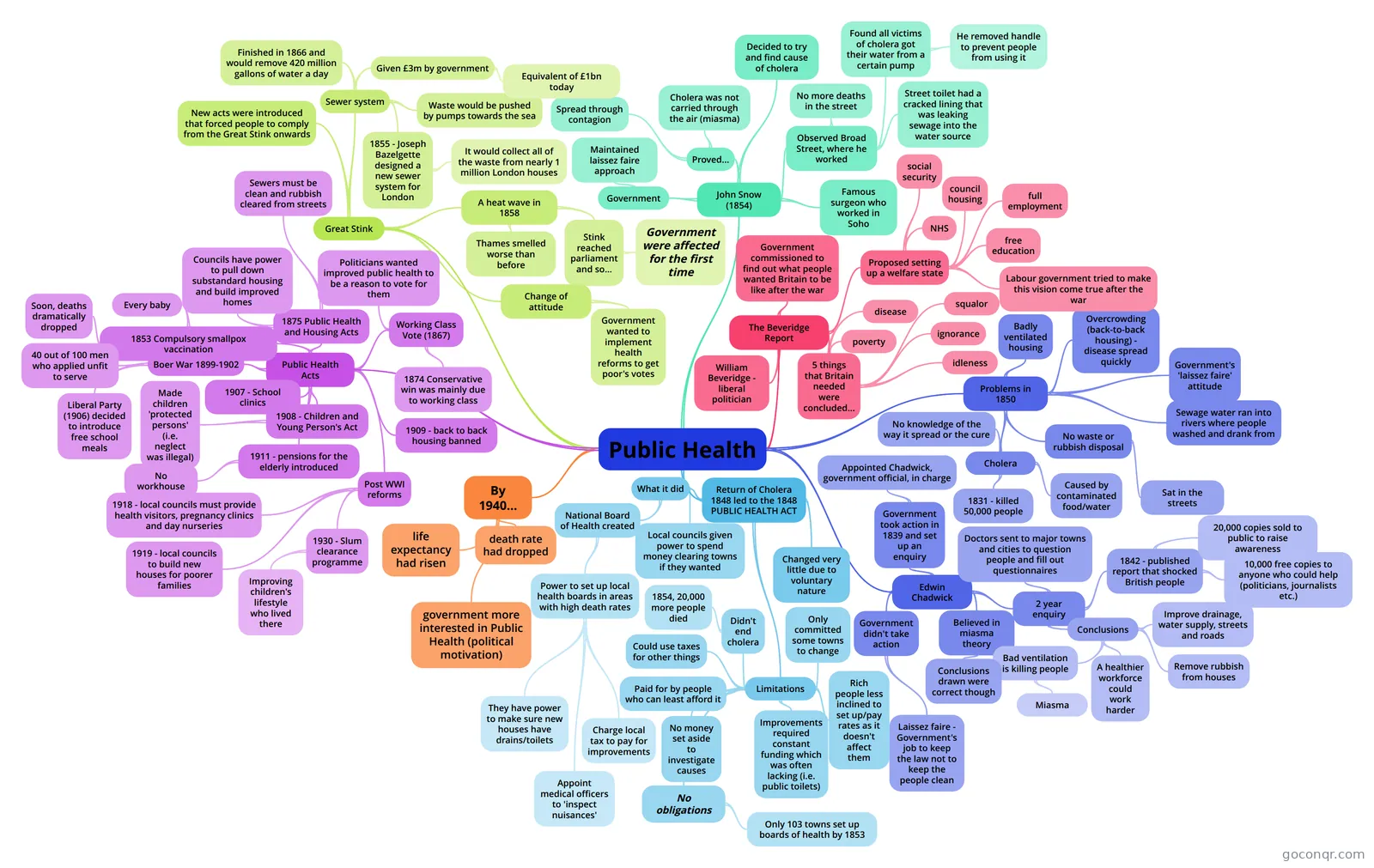
Mind map: Public Health history Britain
Map content
Public Health
Edwin Chadwick
- Government took action in 1839 and set up an enquiry
- Appointed Chadwick, government official, in charge
- 2 year enquiry
- Doctors sent to major towns and cities to question people and fill out questionnaires
- 1842 - published report that shocked British people
- 10,000 free copies to anyone who could help (politicians, journalists etc.)
- 20,000 copies sold to public to raise awareness
- Conclusions
- Improve drainage, water supply, streets and roads
- Remove rubbish from houses
- A healthier workforce could work harder
- Bad ventilation is killing people
- Miasma
- Believed in miasma theory
- Conclusions drawn were correct though
- Government didn't take action
- Laissez faire - Government's job to keep the law not to keep the people clean
- Government took action in 1839 and set up an enquiry
Problems in 1850
- Overcrowding (back-to-back housing) - disease spread quickly
- Sewage water ran into rivers where people washed and drank from
- No waste or rubbish disposal
- Sat in the streets
- Badly ventilated housing
- Government's 'laissez faire' attitude
- Cholera
- Caused by contaminated food/water
- 1831 - killed 50,000 people
- No knowledge of the way it spread or the cure
Return of Cholera 1848 led to the 1848 PUBLIC HEALTH ACT
- What it did
- Local councils given power to spend money clearing towns if they wanted
- National Board of Health created
- Power to set up local health boards in areas with high death rates
- They have power to make sure new houses have drains/toilets
- Charge local tax to pay for improvements
- Appoint medical officers to 'inspect nuisances'
- Power to set up local health boards in areas with high death rates
- Limitations
- No obligations
- Only 103 towns set up boards of health by 1853
- Didn't end cholera
- 1854, 20,000 more people died
- Could use taxes for other things
- Paid for by people who can least afford it
- Improvements required constant funding which was often lacking (i.e. public toilets)
- Only committed some towns to change
- No money set aside to investigate causes
- Rich people less inclined to set up/pay rates as it doesn't affect them
- No obligations
- Changed very little due to voluntary nature
- What it did
John Snow (1854)
- Famous surgeon who worked in Soho
- Decided to try and find cause of cholera
- Observed Broad Street, where he worked
- Found all victims of cholera got their water from a certain pump
- He removed handle to prevent people from using it
- No more deaths in the street
- Street toilet had a cracked lining that was leaking sewage into the water source
- Found all victims of cholera got their water from a certain pump
- Proved...
- Cholera was not carried through the air (miasma)
- Spread through contagion
- Government
- Maintained laissez faire approach
Public Health Acts
- Working Class Vote (1867)
- Politicians wanted improved public health to be a reason to vote for them
- 1874 Conservative win was mainly due to working class
- 1875 Public Health and Housing Acts
- Sewers must be clean and rubbish cleared from streets
- Councils have power to pull down substandard housing and build improved homes
- 1853 Compulsory smallpox vaccination
- Every baby
- Soon, deaths dramatically dropped
- Boer War 1899-1902
- 40 out of 100 men who applied unfit to serve
- Liberal Party (1906) decided to introduce free school meals
- 1907 - School clinics
- 1908 - Children and Young Person's Act
- Made children 'protected persons' (i.e. neglect was illegal)
- 1909 - back to back housing banned
- 1911 - pensions for the elderly introduced
- No workhouse
- Post WWI reforms
- 1918 - local councils must provide health visitors, pregnancy clinics and day nurseries
- 1930 - Slum clearance programme
- Improving children's lifestyle who lived there
- 1919 - local councils to build new houses for poorer families
- Working Class Vote (1867)
Great Stink
- A heat wave in 1858
- Thames smelled worse than before
- Stink reached parliament and so...
- Government were affected for the first time
- Change of attitude
- Government wanted to implement health reforms to get poor's votes
- Sewer system
- 1855 - Joseph Bazelgette designed a new sewer system for London
- It would collect all of the waste from nearly 1 million London houses
- Waste would be pushed by pumps towards the sea
- Given £3m by government
- Equivalent of £1bn today
- Finished in 1866 and would remove 420 million gallons of water a day
- 1855 - Joseph Bazelgette designed a new sewer system for London
- New acts were introduced that forced people to comply from the Great Stink onwards
- A heat wave in 1858
By 1940...
- death rate had dropped
- life expectancy had risen
- government more interested in Public Health (political motivation)
The Beveridge Report
- William Beveridge - liberal politician
- Government commissioned to find out what people wanted Britain to be like after the war
- 5 things that Britain needed were concluded...
- poverty
- disease
- ignorance
- idleness
- squalor
- Proposed setting up a welfare state
- social security
- NHS
- free education
- council housing
- full employment
- Labour government tried to make this vision come true after the war