
Mind map
What were the Cause and Consequences of The Cuban Missile Crisis October 1962
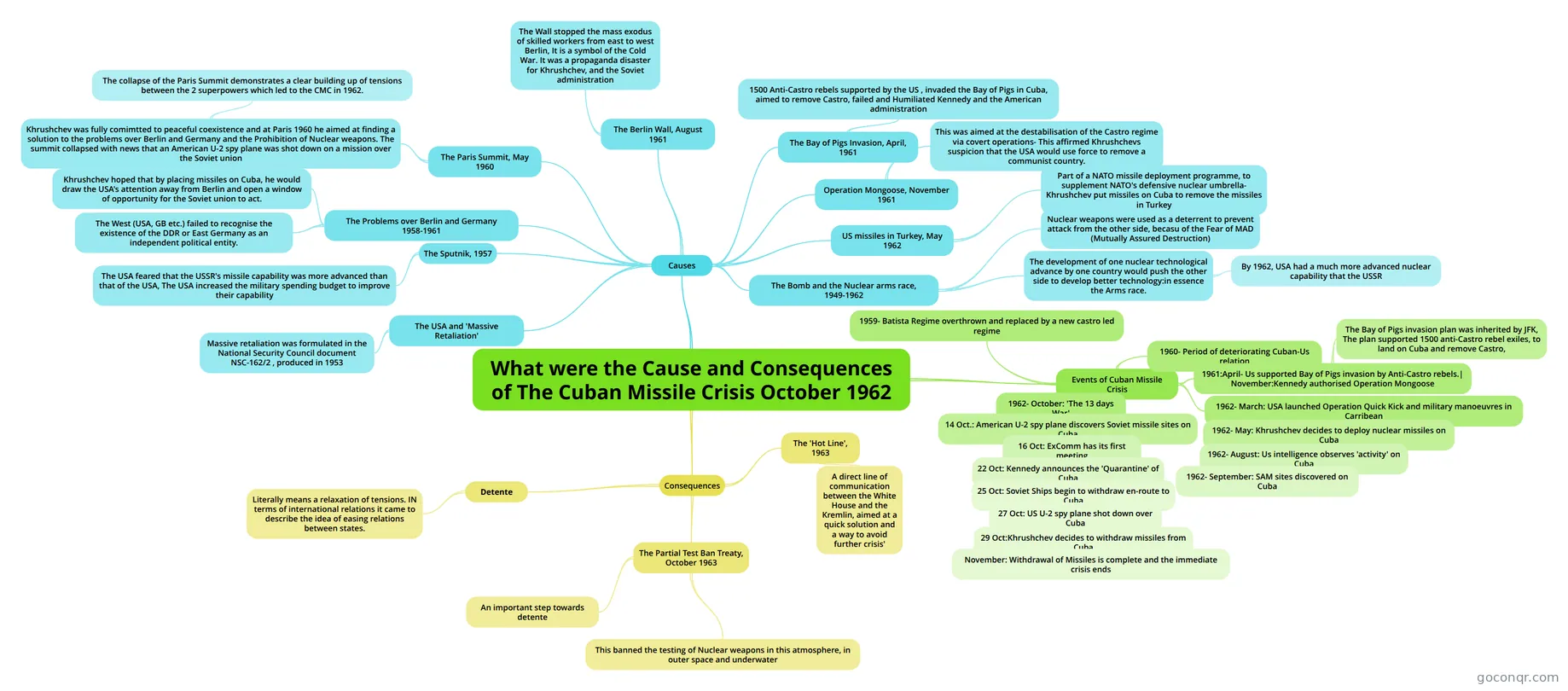
Mind map: Cuban Missile Crisis causes and consequences
Map content
What were the Cause and Consequences of The Cuban Missile Crisis October 1962
Causes
- The Problems over Berlin and Germany 1958-1961
- Khrushchev hoped that by placing missiles on Cuba, he would draw the USA's attention away from Berlin and open a window of opportunity for the Soviet union to act.
- The West (USA, GB etc.) failed to recognise the existence of the DDR or East Germany as an independent political entity.
- The Paris Summit, May 1960
- Khrushchev was fully comimtted to peaceful coexistence and at Paris 1960 he aimed at finding a solution to the problems over Berlin and Germany and the Prohibition of Nuclear weapons. The summit collapsed with news that an American U-2 spy plane was shot down on a mission over the Soviet union
- The collapse of the Paris Summit demonstrates a clear building up of tensions between the 2 superpowers which led to the CMC in 1962.
- Khrushchev was fully comimtted to peaceful coexistence and at Paris 1960 he aimed at finding a solution to the problems over Berlin and Germany and the Prohibition of Nuclear weapons. The summit collapsed with news that an American U-2 spy plane was shot down on a mission over the Soviet union
- The Berlin Wall, August 1961
- The Wall stopped the mass exodus of skilled workers from east to west Berlin, It is a symbol of the Cold War. It was a propaganda disaster for Khrushchev, and the Soviet administration
- The Bomb and the Nuclear arms race, 1949-1962
- The development of one nuclear technological advance by one country would push the other side to develop better technology:in essence the Arms race.
- By 1962, USA had a much more advanced nuclear capability that the USSR
- Nuclear weapons were used as a deterrent to prevent attack from the other side, becasu of the Fear of MAD (Mutually Assured Destruction)
- The development of one nuclear technological advance by one country would push the other side to develop better technology:in essence the Arms race.
- The USA and 'Massive Retaliation'
- Massive retaliation was formulated in the National Security Council document NSC-162/2 , produced in 1953
- The Sputnik, 1957
- The USA feared that the USSR's missile capability was more advanced than that of the USA, The USA increased the military spending budget to improve their capability
- US missiles in Turkey, May 1962
- Part of a NATO missile deployment programme, to supplement NATO's defensive nuclear umbrella- Khrushchev put missiles on Cuba to remove the missiles in Turkey
- The Bay of Pigs Invasion, April, 1961
- 1500 Anti-Castro rebels supported by the US , invaded the Bay of Pigs in Cuba, aimed to remove Castro, failed and Humiliated Kennedy and the American administration
- Operation Mongoose, November 1961
- This was aimed at the destabilisation of the Castro regime via covert operations- This affirmed Khrushchevs suspicion that the USA would use force to remove a communist country.
- The Problems over Berlin and Germany 1958-1961
Consequences
- The 'Hot Line', 1963
- A direct line of communication between the White House and the Kremlin, aimed at a quick solution and a way to avoid further crisis'
- The Partial Test Ban Treaty, October 1963
- This banned the testing of Nuclear weapons in this atmosphere, in outer space and underwater
- An important step towards detente
- Detente
- Literally means a relaxation of tensions. IN terms of international relations it came to describe the idea of easing relations between states.
- The 'Hot Line', 1963
Events of Cuban Missile Crisis
- 1959- Batista Regime overthrown and replaced by a new castro led regime
- 1960- Period of deteriorating Cuban-Us relation
- 1961:April- Us supported Bay of Pigs invasion by Anti-Castro rebels.| November:Kennedy authorised Operation Mongoose
- The Bay of Pigs invasion plan was inherited by JFK, The plan supported 1500 anti-Castro rebel exiles, to land on Cuba and remove Castro,
- 1962- March: USA launched Operation Quick Kick and military manoeuvres in Carribean
- 1962- May: Khrushchev decides to deploy nuclear missiles on Cuba
- 1962- August: Us intelligence observes 'activity' on Cuba
- 1962- September: SAM sites discovered on Cuba
- 1962- August: Us intelligence observes 'activity' on Cuba
- 1962- May: Khrushchev decides to deploy nuclear missiles on Cuba
- 1962- October: 'The 13 days War'
- 14 Oct.: American U-2 spy plane discovers Soviet missile sites on Cuba
- 16 Oct: ExComm has its first meeting
- 22 Oct: Kennedy announces the 'Quarantine' of Cuba
- 25 Oct: Soviet Ships begin to withdraw en-route to Cuba
- 27 Oct: US U-2 spy plane shot down over Cuba
- 29 Oct:Khrushchev decides to withdraw missiles from Cuba
- November: Withdrawal of Missiles is complete and the immediate crisis ends
- 29 Oct:Khrushchev decides to withdraw missiles from Cuba
- 27 Oct: US U-2 spy plane shot down over Cuba
- 25 Oct: Soviet Ships begin to withdraw en-route to Cuba
- 22 Oct: Kennedy announces the 'Quarantine' of Cuba
- 16 Oct: ExComm has its first meeting
- 14 Oct.: American U-2 spy plane discovers Soviet missile sites on Cuba
Information
- Description
- A-Levels History Mind Map on What were the Cause and Consequences of The Cuban Missile Crisis October 1962, created by matthewnr73 on 25/05/2013.
- Created by
- matthewnr73
- Views
- 4,894
- Tags
- Rating