
Mind map
First Civil War (1642 - 1646)
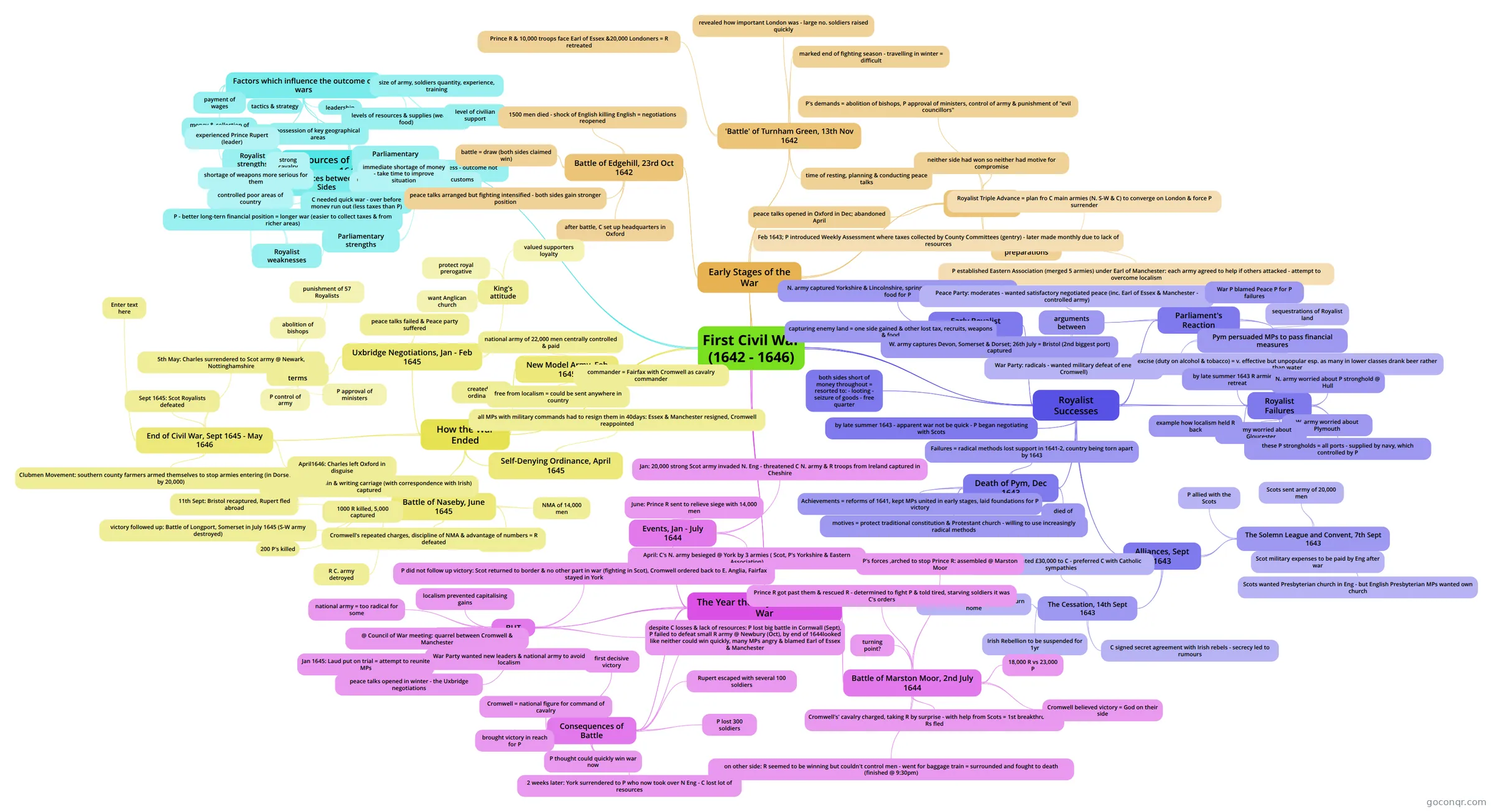
Mind map: First Civil War 1642-1646
Map content
First Civil War (1642 - 1646)
Resources of Two Sides in 1642
- Factors which influence the outcome of wars
- leadership
- levels of resources & supplies (weapons, food)
- payment of wages
- size of army, soldiers quantity, experience, training
- tactics & strategy
- level of civilian support
- propaganda
- possession of key geographical areas
- money & collection of taxes
- Differences between the Sides
- both sides = strengths & weakness - outcome not inevitable
- Royalist strengths
- immediate money
- strong cavalry
- experienced Prince Rupert (leader)
- Royalist weaknesses
- controlled poor areas of country
- shortage of weapons more serious for them
- Parliamentary strengths
- controlled London & ports (collect customs duties)
- controlled navy (prevent help from abroad)
- Parliamentary weaknesses
- immediate shortage of money - take time to improve situation
- C needed quick war - over before money run out (less taxes than P)
- P - better long-tern financial position = longer war (easier to collect taxes & from richer areas)
- Factors which influence the outcome of wars
Early Stages of the War
- Battle of Edgehill, 23rd Oct 1642
- battle = draw (both sides claimed win)
- 1500 men died - shock of English killing English = negotiations reopened
- after battle, C set up headquarters in Oxford
- peace talks arranged but fighting intensified - both sides gain stronger position
- 'Battle' of Turnham Green, 13th Nov 1642
- Prince R & 10,000 troops face Earl of Essex &20,000 Londoners = R retreated
- revealed how important London was - large no. soldiers raised quickly
- marked end of fighting season - travelling in winter = difficult
- time of resting, planning & conducting peace talks
- Winter of 1642-1643
- peace talks opened in Oxford in Dec; abandoned April
- P's demands = abolition of bishops, P approval of ministers, control of army & punishment of "evil councillors"
- neither side had won so neither had motive for compromise
- military preparations
- Royalist Triple Advance = plan fro C main armies (N. S-W & C) to converge on London & force P surrender
- P established Eastern Association (merged 5 armies) under Earl of Manchester: each army agreed to help if others attacked - attempt to overcome localism
- Feb 1643; P introduced Weekly Assessment where taxes collected by County Committees (gentry) - later made monthly due to lack of resources
- Battle of Edgehill, 23rd Oct 1642
Royalist Successes
- Early Royalist Successes
- N. army captured Yorkshire & Lincolnshire, spring 1643 - E. Anglia next = provided food for P
- capturing enemy land = one side gained & other lost tax, recruits, weapons & food
- W. army captures Devon, Somerset & Dorset; 26th July = Bristol (2nd biggest port) captured
- Parliament's Reaction
- arguments between
- Peace Party: moderates - wanted satisfactory negotiated peace (inc. Earl of Essex & Manchester - controlled army)
- War Party: radicals - wanted military defeat of enemy (inc. Cromwell)
- War P blamed Peace P for P failures
- Pym persuaded MPs to pass financial measures
- sequestrations of Royalist land
- forced loan
- excise (duty on alcohol & tobacco) = v. effective but unpopular esp. as many in lower classes drank beer rather than water
- arguments between
- Royalist Failures
- by late summer 1643 R armies in retreat
- N. army worried about P stronghold @ Hull
- W. army worried about Plymouth
- C. army worried about Gloucester
- example how localism held R back
- these P strongholds = all ports - supplied by navy, which controlled by P
- Alliances, Sept 1643
- The Solemn League and Convent, 7th Sept 1643
- P allied with the Scots
- Scots sent army of 20,000 men
- Scots wanted Presbyterian church in Eng - but English Presbyterian MPs wanted own church
- Scot military expenses to be paid by Eng after war
- The Cessation, 14th Sept 1643
- C signed secret agreement with Irish rebels - secrecy led to rumours
- Irish Rebellion to be suspended for 1yr
- Irish rebels granted £30,000 to C - preferred C with Catholic sympathies
- English troops in Ireland could return home
- The Solemn League and Convent, 7th Sept 1643
- Death of Pym, Dec 1643
- died of cancer
- motives = protect traditional constitution & Protestant church - willing to use increasingly radical methods
- Achievements = reforms of 1641, kept MPs united in early stages, laid foundations for P victory
- Failures = radical methods lost support in 1641-2, country being torn apart by 1643
- both sides short of money throughout = resorted to: - looting - seizure of goods - free quarter
- by late summer 1643 - apparent war not be quick - P began negotiating with Scots
- Early Royalist Successes
The Year the Royalists Lost the War
- Events, Jan - July 1644
- Jan: 20,000 strong Scot army invaded N. Eng - threatened C N. army & R troops from Ireland captured in Cheshire
- April: C's N. army besieged @ York by 3 armies ( Scot, P's Yorkshire & Eastern Association)
- June: Prince R sent to relieve siege with 14,000 men
- Battle of Marston Moor, 2nd July 1644
- turning point?
- P's forces ,arched to stop Prince R: assembled @ Marston Moor
- Prince R got past them & rescued R - determined to fight P & told tired, starving soldiers it was C's orders
- 18,000 R vs 23,000 P
- Cromwell's' cavalry charged, taking R by surprise - with help from Scots = 1st breakthrough & Rs fled
- on other side: R seemed to be winning but couldn't control men - went for baggage train = surrounded and fought to death (finished @ 9:30pm)
- Cromwell believed victory = God on their side
- Consequences of Battle
- 1000 R dead, 15000 captured, N. army destroyed
- Rupert escaped with several 100 soldiers
- P lost 300 soldiers
- 2 weeks later: York surrendered to P who now took over N Eng - C lost lot of resources
- brought victory in reach for P
- Cromwell = national figure for command of cavalry
- first decisive victory
- P thought could quickly win war now
- BUT
- P did not follow up victory: Scot returned to border & no other part in war (fighting in Scot), Cromwell ordered back to E. Anglia, Fairfax stayed in York
- localism prevented capitalising gains
- despite C losses & lack of resources: P lost big battle in Cornwall (Sept), P failed to defeat small R army @ Newbury (Oct), by end of 1644looked like neither could win quickly, many MPs angry & blamed Earl of Essex & Manchester
- War Party wanted new leaders & national army to avoid localism
- @ Council of War meeting: quarrel between Cromwell & Manchester
- national army = too radical for some
- peace talks opened in winter - the Uxbridge negotiations
- Jan 1645: Laud put on trial = attempt to reunite MPs
- Events, Jan - July 1644
How the War Ended
- Uxbridge Negotiations, Jan - Feb 1645
- peace talks failed & Peace party suffered
- Parliament's terms
- abolition of bishops
- P approval of ministers
- P control of army
- punishment of 57 Royalists
- King's attitude
- want Anglican church
- protect royal prerogative
- valued supporters loyalty
- New Model Army, Feb 1645
- created by ordinance
- national army of 22,000 men centrally controlled & paid
- free from localism = could be sent anywhere in country
- commander = Fairfax with Cromwell as cavalry commander
- Self-Denying Ordinance, April 1645
- all MPs with military commands had to resign them in 40days: Essex & Manchester resigned, Cromwell reappointed
- Battle of Naseby, June 1645
- NMA of 14,000 men
- R army of 7500 men
- Cromwell's repeated charges, discipline of NMA & advantage of numbers = R defeated
- 1000 R killed, 5,000 captured
- R cannon, baggage train & writing carriage (with correspondence with Irish) captured
- 200 P's killed
- R C. army detroyed
- victory followed up: Battle of Longport, Somerset in July 1645 (S-W army destroyed)
- 11th Sept: Bristol recaptured, Rupert fled abroad
- End of Civil War, Sept 1645 - May 1646
- Sept 1645: Scot Royalists defeated
- Clubmen Movement: southern county farmers armed themselves to stop armies entering (in Dorset, supported by 20,000)
- April1646: Charles left Oxford in disguise
- 5th May: Charles surrendered to Scot army @ Newark, Nottinghamshire
- Enter text here
- Uxbridge Negotiations, Jan - Feb 1645
Information
- Description
- (History) Mind Map on First Civil War (1642 - 1646), created by stacie.carter on 30/05/2013.
- Created by
- stacie.carter
- Views
- 108
- Tags
- Rating