
Mind map
Recognition
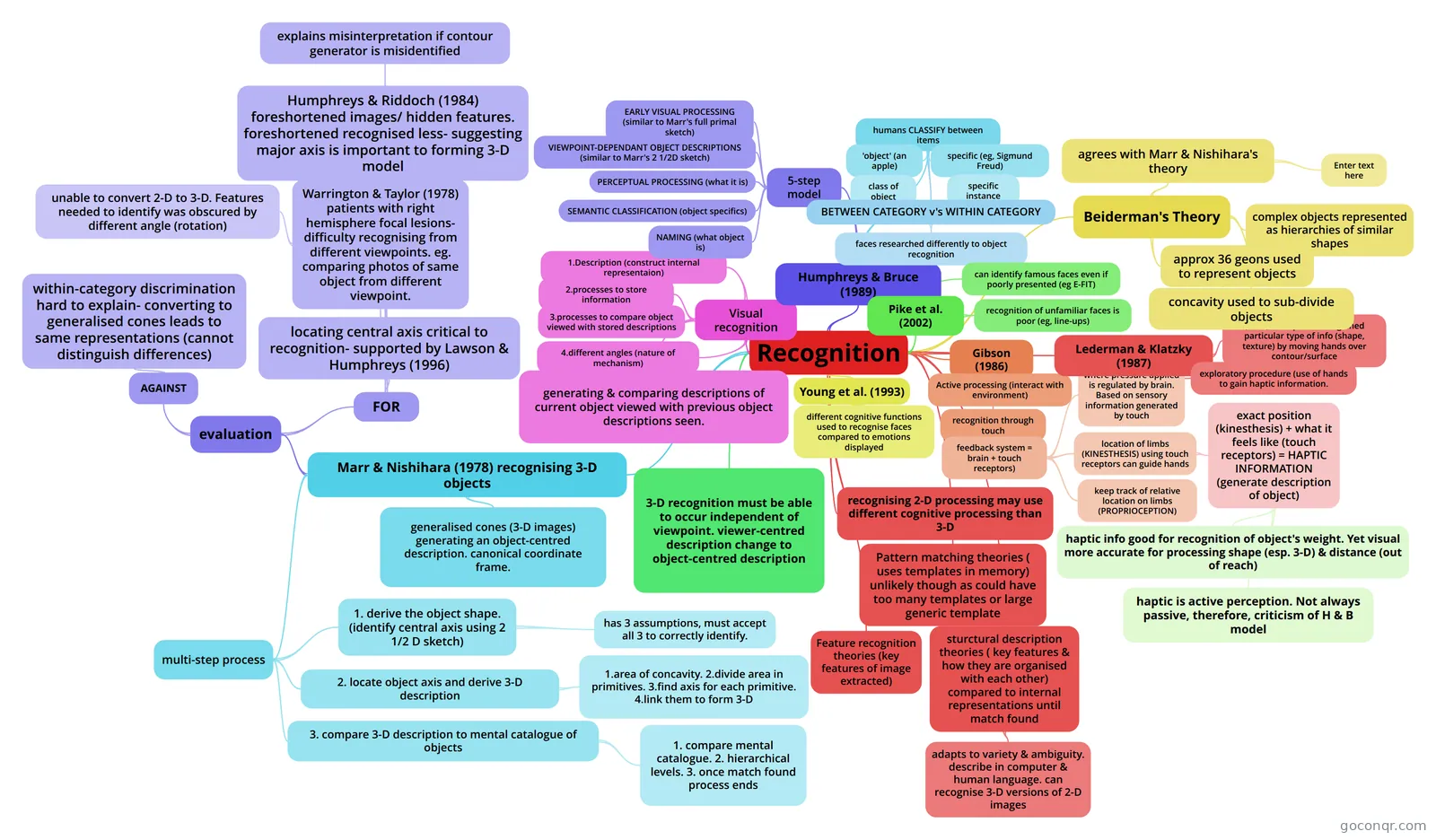
Mind map: Recognition in cognitive psychology
Map content
Recognition
Visual recognition
- 1.Description (construct internal representaion)
- 2.processes to store information
- 3.processes to compare object viewed with stored descriptions
- 4.different angles (nature of mechanism)
- generating & comparing descriptions of current object viewed with previous object descriptions seen.
Humphreys & Bruce (1989)
- 5-step model
- PERCEPTUAL PROCESSING (what it is)
- SEMANTIC CLASSIFICATION (object specifics)
- NAMING (what object is)
- VIEWPOINT-DEPENDANT OBJECT DESCRIPTIONS (similar to Marr's 2 1/2D sketch)
- EARLY VISUAL PROCESSING (similar to Marr's full primal sketch)
- humans CLASSIFY between items
- 'object' (an apple)
- class of object
- specific (eg, Sigmund Freud)
- specific instance
- BETWEEN CATEGORY v's WITHIN CATEGORY
- faces researched differently to object recognition
- 'object' (an apple)
- 5-step model
Pike et al. (2002)
- can identify famous faces even if poorly presented (eg E-FIT)
- recognition of unfamiliar faces is poor (eg, line-ups)
Young et al. (1993)
- different cognitive functions used to recognise faces compared to emotions displayed
Gibson (1986)
- Active processing (interact with environment)
- recognition through touch
- feedback system = brain + touch receptors)
- where pressure applied is regulated by brain. Based on sensory information generated by touch
- location of limbs (KINESTHESIS) using touch receptors can guide hands
- exact position (kinesthesis) + what it feels like (touch receptors) = HAPTIC INFORMATION (generate description of object)
- haptic info good for recognition of object's weight. Yet visual more accurate for processing shape (esp. 3-D) & distance (out of reach)
- haptic is active perception. Not always passive, therefore, criticism of H & B model
- exact position (kinesthesis) + what it feels like (touch receptors) = HAPTIC INFORMATION (generate description of object)
- keep track of relative location on limbs (PROPRIOCEPTION)
- feedback system = brain + touch receptors)
Lederman & Klatzky (1987)
- exploratory procedure (use of hands to gain haptic information.
- (1990) each procedure gained particular type of info (shape, texture) by moving hands over contour/surface
recognising 2-D processing may use different cognitive processing than 3-D
Marr & Nishihara (1978) recognising 3-D objects
- generalised cones (3-D images) generating an object-centred description. canonical coordinate frame.
- multi-step process
- 1. derive the object shape. (identify central axis using 2 1/2 D sketch)
- has 3 assumptions, must accept all 3 to correctly identify.
- 2. locate object axis and derive 3-D description
- 1.area of concavity. 2.divide area in primitives. 3.find axis for each primitive. 4.link them to form 3-D
- 3. compare 3-D description to mental catalogue of objects
- 1. compare mental catalogue. 2. hierarchical levels. 3. once match found process ends
- 1. derive the object shape. (identify central axis using 2 1/2 D sketch)
- evaluation
- FOR
- locating central axis critical to recognition- supported by Lawson & Humphreys (1996)
- Warrington & Taylor (1978) patients with right hemisphere focal lesions- difficulty recognising from different viewpoints. eg. comparing photos of same object from different viewpoint.
- unable to convert 2-D to 3-D. Features needed to identify was obscured by different angle (rotation)
- Humphreys & Riddoch (1984) foreshortened images/ hidden features. foreshortened recognised less- suggesting major axis is important to forming 3-D model
- explains misinterpretation if contour generator is misidentified
- AGAINST
- within-category discrimination hard to explain- converting to generalised cones leads to same representations (cannot distinguish differences)
- FOR
Pattern matching theories ( uses templates in memory) unlikely though as could have too many templates or large generic template
Feature recognition theories (key features of image extracted)
sturctural description theories ( key features & how they are organised with each other) compared to internal representations until match found
- adapts to variety & ambiguity. describe in computer & human language. can recognise 3-D versions of 2-D images
3-D recognition must be able to occur independent of viewpoint. viewer-centred description change to object-centred description
Beiderman's Theory
- agrees with Marr & Nishihara's theory
- Enter text here
- complex objects represented as hierarchies of similar shapes
- approx 36 geons used to represent objects
- concavity used to sub-divide objects
- agrees with Marr & Nishihara's theory