
Mind map
Bacteria
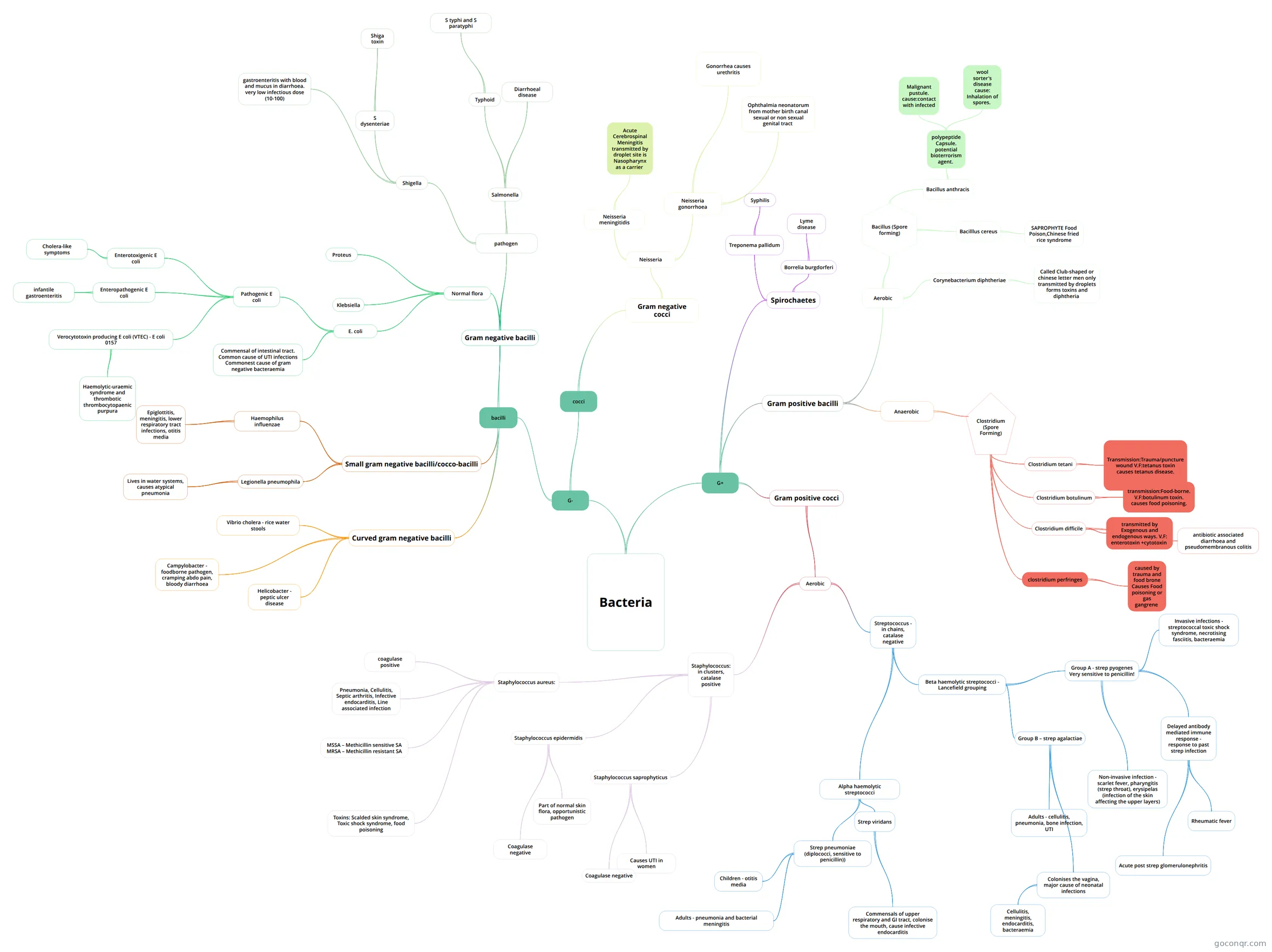
Mind map: Bacteria
Map content
Bacteria
G-
- bacilli
- Gram negative bacilli
- pathogen
- Shigella
- gastroenteritis with blood and mucus in diarrhoea. very low infectious dose (10-100)
- S dysenteriae
- Shiga toxin
- Salmonella
- Diarrhoeal disease
- Typhoid
- S typhi and S paratyphi
- Shigella
- Normal flora
- E. coli
- Commensal of intestinal tract. Common cause of UTI infections Commonest cause of gram negative bacteraemia
- Pathogenic E coli
- Enterotoxigenic E coli
- Cholera-like symptoms
- Enteropathogenic E coli
- infantile gastroenteritis
- Verocytotoxin producing E coli (VTEC) - E coli 0157
- Haemolytic-uraemic syndrome and thrombotic thrombocytopaenic purpura
- Enterotoxigenic E coli
- Klebsiella
- Proteus
- E. coli
- pathogen
- Small gram negative bacilli/cocco-bacilli
- Haemophilus influenzae
- Epiglottitis, meningitis, lower respiratory tract infections, otitis media
- Legionella pneumophila
- Lives in water systems, causes atypical pneumonia
- Haemophilus influenzae
- Curved gram negative bacilli
- Campylobacter - foodborne pathogen, cramping abdo pain, bloody diarrhoea
- Helicobacter - peptic ulcer disease
- Vibrio cholera - rice water stools
- Gram negative bacilli
- cocci
- Gram negative cocci
- Neisseria
- Neisseria meningitidis
- Acute Cerebrospinal Meningitis transmitted by droplet site is Nasopharynx as a carrier
- Neisseria gonorrhoea
- Gonorrhea causes urethritis
- Ophthalmia neonatorum from mother birth canal sexual or non sexual genital tract
- Neisseria meningitidis
- Neisseria
- Gram negative cocci
- bacilli
G+
- Gram positive cocci
- Aerobic
- Staphylococcus: in clusters, catalase positive
- Staphylococcus aureus:
- Pneumonia, Cellulitis, Septic arthritis, Infective endocarditis, Line associated infection
- MSSA – Methicillin sensitive SA MRSA – Methicillin resistant SA
- Toxins: Scalded skin syndrome, Toxic shock syndrome, food poisoning
- coagulase positive
- Staphylococcus epidermidis
- Coagulase negative
- Part of normal skin flora, opportunistic pathogen
- Staphylococcus saprophyticus
- Causes UTI in women
- Coagulase negative
- Staphylococcus aureus:
- Streptococcus - in chains, catalase negative
- Beta haemolytic streptococci - Lancefield grouping
- Group A - strep pyogenes Very sensitive to penicillin!
- Non-invasive infection - scarlet fever, pharyngitis (strep throat), erysipelas (infection of the skin affecting the upper layers)
- Invasive infections - streptococcal toxic shock syndrome, necrotising fasciitis, bacteraemia
- Delayed antibody mediated immune response - response to past strep infection
- Rheumatic fever
- Acute post strep glomerulonephritis
- Group B – strep agalactiae
- Colonises the vagina, major cause of neonatal infections
- Cellulitis, meningitis, endocarditis, bacteraemia
- Adults - cellulitis, pneumonia, bone infection, UTI
- Colonises the vagina, major cause of neonatal infections
- Group A - strep pyogenes Very sensitive to penicillin!
- Alpha haemolytic streptococci
- Strep pneumoniae (diplococci, sensitive to penicillin))
- Adults - pneumonia and bacterial meningitis
- Children - otitis media
- Strep viridans
- Commensals of upper respiratory and GI tract, colonise the mouth, cause infective endocarditis
- Strep pneumoniae (diplococci, sensitive to penicillin))
- Beta haemolytic streptococci - Lancefield grouping
- Staphylococcus: in clusters, catalase positive
- Aerobic
- Gram positive bacilli
- Aerobic
- Bacillus (Spore forming)
- Bacillus anthracis
- polypeptide Capsule. potential bioterrorism agent.
- Malignant pustule. cause:contact with infected
- wool sorter's disease cause: Inhalation of spores.
- polypeptide Capsule. potential bioterrorism agent.
- Malignant pustule. cause:contact with infected
- wool sorter's disease cause: Inhalation of spores.
- polypeptide Capsule. potential bioterrorism agent.
- Bacilllus cereus
- SAPROPHYTE Food Poison,Chinese fried rice syndrome
- Bacillus anthracis
- Corynebacterium diphtheriae
- Called Club-shaped or chinese letter men only transmitted by droplets forms toxins and diphtheria
- Bacillus (Spore forming)
- Anaerobic
- Clostridium (Spore Forming)
- Clostridium botulinum
- transmission:Food-borne. V.F:botulinum toxin. causes food poisoning.
- transmission:Food-borne. V.F:botulinum toxin. causes food poisoning.
- Clostridium tetani
- Transmission:Trauma/puncture wound V.F:tetanus toxin causes tetanus disease.
- Transmission:Trauma/puncture wound V.F:tetanus toxin causes tetanus disease.
- Clostridium difficile
- antibiotic associated diarrhoea and pseudomembranous colitis
- transmitted by Exogenous and endogenous ways. V.F: enterotoxin +cytotoxin
- transmitted by Exogenous and endogenous ways. V.F: enterotoxin +cytotoxin
- clostridium perfringes
- caused by trauma and food brone Causes Food poisoning or gas gangrene
- clostridium perfringes
- caused by trauma and food brone Causes Food poisoning or gas gangrene
- Clostridium botulinum
- Clostridium (Spore Forming)
- Aerobic
- Spirochaetes
- Treponema pallidum
- Syphilis
- Borrelia burgdorferi
- Lyme disease
- Treponema pallidum
- Gram positive cocci
Information
- Description
- Classification of bacteria according to gram stain and shape
- Created by
- Lamees Sheikh
- Views
- 1
- Tags
- History
-
- Created by Merike Mikkov · Dec 1, 2016
- Copied by Lamees Sheikh · Mar 15, 2019
- Rating