
Mind map
Endocrine Glands
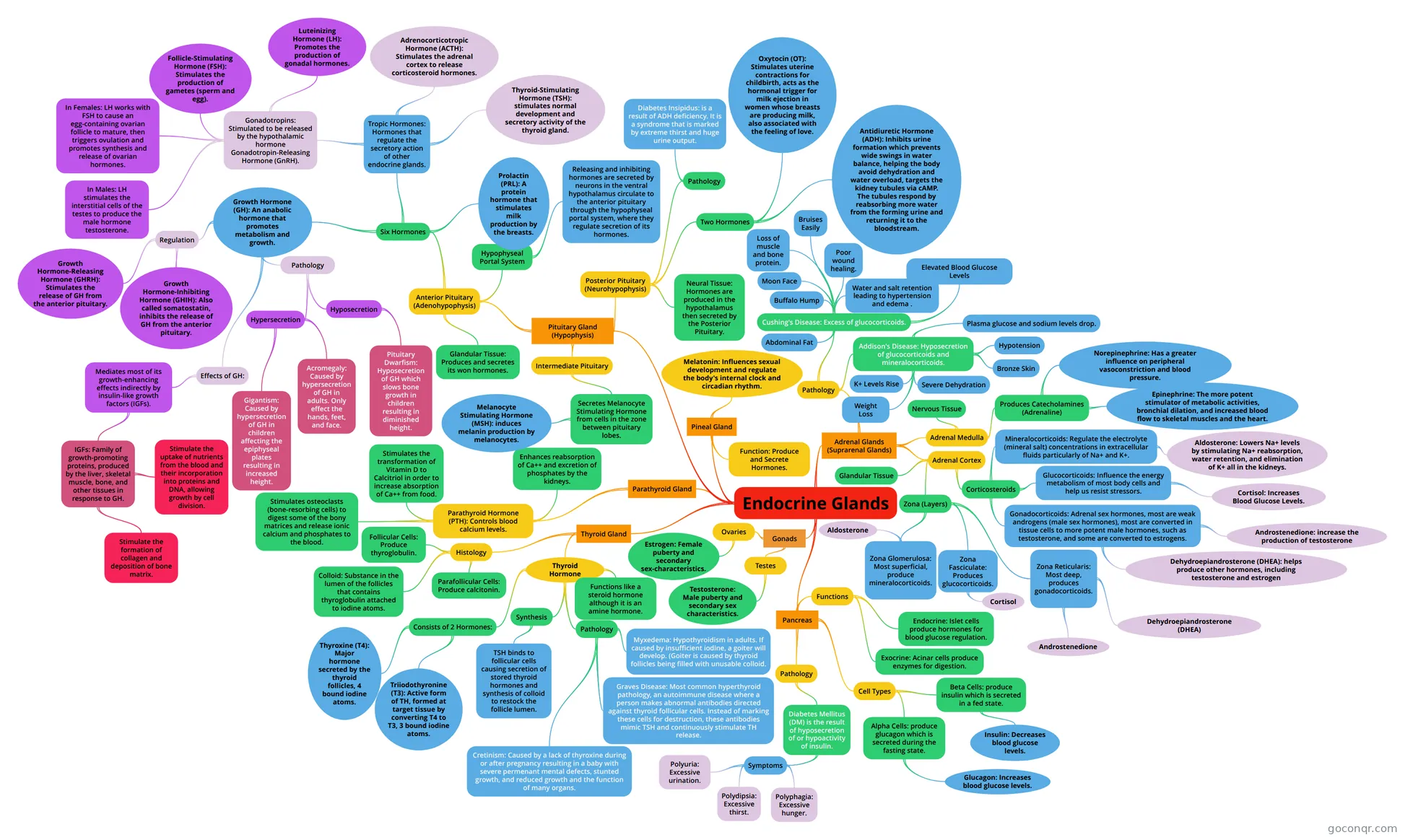
Mind map: Endocrine glands
Map content
Endocrine Glands
Pituitary Gland (Hypophysis)
- Anterior Pituitary (Adenohypophysis)
- Hypophyseal Portal System
- Releasing and inhibiting hormones are secreted by neurons in the ventral hypothalamus circulate to the anterior pituitary through the hypophyseal portal system, where they regulate secretion of its hormones.
- Six Hormones
- Tropic Hormones: Hormones that regulate the secretory action of other endocrine glands.
- Gonadotropins: Stimulated to be released by the hypothalamic hormone Gonadotropin-Releasing Hormone (GnRH).
- Luteinizing Hormone (LH): Promotes the production of gonadal hormones.
- Follicle-Stimulating Hormone (FSH): Stimulates the production of gametes (sperm and egg).
- In Females: LH works with FSH to cause an egg-containing ovarian follicle to mature, then triggers ovulation and promotes synthesis and release of ovarian hormones.
- In Males: LH stimulates the interstitial cells of the testes to produce the male hormone testosterone.
- Adrenocorticotropic Hormone (ACTH): Stimulates the adrenal cortex to release corticosteroid hormones.
- Thyroid-Stimulating Hormone (TSH): stimulates normal development and secretory activity of the thyroid gland.
- Gonadotropins: Stimulated to be released by the hypothalamic hormone Gonadotropin-Releasing Hormone (GnRH).
- Growth Hormone (GH): An anabolic hormone that promotes metabolism and growth.
- Regulation
- Growth Hormone-Releasing Hormone (GHRH): Stimulates the release of GH from the anterior pituitary.
- Growth Hormone-Inhibiting Hormone (GHIH): Also called somatostatin, inhibits the release of GH from the anterior pituitary.
- Pathology
- Hypersecretion
- Gigantism: Caused by hypersecretion of GH in children affecting the epiphyseal plates resulting in increased height.
- Acromegaly: Caused by hypersecretion of GH in adults. Only effect the hands, feet, and face.
- Hyposecretion
- Pituitary Dwarfism: Hyposecretion of GH which slows bone growth in children resulting in diminished height.
- Hypersecretion
- Effects of GH:
- Mediates most of its growth-enhancing effects indirectly by insulin-like growth factors (IGFs).
- IGFs: Family of growth-promoting proteins, produced by the liver, skeletal muscle, bone, and other tissues in response to GH.
- Stimulate the uptake of nutrients from the blood and their incorporation into proteins and DNA, allowing growth by cell division.
- Stimulate the formation of collagen and deposition of bone matrix.
- IGFs: Family of growth-promoting proteins, produced by the liver, skeletal muscle, bone, and other tissues in response to GH.
- Mediates most of its growth-enhancing effects indirectly by insulin-like growth factors (IGFs).
- Regulation
- Prolactin (PRL): A protein hormone that stimulates milk production by the breasts.
- Tropic Hormones: Hormones that regulate the secretory action of other endocrine glands.
- Glandular Tissue: Produces and secretes its won hormones.
- Hypophyseal Portal System
- Intermediate Pituitary
- Secretes Melanocyte Stimulating Hormone from cells in the zone between pituitary lobes.
- Melanocyte Stimulating Hormone (MSH): induces melanin production by melanocytes.
- Secretes Melanocyte Stimulating Hormone from cells in the zone between pituitary lobes.
- Posterior Pituitary (Neurohypophysis)
- Pathology
- Diabetes Insipidus: is a result of ADH deficiency. It is a syndrome that is marked by extreme thirst and huge urine output.
- Two Hormones
- Oxytocin (OT): Stimulates uterine contractions for childbirth, acts as the hormonal trigger for milk ejection in women whose breasts are producing milk, also associated with the feeling of love.
- Antidiuretic Hormone (ADH): Inhibits urine formation which prevents wide swings in water balance, helping the body avoid dehydration and water overload, targets the kidney tubules via cAMP. The tubules respond by reabsorbing more water from the forming urine and returning it to the bloodstream.
- Neural Tissue: Hormones are produced in the hypothalamus then secreted by the Posterior Pituitary.
- Pathology
- Anterior Pituitary (Adenohypophysis)
Parathyroid Gland
- Parathyroid Hormone (PTH): Controls blood calcium levels.
- Stimulates osteoclasts (bone-resorbing cells) to digest some of the bony matrices and release ionic calcium and phosphates to the blood.
- Enhances reabsorption of Ca++ and excretion of phosphates by the kidneys.
- Stimulates the transformation of Vitamin D to Calcitriol in order to increase absorption of Ca++ from food.
- Parathyroid Hormone (PTH): Controls blood calcium levels.
Thyroid Gland
- Histology
- Follicular Cells: Produce thyroglobulin.
- Parafollicular Cells: Produce calcitonin.
- Colloid: Substance in the lumen of the follicles that contains thyroglobulin attached to iodine atoms.
- Thyroid Hormone
- Consists of 2 Hormones:
- Thyroxine (T4): Major hormone secreted by the thyroid follicles, 4 bound iodine atoms.
- Triiodothyronine (T3): Active form of TH, formed at target tissue by converting T4 to T3, 3 bound iodine atoms.
- Synthesis
- TSH binds to follicular cells causing secretion of stored thyroid hormones and synthesis of colloid to restock the follicle lumen.
- Functions like a steroid hormone although it is an amine hormone.
- Pathology
- Myxedema: Hypothyroidism in adults. If caused by insufficient iodine, a goiter will develop. (Goiter is caused by thyroid follicles being filled with unusable colloid.
- Graves Disease: Most common hyperthyroid pathology, an autoimmune disease where a person makes abnormal antibodies directed against thyroid follicular cells. Instead of marking these cells for destruction, these antibodies mimic TSH and continuously stimulate TH release.
- Cretinism: Caused by a lack of thyroxine during or after pregnancy resulting in a baby with severe permenant mental defects, stunted growth, and reduced growth and the function of many organs.
- Consists of 2 Hormones:
- Histology
Pancreas
- Pathology
- Diabetes Mellitus (DM) is the result of hyposecretion of or hypoactivity of insulin.
- Symptoms
- Polyuria: Excessive urination.
- Polydipsia: Excessive thirst.
- Polyphagia: Excessive hunger.
- Symptoms
- Diabetes Mellitus (DM) is the result of hyposecretion of or hypoactivity of insulin.
- Functions
- Endocrine: Islet cells produce hormones for blood glucose regulation.
- Exocrine: Acinar cells produce enzymes for digestion.
- Cell Types
- Alpha Cells: produce glucagon which is secreted during the fasting state.
- Glucagon: Increases blood glucose levels.
- Beta Cells: produce insulin which is secreted in a fed state.
- Insulin: Decreases blood glucose levels.
- Alpha Cells: produce glucagon which is secreted during the fasting state.
- Pathology
Adrenal Glands (Suprarenal Glands)
- Pathology
- Cushing's Disease: Excess of glucocorticoids.
- Elevated Blood Glucose Levels
- Loss of muscle and bone protein.
- Moon Face
- Buffalo Hump
- Abdominal Fat
- Water and salt retention leading to hypertension and edema .
- Bruises Easily
- Poor wound healing.
- Addison's Disease: Hyposecretion of glucocorticoids and mineralocorticoids.
- Hypotension
- Plasma glucose and sodium levels drop.
- K+ Levels Rise
- Severe Dehydration
- Weight Loss
- Bronze Skin
- Cushing's Disease: Excess of glucocorticoids.
- Adrenal Medulla
- Nervous Tissue
- Produces Catecholamines (Adrenaline)
- Epinephrine: The more potent stimulator of metabolic activities, bronchial dilation, and increased blood flow to skeletal muscles and the heart.
- Norepinephrine: Has a greater influence on peripheral vasoconstriction and blood pressure.
- Adrenal Cortex
- Corticosteroids
- Mineralocorticoids: Regulate the electrolyte (mineral salt) concentrations in extracellular fluids particularly of Na+ and K+.
- Aldosterone: Lowers Na+ levels by stimulating Na+ reabsorption, water retention, and elimination of K+ all in the kidneys.
- Glucocorticoids: Influence the energy metabolism of most body cells and help us resist stressors.
- Cortisol: Increases Blood Glucose Levels.
- Gonadocorticoids: Adrenal sex hormones, most are weak androgens (male sex hormones), most are converted in tissue cells to more potent male hormones, such as testosterone, and some are converted to estrogens.
- Androstenedione: increase the production of testosterone
- Dehydroepiandrosterone (DHEA): helps produce other hormones, including testosterone and estrogen
- Mineralocorticoids: Regulate the electrolyte (mineral salt) concentrations in extracellular fluids particularly of Na+ and K+.
- Glandular Tissue
- Zona (Layers)
- Zona Glomerulosa: Most superficial, produce mineralocorticoids.
- Aldosterone
- Zona Fasciculate: Produces glucocorticoids.
- Cortisol
- Zona Reticularis: Most deep, produces gonadocorticoids.
- Dehydroepiandrosterone (DHEA)
- Androstenedione
- Zona Glomerulosa: Most superficial, produce mineralocorticoids.
- Corticosteroids
- Pathology
Pineal Gland
- Function: Produce and Secrete Hormones.
- Melatonin: Influences sexual development and regulate the body's internal clock and circadian rhythm.
Gonads
- Ovaries
- Estrogen: Female puberty and secondary sex-characteristics.
- Testes
- Testosterone: Male puberty and secondary sex characteristics.
- Ovaries
Information
- Description
- Anatomy and Physiology Mind Map on Endocrine Glands, created by Brianna Craver on 11/09/2019.
- Created by
- Brianna Craver
- Views
- 19
- Rating