
Mind map
Chapter 11
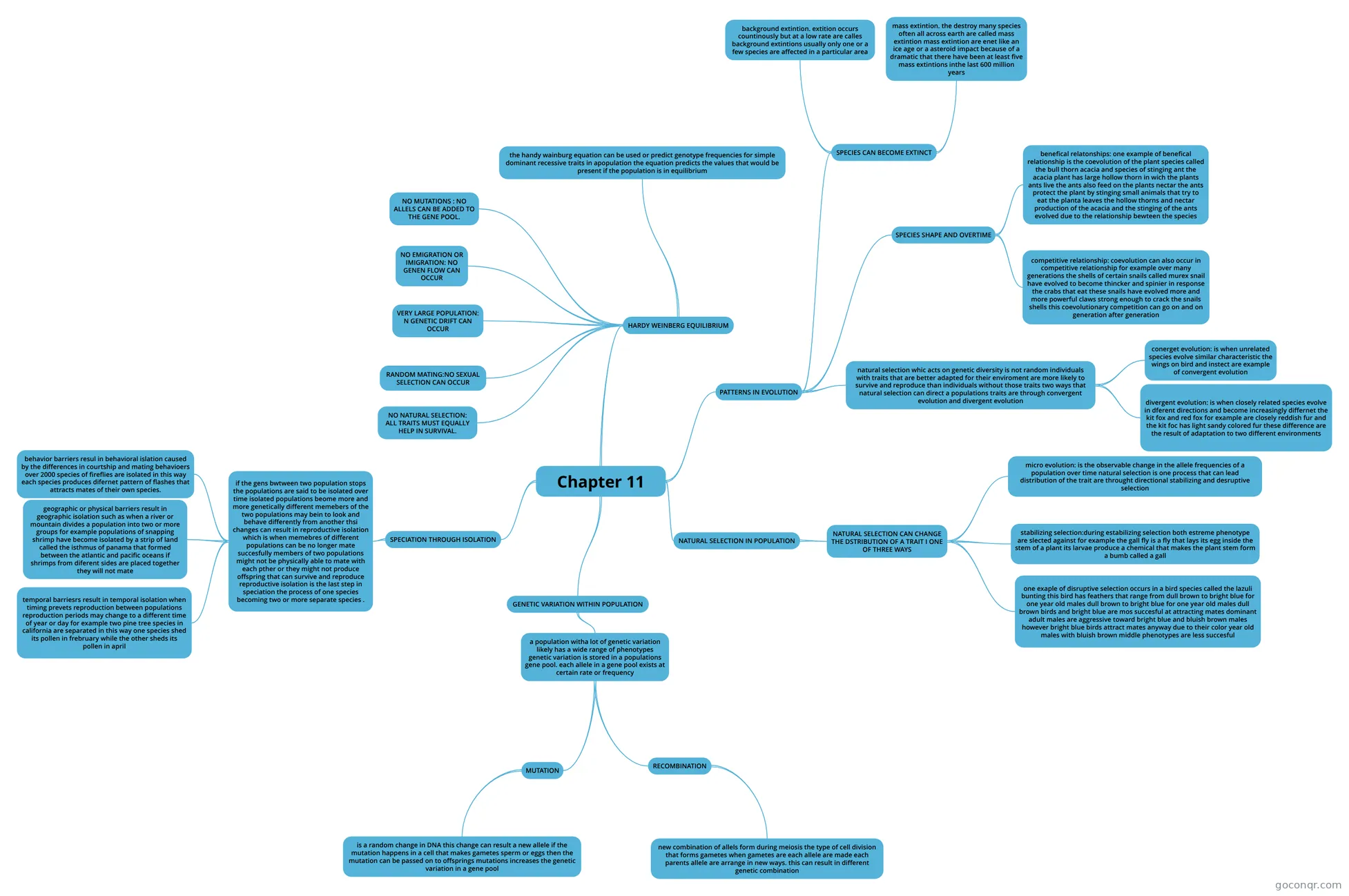
Mind map: Chapter 11 evolution of populations
Map content
Chapter 11
GENETIC VARIATION WITHIN POPULATION
- a population witha lot of genetic variation likely has a wide range of phenotypes genetic variation is stored in a populations gene pool. each allele in a gene pool exists at certain rate or frequency
- MUTATION
- is a random change in DNA this change can result a new allele if the mutation happens in a cell that makes gametes sperm or eggs then the mutation can be passed on to offsprings mutations increases the genetic variation in a gene pool
- RECOMBINATION
- new combination of allels form during meiosis the type of cell division that forms gametes when gametes are each allele are made each parents allele are arrange in new ways. this can result in different genetic combination
- MUTATION
- a population witha lot of genetic variation likely has a wide range of phenotypes genetic variation is stored in a populations gene pool. each allele in a gene pool exists at certain rate or frequency
NATURAL SELECTION IN POPULATION
- NATURAL SELECTION CAN CHANGE THE DSTRIBUTION OF A TRAIT I ONE OF THREE WAYS
- micro evolution: is the observable change in the allele frequencies of a population over time natural selection is one process that can lead distribution of the trait are throught directional stabilizing and desruptive selection
- stabilizing selection:during estabilizing selection both estreme phenotype are slected against for example the gall fly is a fly that lays its egg inside the stem of a plant its larvae produce a chemical that makes the plant stem form a bumb called a gall
- one exaple of disruptive selection occurs in a bird species called the lazuli bunting this bird has feathers that range from dull brown to bright blue for one year old males dull brown to bright blue for one year old males dull brown birds and bright blue are mos succesful at attracting mates dominant adult males are aggressive toward bright blue and bluish brown males however bright blue birds attract mates anyway due to their color year old males with bluish brown middle phenotypes are less succesful
- NATURAL SELECTION CAN CHANGE THE DSTRIBUTION OF A TRAIT I ONE OF THREE WAYS
HARDY WEINBERG EQUILIBRIUM
- VERY LARGE POPULATION: N GENETIC DRIFT CAN OCCUR
- NO EMIGRATION OR IMIGRATION: NO GENEN FLOW CAN OCCUR
- NO MUTATIONS : NO ALLELS CAN BE ADDED TO THE GENE POOL.
- RANDOM MATING:NO SEXUAL SELECTION CAN OCCUR
- NO NATURAL SELECTION: ALL TRAITS MUST EQUALLY HELP IN SURVIVAL.
- the handy wainburg equation can be used or predict genotype frequencies for simple dominant recessive traits in apopulation the equation predicts the values that would be present if the population is in equilibrium
SPECIATION THROUGH ISOLATION
- if the gens bwtween two population stops the populations are said to be isolated over time isolated populations beome more and more genetically different memebers of the two populations may bein to look and behave differently from another thsi changes can result in reproductive isolation which is when memebres of different populations can be no longer mate succesfully members of two populations might not be physically able to mate with each pther or they might not produce offspring that can survive and reproduce reproductive isolation is the last step in speciation the process of one species becoming two or more separate species .
- behavior barriers resul in behavioral islation caused by the differences in courtship and mating behavioers over 2000 species of fireflies are isolated in this way each species produces difernet pattern of flashes that attracts mates of their own species.
- geographic or physical barriers result in geographic isolation such as when a river or mountain divides a population into two or more groups for example populations of snapping shrimp have become isolated by a strip of land called the isthmus of panama that formed between the atlantic and pacific oceans if shrimps from diferent sides are placed together they will not mate
- temporal barriesrs result in temporal isolation when timing prevets reproduction between populations reproduction periods may change to a different time of year or day for example two pine tree species in california are separated in this way one species shed its pollen in frebruary while the other sheds its pollen in april
- if the gens bwtween two population stops the populations are said to be isolated over time isolated populations beome more and more genetically different memebers of the two populations may bein to look and behave differently from another thsi changes can result in reproductive isolation which is when memebres of different populations can be no longer mate succesfully members of two populations might not be physically able to mate with each pther or they might not produce offspring that can survive and reproduce reproductive isolation is the last step in speciation the process of one species becoming two or more separate species .
PATTERNS IN EVOLUTION
- natural selection whic acts on genetic diversity is not random individuals with traits that are better adapted for their enviroment are more likely to survive and reproduce than individuals without those traits two ways that natural selection can direct a populations traits are through convergent evolution and divergent evolution
- conerget evolution: is when unrelated species evolve similar characteristic the wings on bird and instect are example of convergent evolution
- divergent evolution: is when closely related species evolve in dferent directions and become increasingly differnet the kit fox and red fox for example are closely reddish fur and the kit foc has light sandy colored fur these difference are the result of adaptation to two different environments
- SPECIES SHAPE AND OVERTIME
- benefical relatonships: one example of benefical relationship is the coevolution of the plant species called the bull thorn acacia and species of stinging ant the acacia plant has large hollow thorn in wich the plants ants live the ants also feed on the plants nectar the ants protect the plant by stinging small animals that try to eat the planta leaves the hollow thorns and nectar production of the acacia and the stinging of the ants evolved due to the relationship bewteen the species
- competitive relationship: coevolution can also occur in competitive relationship for example over many generations the shells of certain snails called murex snail have evolved to become thincker and spinier in response the crabs that eat these snails have evolved more and more powerful claws strong enough to crack the snails shells this coevolutionary competition can go on and on generation after generation
- SPECIES CAN BECOME EXTINCT
- background extintion. extition occurs countinously but at a low rate are calles background extintions usually only one or a few species are affected in a particular area
- mass extintion. the destroy many species often all across earth are called mass extintion mass extintion are enet like an ice age or a asteroid impact because of a dramatic that there have been at least five mass extintions inthe last 600 million years
- natural selection whic acts on genetic diversity is not random individuals with traits that are better adapted for their enviroment are more likely to survive and reproduce than individuals without those traits two ways that natural selection can direct a populations traits are through convergent evolution and divergent evolution
Information
- Description
- Mind Map on Chapter 11, created by leonidas padilla on 27/02/2021.
- Created by
- leonidas padilla
- Views
- 0
- History
-
- Created by leonidas padilla · Feb 27, 2021
- Copied by leonidas padilla · Feb 27, 2021
- Rating