
Mind map
Establishing Weimar
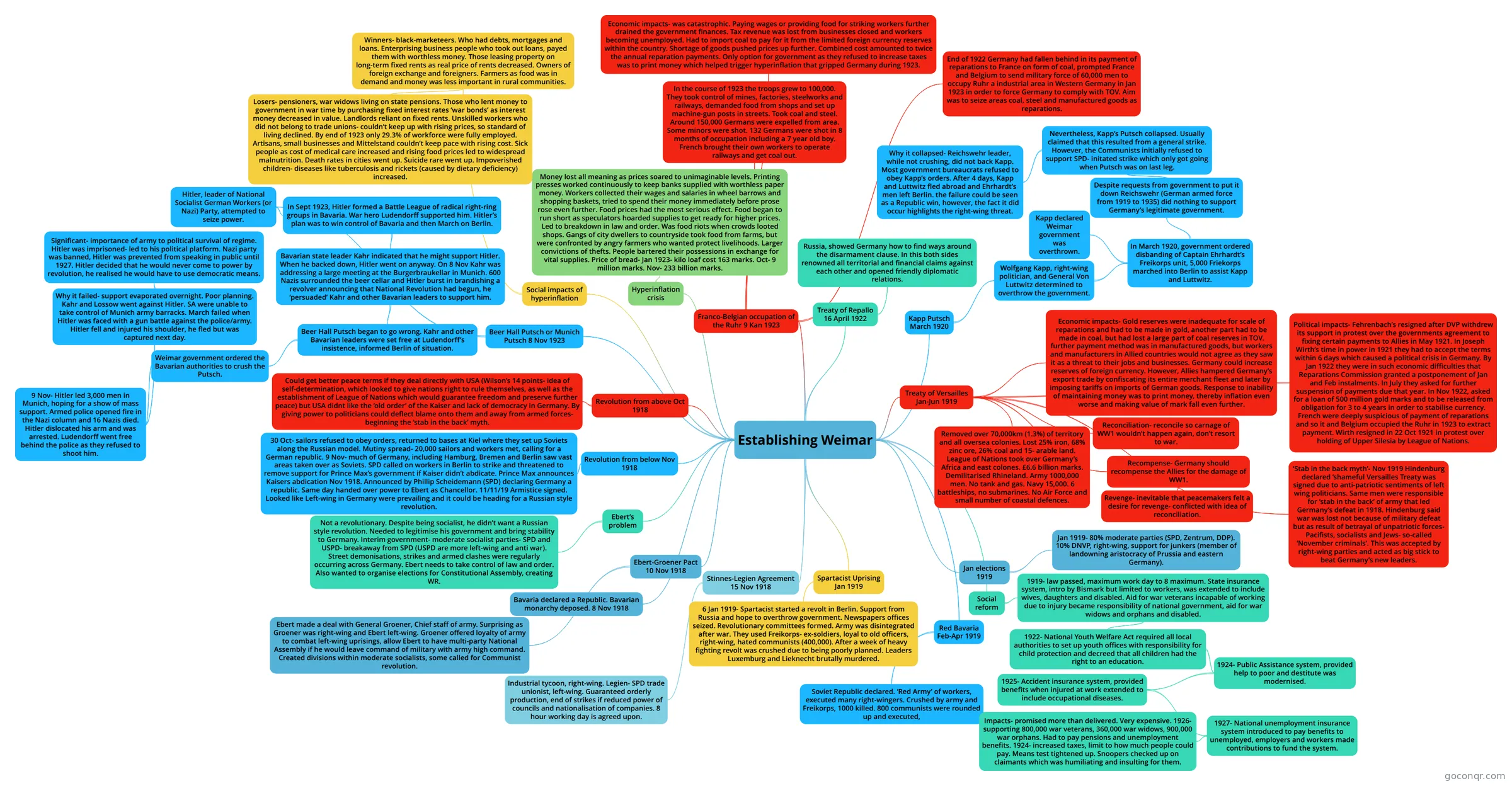
Mind map: Establishing Weimar
Map content
Establishing Weimar
Revolution from above Oct 1918
- Could get better peace terms if they deal directly with USA (Wilson’s 14 points- idea of self-determination, which looked to give nations right to rule themselves, as well as the establishment of League of Nations which would guarantee freedom and preserve further peace) but USA didnt like the ‘old order’ of the Kaiser and lack of democracy in Germany. By giving power to politicians could deflect blame onto them and away from armed forces- beginning the ‘stab in the back’ myth.
Revolution from below Nov 1918
- 30 Oct- sailors refused to obey orders, returned to bases at Kiel where they set up Soviets along the Russian model. Mutiny spread- 20,000 sailors and workers met, calling for a German republic. 9 Nov- much of Germany, including Hamburg, Bremen and Berlin saw vast areas taken over as Soviets. SPD called on workers in Berlin to strike and threatened to remove support for Prince Max’s government if Kaiser didn’t abdicate. Prince Max announces Kaisers abdication Nov 1918. Announced by Phillip Scheidemann (SPD) declaring Germany a republic. Same day handed over power to Ebert as Chancellor. 11/11/19 Armistice signed. Looked like Left-wing in Germany were prevailing and it could be heading for a Russian style revolution.
Ebert’s problem
- Not a revolutionary. Despite being socialist, he didn’t want a Russian style revolution. Needed to legitimise his government and bring stability to Germany. Interim government- moderate socialist parties- SPD and USPD- breakaway from SPD (USPD are more left-wing and anti war). Street demonisations, strikes and armed clashes were regularly occurring across Germany. Ebert needs to take control of law and order. Also wanted to organise elections for Constitutional Assembly, creating WR.
Ebert-Groener Pact 10 Nov 1918
- Ebert made a deal with General Groener, Chief staff of army. Surprising as Groener was right-wing and Ebert left-wing. Groener offered loyalty of army to combat left-wing uprisings, allow Ebert to have multi-party National Assembly if he would leave command of military with army high command. Created divisions within moderate socialists, some called for Communist revolution.
Spartacist Uprising Jan 1919
- 6 Jan 1919- Spartacist started a revolt in Berlin. Support from Russia and hope to overthrow government. Newspapers offices seized. Revolutionary committees formed. Army was disintegrated after war. They used Freikorps- ex-soldiers, loyal to old officers, right-wing, hated communists (400,000). After a week of heavy fighting revolt was crushed due to being poorly planned. Leaders Luxemburg and Lieknecht brutally murdered.
Social reform
- 1919- law passed, maximum work day to 8 maximum. State insurance system, intro by Bismark but limited to workers, was extended to include wives, daughters and disabled. Aid for war veterans incapable of working due to injury became responsibility of national government, aid for war widows and orphans and disabled.
- 1922- National Youth Welfare Act required all local authorities to set up youth offices with responsibility for child protection and decreed that all children had the right to an education.
- 1924- Public Assistance system, provided help to poor and destitute was modernised.
- 1925- Accident insurance system, provided benefits when injured at work extended to include occupational diseases.
- 1927- National unemployment insurance system introduced to pay benefits to unemployed, employers and workers made contributions to fund the system.
- Impacts- promised more than delivered. Very expensive. 1926- supporting 800,000 war veterans, 360,000 war widows, 900,000 war orphans. Had to pay pensions and unemployment benefits. 1924- increased taxes, limit to how much people could pay. Means test tightened up. Snoopers checked up on claimants which was humiliating and insulting for them.
- 1927- National unemployment insurance system introduced to pay benefits to unemployed, employers and workers made contributions to fund the system.
- 1925- Accident insurance system, provided benefits when injured at work extended to include occupational diseases.
- 1924- Public Assistance system, provided help to poor and destitute was modernised.
- 1922- National Youth Welfare Act required all local authorities to set up youth offices with responsibility for child protection and decreed that all children had the right to an education.
- 1919- law passed, maximum work day to 8 maximum. State insurance system, intro by Bismark but limited to workers, was extended to include wives, daughters and disabled. Aid for war veterans incapable of working due to injury became responsibility of national government, aid for war widows and orphans and disabled.
Jan elections 1919
- Jan 1919- 80% moderate parties (SPD, Zentrum, DDP). 10% DNVP, right-wing, support for junkers (member of landowning aristocracy of Prussia and eastern Germany).
Treaty of Versailles Jan-Jun 1919
- Reconciliation- reconcile so carnage of WW1 wouldn’t happen again, don’t resort to war.
- Recompense- Germany should recompense the Allies for the damage of WW1.
- Revenge- inevitable that peacemakers felt a desire for revenge- conflicted with idea of reconciliation.
- Removed over 70,000km (1.3%) of territory and all oversea colonies. Lost 25% iron, 68% zinc ore, 26% coal and 15- arable land. League of Nations took over Germany’s Africa and east colones. £6.6 billion marks. Demilitarised Rhineland. Army 1000,000 men. No tank and gas. Navy 15,000. 6 battleships, no submarines. No Air Force and small number of coastal defences.
- ‘Stab in the back myth’- Nov 1919 Hindenburg declared ‘shameful Versailles Treaty was signed due to anti-patriotic sentiments of left wing politicians. Same men were responsible for ‘stab in the back’ of army that led Germany’s defeat in 1918. Hindenburg said war was lost not because of military defeat but as result of betrayal of unpatriotic forces- Pacifists, socialists and Jews- so-called ‘November criminals’. This was accepted by right-wing parties and acted as big stick to beat Germany’s new leaders.
- Political impacts- Fehrenbach’s resigned after DVP withdrew its support in protest over the governments agreement to fixing certain payments to Allies in May 1921. In Joseph Wirth’s time in power in 1921 they had to accept the terms within 6 days which caused a political crisis in Germany. By Jan 1922 they were in such economic difficulties that Reparations Commission granted a postponement of Jan and Feb instalments. In July they asked for further suspension of payments due that year. In Nov 1922, asked for a loan of 500 million gold marks and to be released from obligation for 3 to 4 years in order to stabilise currency. French were deeply suspicious of payment of reparations and so it and Belgium occupied the Ruhr in 1923 to extract payment. Wirth resigned in 22 Oct 1921 in protest over holding of Upper Silesia by League of Nations.
- Economic impacts- Gold reserves were inadequate for scale of reparations and had to be made in gold, another part had to be made in coal, but had lost a large part of coal reserves in TOV. further payment method was in manufactured goods, but workers and manufacturers in Allied countries would not agree as they saw it as a threat to their jobs and businesses. Germany could increase reserves of foreign currency. However, Allies hampered Germany’s export trade by confiscating its entire merchant fleet and later by imposing tariffs on imports of German goods. Response to inability of maintaining money was to print money, thereby inflation even worse and making value of mark fall even further.
Kapp Putsch March 1920
- Wolfgang Kapp, right-wing politician, and General Von Luttwitz determined to overthrow the government.
- In March 1920, government ordered disbanding of Captain Ehrhardt’s Freikorps unit, 5,000 Friekorps marched into Berlin to assist Kapp and Luttwitz.
- Kapp declared Weimar government was overthrown.
- Despite requests from government to put it down Reichswehr (German armed force from 1919 to 1935) did nothing to support Germany’s legitimate government.
- Nevertheless, Kapp’s Putsch collapsed. Usually claimed that this resulted from a general strike. However, the Communists initially refused to support SPD- initated strike which only got going when Putsch was on last leg.
- Why it collapsed- Reichswehr leader, while not crushing, did not back Kapp. Most government bureaucrats refused to obey Kapp’s orders. After 4 days, Kapp and Luttwitz fled abroad and Ehrhardt’s men left Berlin. the failure could be seen as a Republic win, however, the fact it did occur highlights the right-wing threat.
- Nevertheless, Kapp’s Putsch collapsed. Usually claimed that this resulted from a general strike. However, the Communists initially refused to support SPD- initated strike which only got going when Putsch was on last leg.
- In March 1920, government ordered disbanding of Captain Ehrhardt’s Freikorps unit, 5,000 Friekorps marched into Berlin to assist Kapp and Luttwitz.
- Wolfgang Kapp, right-wing politician, and General Von Luttwitz determined to overthrow the government.
Treaty of Repallo 16 April 1922
- Russia, showed Germany how to find ways around the disarmament clause. In this both sides renowned all territorial and financial claims against each other and opened friendly diplomatic relations.
Franco-Belgian occupation of the Ruhr 9 Kan 1923
- End of 1922 Germany had fallen behind in its payment of reparations to France on form of coal, prompted France and Belgium to send military force of 60,000 men to occupy Ruhr a industrial area in Western Germany in Jan 1923 in order to force Germany to comply with TOV. Aim was to seize areas coal, steel and manufactured goods as reparations.
- In the course of 1923 the troops grew to 100,000. They took control of mines, factories, steelworks and railways, demanded food from shops and set up machine-gun posts in streets. Took coal and steel. Around 150,000 Germans were expelled from area. Some minors were shot. 132 Germans were shot in 8 months of occupation including a 7 year old boy. French brought their own workers to operate railways and get coal out.
- Economic impacts- was catastrophic. Paying wages or providing food for striking workers further drained the government finances. Tax revenue was lost from businesses closed and workers becoming unemployed. Had to import coal to pay for it from the limited foreign currency reserves within the country. Shortage of goods pushed prices up further. Combined cost amounted to twice the annual reparation payments. Only option for government as they refused to increase taxes was to print money which helped trigger hyperinflation that gripped Germany during 1923.
Hyperinflation crisis
- Money lost all meaning as prices soared to unimaginable levels. Printing presses worked continuously to keep banks supplied with worthless paper money. Workers collected their wages and salaries in wheel barrows and shopping baskets, tried to spend their money immediately before prose rose even further. Food prices had the most serious effect. Food began to run short as speculators hoarded supplies to get ready for higher prices. Led to breakdown in law and order. Was food riots when crowds looted shops. Gangs of city dwellers to countryside took food from farms, but were confronted by angry farmers who wanted protect livelihoods. Larger convictions of thefts. People bartered their possessions in exchange for vital supplies. Price of bread- Jan 1923- kilo loaf cost 163 marks. Oct- 9 million marks. Nov- 233 billion marks.
Social impacts of hyperinflation
- Winners- black-marketeers. Who had debts, mortgages and loans. Enterprising business people who took out loans, payed them with worthless money. Those leasing property on long-term fixed rents as real price of rents decreased. Owners of foreign exchange and foreigners. Farmers as food was in demand and money was less important in rural communities.
- Losers- pensioners, war widows living on state pensions. Those who lent money to government in war time by purchasing fixed interest rates ‘war bonds’ as interest money decreased in value. Landlords reliant on fixed rents. Unskilled workers who did not belong to trade unions- couldn’t keep up with rising prices, so standard of living declined. By end of 1923 only 29.3% of workforce were fully employed. Artisans, small businesses and Mittelstand couldn’t keep pace with rising cost. Sick people as cost of medical care increased and rising food prices led to widespread malnutrition. Death rates in cities went up. Suicide rare went up. Impoverished children- diseases like tuberculosis and rickets (caused by dietary deficiency) increased.
- Winners- black-marketeers. Who had debts, mortgages and loans. Enterprising business people who took out loans, payed them with worthless money. Those leasing property on long-term fixed rents as real price of rents decreased. Owners of foreign exchange and foreigners. Farmers as food was in demand and money was less important in rural communities.
Beer Hall Putsch or Munich Putsch 8 Nov 1923
- Hitler, leader of National Socialist German Workers (or Nazi) Party, attempted to seize power.
- In Sept 1923, Hitler formed a Battle League of radical right-ring groups in Bavaria. War hero Ludendorff supported him. Hitler’s plan was to win control of Bavaria and then March on Berlin.
- Bavarian state leader Kahr indicated that he might support Hitler. When he backed down, Hitler went on anyway. On 8 Nov Kahr was addressing a large meeting at the Burgerbraukellar in Munich. 600 Nazis surrounded the beer cellar and Hitler burst in brandishing a revolver announcing that National Revolution had begun, he ‘persuaded’ Kahr and other Bavarian leaders to support him.
- Beer Hall Putsch began to go wrong. Kahr and other Bavarian leaders were set free at Ludendorff’s insistence, informed Berlin of situation.
- Weimar government ordered the Bavarian authorities to crush the Putsch.
- 9 Nov- Hitler led 3,000 men in Munich, hoping for a show of mass support. Armed police opened fire in the Nazi column and 16 Nazis died. Hitler dislocated his arm and was arrested. Ludendorff went free behind the police as they refused to shoot him.
- Why it failed- support evaporated overnight. Poor planning. Kahr and Lossow went against Hitler. SA were unable to take control of Munich army barracks. March failed when Hitler was faced with a gun battle against the police/army. Hitler fell and injured his shoulder, he fled but was captured next day.
- Significant- importance of army to political survival of regime. Hitler was imprisoned- led to his political platform. Nazi party was banned, Hitler was prevented from speaking in public until 1927. Hitler decided that he would never come to power by revolution, he realised he would have to use democratic means.
- Why it failed- support evaporated overnight. Poor planning. Kahr and Lossow went against Hitler. SA were unable to take control of Munich army barracks. March failed when Hitler was faced with a gun battle against the police/army. Hitler fell and injured his shoulder, he fled but was captured next day.
- 9 Nov- Hitler led 3,000 men in Munich, hoping for a show of mass support. Armed police opened fire in the Nazi column and 16 Nazis died. Hitler dislocated his arm and was arrested. Ludendorff went free behind the police as they refused to shoot him.
- Weimar government ordered the Bavarian authorities to crush the Putsch.
- Beer Hall Putsch began to go wrong. Kahr and other Bavarian leaders were set free at Ludendorff’s insistence, informed Berlin of situation.
- Bavarian state leader Kahr indicated that he might support Hitler. When he backed down, Hitler went on anyway. On 8 Nov Kahr was addressing a large meeting at the Burgerbraukellar in Munich. 600 Nazis surrounded the beer cellar and Hitler burst in brandishing a revolver announcing that National Revolution had begun, he ‘persuaded’ Kahr and other Bavarian leaders to support him.
- In Sept 1923, Hitler formed a Battle League of radical right-ring groups in Bavaria. War hero Ludendorff supported him. Hitler’s plan was to win control of Bavaria and then March on Berlin.
- Hitler, leader of National Socialist German Workers (or Nazi) Party, attempted to seize power.
Bavaria declared a Republic. Bavarian monarchy deposed. 8 Nov 1918
Stinnes-Legien Agreement 15 Nov 1918
- Industrial tycoon, right-wing. Legien- SPD trade unionist, left-wing. Guaranteed orderly production, end of strikes if reduced power of councils and nationalisation of companies. 8 hour working day is agreed upon.
Red Bavaria Feb-Apr 1919
- Soviet Republic declared. ‘Red Army’ of workers, executed many right-wingers. Crushed by army and Freikorps, 1000 killed. 800 communists were rounded up and executed,
Information
- Description
- A level History Mind Map on Establishing Weimar, created by Noah Richardson on 11/01/2023.
- Created by
- Noah Richardson
- Views
- 5
- Rating
More on Origins of the Weimar Republic