
Mind map
Social Influence
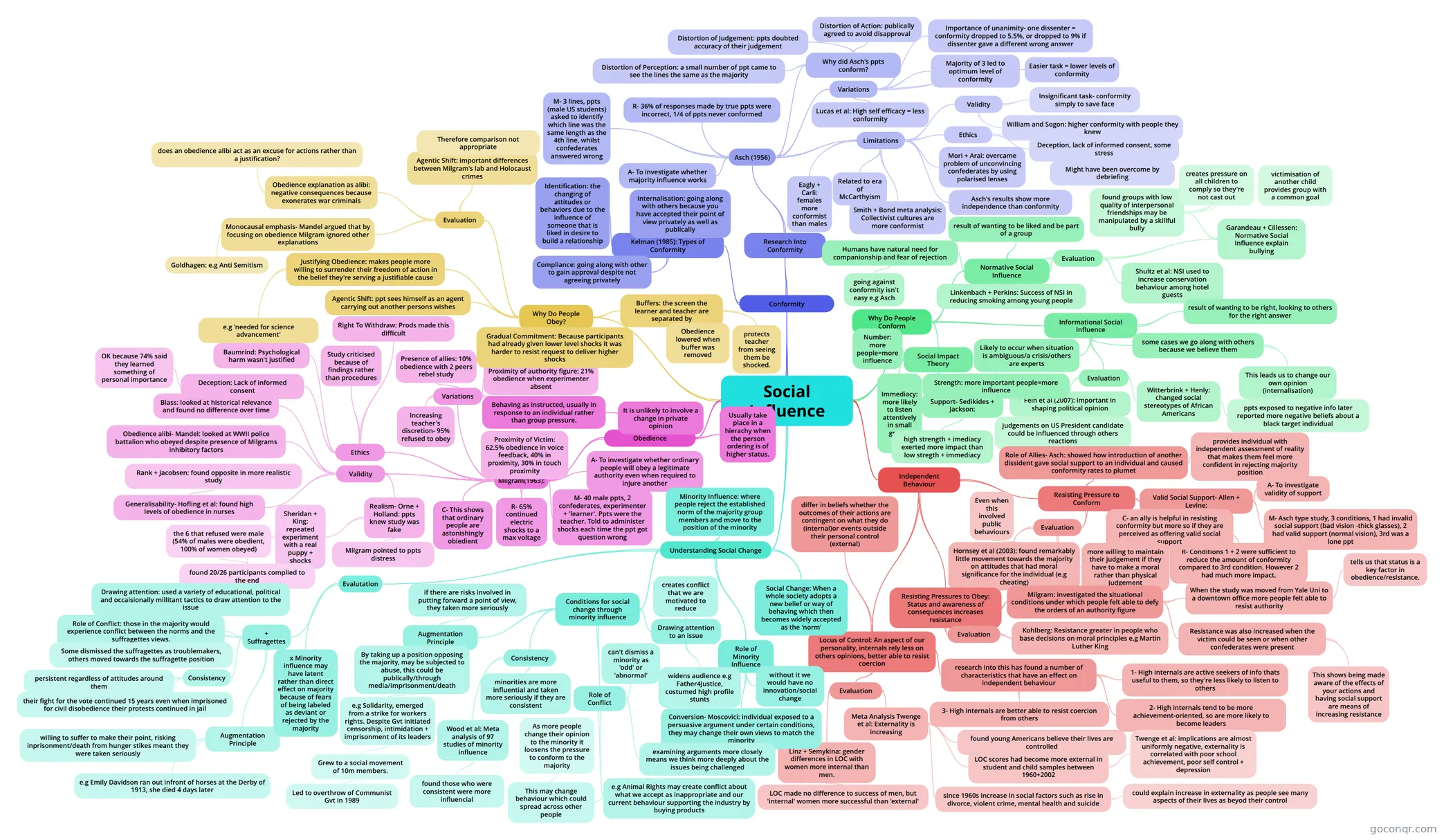
Mind map: Social influence
Map content
Social Influence
Conformity
- Kelman (1985): Types of Conformity
- Compliance: going along with other to gain approval despite not agreeing privately
- Internalisation: going along with others because you have accepted their point of view privately as well as publically
- Identification: the changing of attitudes or behaviors due to the influence of someone that is liked in desire to build a relationship
- Research Into Conformity
- Asch (1956)
- A- To investigate whether majority influence works
- M- 3 lines, ppts (male US students) asked to identify which line was the same length as the 4th line, whilst confederates answered wrong
- R- 36% of responses made by true ppts were incorrect, 1/4 of ppts never conformed
- Why did Asch's ppts conform?
- Distortion of Perception: a small number of ppt came to see the lines the same as the majority
- Distortion of Judgement: ppts doubted accuracy of their judgement
- Distortion of Action: publically agreed to avoid disapproval
- Variations
- Easier task = lower levels of conformity
- Lucas et al: High self efficacy = less conformity
- Majority of 3 led to optimum level of conformity
- Importance of unanimity- one dissenter = conformity dropped to 5.5%, or dropped to 9% if dissenter gave a different wrong answer
- Limitations
- Validity
- Insignificant task- conformity simply to save face
- William and Sogon: higher conformity with people they knew
- Ethics
- Deception, lack of informed consent, some stress
- Might have been overcome by debriefing
- Deception, lack of informed consent, some stress
- Eagly + Carli: females more conformist than males
- Smith + Bond meta analysis: Collectivist cultures are more conformist
- Related to era of McCarthyism
- Mori + Arai: overcame problem of unconvincing confederates by using polarised lenses
- Asch's results show more independence than conformity
- Validity
- Asch (1956)
- Kelman (1985): Types of Conformity
Independent Behaviour
- Resisting Pressure to Conform
- Role of Allies- Asch: showed how introduction of another dissident gave social support to an individual and caused conformity rates to plumet
- provides individual with independent assessment of reality that makes them feel more confident in rejecting majority position
- Valid Social Support- Allen + Levine:
- A- To investigate validity of support
- M- Asch type study, 3 conditions, 1 had invalid social support (bad vision -thick glasses), 2 had valid support (normal vision), 3rd was a lone ppt
- R- Conditions 1 + 2 were sufficient to reduce the amount of conformity compared to 3rd condition. However 2 had much more impact.
- C- an ally is helpful in resisting conformity but more so if they are perceived as offering valid social support
- Evaluation
- more willing to maintain their judgement if they have to make a moral rather than physical judgement
- Hornsey et al (2003): found remarkably little movement towards the majority on attitudes that had moral significance for the individual (e.g cheating)
- Even when this involved public behaviours
- Role of Allies- Asch: showed how introduction of another dissident gave social support to an individual and caused conformity rates to plumet
- Resisting Pressures to Obey: Status and awareness of consequences increases resistance
- Milgram: investigated the situational conditions under which people felt able to defy the orders of an authority figure
- When the study was moved from Yale Uni to a downtown office more people felt able to resist authority
- tells us that status is a key factor in obedience/resistance.
- Resistance was also increased when the victim could be seen or when other confederates were present
- This shows being made aware of the effects of your actions and having social support are means of increasing resistance
- When the study was moved from Yale Uni to a downtown office more people felt able to resist authority
- Evaluation
- Kohlberg: Resistance greater in people who base decisions on moral principles e.g Martin Luther King
- Milgram: investigated the situational conditions under which people felt able to defy the orders of an authority figure
- Locus of Control: An aspect of our personality, internals rely less on others opinions, better able to resist coercion
- differ in beliefs whether the outcomes of their actions are contingent on what they do (internal)or events outside their personal control (external)
- research into this has found a number of characteristics that have an effect on independent behaviour
- 1- High internals are active seekers of info thats useful to them, so they're less likely to listen to others
- 2- High internals tend to be more achievement-oriented, so are more likely to become leaders
- 3- High internals are better able to resist coercion from others
- Evaluation
- Meta Analysis Twenge et al: Externality is increasing
- found young Americans believe their lives are controlled
- LOC scores had become more external in student and child samples between 1960+2002
- Twenge et al: implications are almost uniformly negative, externality is correlated with poor school achievement, poor self control + depression
- since 1960s increase in social factors such as rise in divorce, violent crime, mental health and suicide
- could explain increase in externality as people see many aspects of their lives as beyod their control
- Linz + Semykina: gender differences in LOC with women more internal than men.
- LOC made no difference to success of men, but 'internal' women more successful than 'external'
- Meta Analysis Twenge et al: Externality is increasing
- Resisting Pressure to Conform
Understanding Social Change
- Minority Influence: where people reject the established norm of the majority group members and move to the position of the minority
- Social Change: When a whole society adopts a new belief or way of behaving which then becomes widely accepted as the 'norm'
- Role of Minority Influence
- without it we would have no innovation/social change
- Conversion- Moscovici: individual exposed to a persuasive argument under certain conditions, they may change their own views to match the minority
- Conditions for social change through minority influence
- Drawing attention to an issue
- creates conflict that we are motivated to reduce
- widens audience e.g Father4Justice, costumed high profile stunts
- Role of Conflict
- can't dismiss a minority as 'odd' or 'abnormal'
- examining arguments more closely means we think more deeply about the issues being challenged
- e.g Animal Rights may create conflict about what we accept as inappropriate and our current behaviour supporting the industry by buying products
- This may change behaviour which could spread across other people
- As more people change their opinion to the minority it loosens the pressure to conform to the majority
- This may change behaviour which could spread across other people
- Consistency
- minorities are more influential and taken more seriously if they are consistent
- Wood et al: Meta analysis of 97 studies of minority influence
- found those who were consistent were more influencial
- Augmentation Principle
- if there are risks involved in putting forward a point of view, they taken more seriously
- By taking up a position opposing the majority, may be subjected to abuse, this could be publically/through media/imprisonment/death
- e.g Solidarity, emerged from a strike for workers rights. Despite Gvt initiated censorship, intimidation + imprisonment of its leaders
- Grew to a social movement of 10m members.
- Led to overthrow of Communist Gvt in 1989
- Grew to a social movement of 10m members.
- e.g Solidarity, emerged from a strike for workers rights. Despite Gvt initiated censorship, intimidation + imprisonment of its leaders
- Drawing attention to an issue
- Evalutation
- + Suffragettes
- Drawing attention: used a variety of educational, political and occaisionally millitant tactics to draw attention to the issue
- Role of Conflict: those in the majority would experience conflict between the norms and the suffragettes views.
- Some dismissed the suffragettes as troublemakers, others moved towards the suffragette position
- Consistency
- persistent regardless of attitudes around them
- their fight for the vote continued 15 years even when imprisoned for civil disobedience their protests continued in jail
- Augmentation Principle
- willing to suffer to make their point, risking inprisonment/death from hunger stikes meant they were taken seriously
- e.g Emily Davidson ran out infront of horses at the Derby of 1913, she died 4 days later
- x Minority influence may have latent rather than direct effect on majority because of fears of being labeled as deviant or rejected by the majority
- + Suffragettes
Obedience
- Behaving as instructed, usually in response to an individual rather than group pressure.
- Usually take place in a hierachy when the person ordering is of higher status.
- It is unlikely to involve a change in private opinion
- Milgram(1963):
- A- To investigate whether ordinary people will obey a legitimate authority even when required to injure another
- M- 40 male ppts, 2 confederates, experimenter + 'learner'. Ppts were the teacher. Told to administer shocks each time the ppt got question wrong
- R- 65% continued electric shocks to a max voltage
- C- This shows that ordinary people are astonishingly obiedient
- Variations
- Proximity of Victim: 62.5% obedience in voice feedback, 40% in proximity, 30% in touch proximity
- Proximity of authority figure: 21% obedience when experimenter absent
- Presence of allies: 10% obedience with 2 peers rebel study
- Increasing teacher's discretion- 95% refused to obey
- Validity
- Realism- Orne + Holland: ppts knew study was fake
- Milgram pointed to ppts distress
- Sheridan + King: repeated experiment with a real puppy + shocks
- found 20/26 participants complied to the end
- the 6 that refused were male (54% of males were obedient, 100% of women obeyed)
- found 20/26 participants complied to the end
- Blass: looked at historical relevance and found no difference over time
- Obedience alibi- Mandel: looked at WWII police battalion who obeyed despite presence of Milgrams inhibitory factors
- Generalisability- Hofling et al: found high levels of obedience in nurses
- Rank + Jacobsen: found opposite in more realistic study
- Realism- Orne + Holland: ppts knew study was fake
- Ethics
- Deception: Lack of informed consent
- OK because 74% said they learned something of personal importance
- Right To Withdraw: Prods made this difficult
- Baumrind: Psychological harm wasn't justified
- Study criticised because of findings rather than procedures
- Deception: Lack of informed consent
Why Do People Obey?
- Gradual Commitment: Because participants had already given lower level shocks it was harder to resist request to deliver higher shocks
- Agentic Shift: ppt sees himself as an agent carrying out another persons wishes
- Buffers: the screen the learner and teacher are separated by
- protects teacher from seeing them be shocked.
- Obedience lowered when buffer was removed
- Justifying Obedience: makes people more willing to surrender their freedom of action in the belief they're serving a justifiable cause
- e.g 'needed for science advancement'
- Evaluation
- Monocausal emphasis- Mandel argued that by focusing on obedience Milgram ignored other explanations
- Goldhagen: e.g Anti Semitism
- Agentic Shift: important differences between Milgram's lab and Holocaust crimes
- Therefore comparison not appropriate
- Obedience explanation as alibi: negative consequences because exonerates war criminals
- does an obedience alibi act as an excuse for actions rather than a justification?
- Monocausal emphasis- Mandel argued that by focusing on obedience Milgram ignored other explanations
Why Do People Conform
- Normative Social Influence
- result of wanting to be liked and be part of a group
- Humans have natural need for companionship and fear of rejection
- going against conformity isn't easy e.g Asch
- Evaluation
- Garandeau + Cillessen: Normative Social Influence explain bullying
- found groups with low quality of interpersonal friendships may be manipulated by a skillful bully
- victimisation of another child provides group with a common goal
- creates pressure on all children to comply so they're not cast out
- found groups with low quality of interpersonal friendships may be manipulated by a skillful bully
- Shultz et al: NSI used to increase conservation behaviour among hotel guests
- Linkenbach + Perkins: Success of NSI in reducing smoking among young people
- Garandeau + Cillessen: Normative Social Influence explain bullying
- Informational Social Influence
- result of wanting to be right, looking to others for the right answer
- some cases we go along with others because we believe them
- This leads us to change our own opinion (internalisation)
- Likely to occur when situation is ambiguous/a crisis/others are experts
- Evaluation
- Witterbrink + Henly: changed social stereotypes of African Americans
- ppts exposed to negative info later reported more negative beliefs about a black target individual
- Fein et al (2007): important in shaping political opinion
- judgements on US President candidate could be influenced through others reactions
- Witterbrink + Henly: changed social stereotypes of African Americans
- Social Impact Theory
- Number: more people=more influence
- Strength: more important people=more influence
- Immediacy: more likely to listen attentively in small groups
- Support- Sedikides + Jackson:
- high strength + imediacy exerted more impact than low stregth + immediacy
- Normative Social Influence
Information
- Description
- Psychology Mind Map on Social Influence, created by Katie Mortley on 08/04/2013.
- Created by
- Katie Mortley
- Views
- 274
- Tags
- Rating