
Mind map
Eating Behaviour
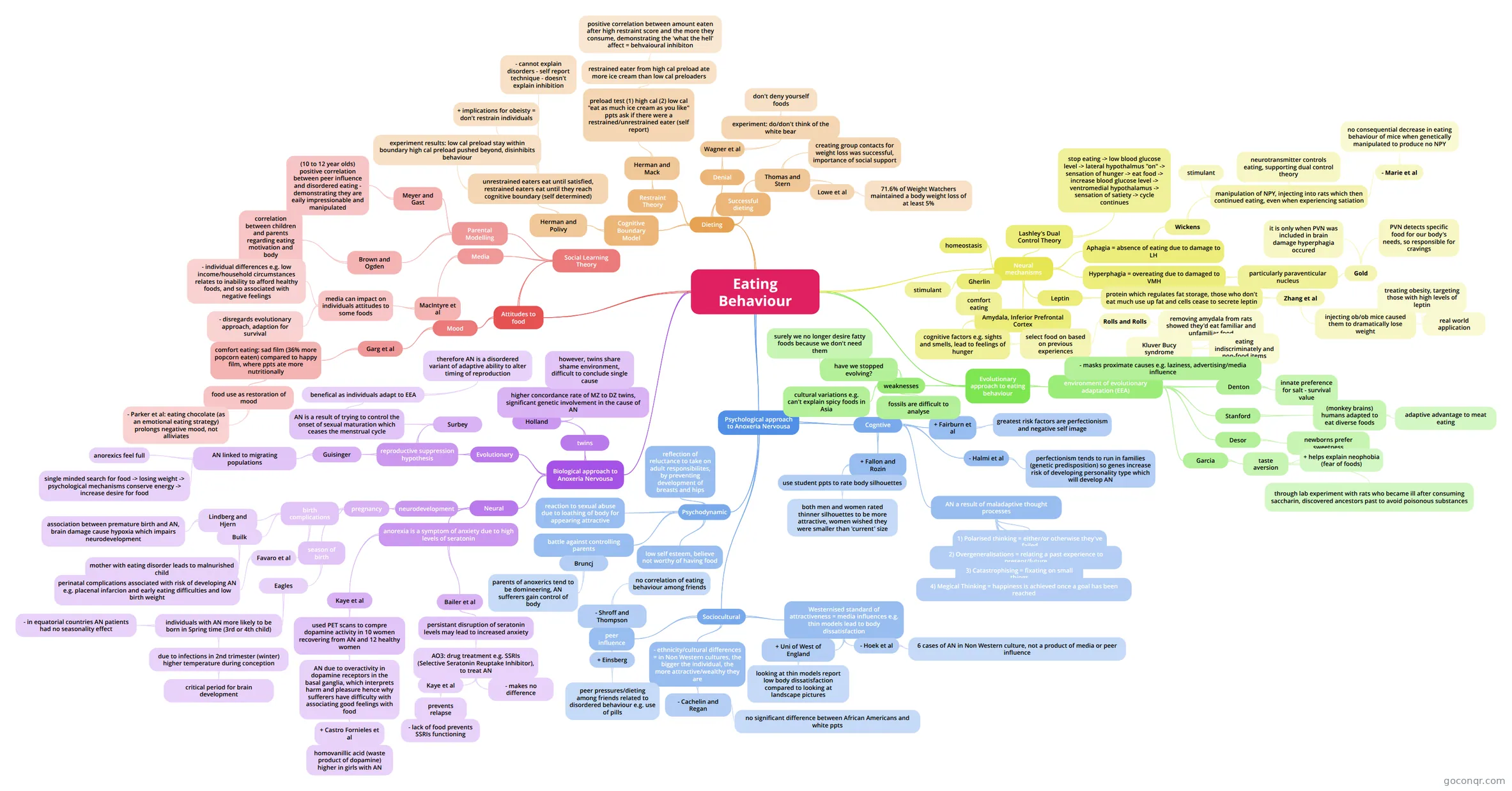
Mind map: Eating behaviour
Map content
Eating Behaviour
Attitudes to food
- Social Learning Theory
- Parental Modelling
- Brown and Ogden
- correlation between children and parents regarding eating motivation and body dissatisfaction
- Meyer and Gast
- (10 to 12 year olds) positive correlation between peer influence and disordered eating - demonstrating they are eaily impressionable and manipulated
- Brown and Ogden
- Media
- MacIntyre et al
- media can impact on individuals attitudes to some foods
- - individual differences e.g. low income/household circumstances relates to inability to afford healthy foods, and so associated with negative feelings
- - disregards evolutionary approach, adaption for survival
- media can impact on individuals attitudes to some foods
- MacIntyre et al
- Parental Modelling
- Mood
- Garg et al
- comfort eating: sad film (36% more popcorn eaten) compared to happy film, where ppts ate more nutritionally
- food use as restoration of mood
- - Parker et al: eating chocolate (as an emotional eating strategy) prolongs negative mood, not alliviates
- food use as restoration of mood
- comfort eating: sad film (36% more popcorn eaten) compared to happy film, where ppts ate more nutritionally
- Garg et al
- Social Learning Theory
Neural mechanisms
- Lashley's Dual Control Theory
- stop eating -> low blood glucose level -> lateral hypothalmus "on" -> sensation of hunger -> eat food -> increase blood glucose level -> ventromedial hypothalamus -> sensation of satiety -> cycle continues
- Aphagia = absence of eating due to damage to LH
- Wickens
- manipulation of NPY, injecting into rats which then continued eating, even when experiencing satiation
- neurotransmitter controls eating, supporting dual control theory
- stimulant
- - Marie et al
- no consequential decrease in eating behaviour of mice when genetically manipulated to produce no NPY
- manipulation of NPY, injecting into rats which then continued eating, even when experiencing satiation
- Wickens
- Hyperphagia = overeating due to damaged to VMH
- particularly paraventicular nucleus
- Gold
- it is only when PVN was included in brain damage hyperphagia occured
- PVN detects specific food for our body's needs, so responsible for cravings
- Gold
- particularly paraventicular nucleus
- Leptin
- protein which regulates fat storage, those who don't eat much use up fat and cells cease to secrete leptin
- Zhang et al
- injecting ob/ob mice caused them to dramatically lose weight
- real world application
- treating obesity, targeting those with high levels of leptin
- real world application
- injecting ob/ob mice caused them to dramatically lose weight
- Zhang et al
- protein which regulates fat storage, those who don't eat much use up fat and cells cease to secrete leptin
- Gherlin
- stimulant
- comfort eating
- homeostasis
- Amydala, Inferior Prefrontal Cortex
- cognitive factors e.g. sights and smells, lead to feelings of hunger
- select food on based on previous experiences
- Rolls and Rolls
- removing amydala from rats showed they'd eat familiar and unfamiliar food
- Kluver Bucy syndrome
- eating indiscriminately and non-food items
- Kluver Bucy syndrome
- removing amydala from rats showed they'd eat familiar and unfamiliar food
- Rolls and Rolls
- select food on based on previous experiences
- cognitive factors e.g. sights and smells, lead to feelings of hunger
- Lashley's Dual Control Theory
Evolutionary approach to eating behaviour
- environment of evolutionary adaptation (EEA)
- Denton
- innate preference for salt - survival value
- Stanford
- (monkey brains) humans adapted to eat diverse foods
- adaptive advantage to meat eating
- (monkey brains) humans adapted to eat diverse foods
- Desor
- newborns prefer sweetness
- Garcia
- taste aversion
- + helps explain neophobia (fear of foods)
- through lab experiment with rats who became ill after consuming saccharin, discovered ancestors past to avoid poisonous substances
- taste aversion
- - masks proximate causes e.g. laziness, advertising/media influence
- Denton
- weaknesses
- cultural variations e.g. can't explain spicy foods in Asia
- fossils are difficult to analyse
- have we stopped evolving?
- surely we no longer desire fatty foods because we don't need them
- environment of evolutionary adaptation (EEA)
Dieting
- Restraint Theory
- Herman and Mack
- preload test (1) high cal (2) low cal "eat as much ice cream as you like" ppts ask if there were a restrained/unrestrained eater (self report)
- restrained eater from high cal preload ate more ice cream than low cal preloaders
- positive correlation between amount eaten after high restraint score and the more they consume, demonstrating the 'what the hell' affect = behvaioural inhibiton
- restrained eater from high cal preload ate more ice cream than low cal preloaders
- preload test (1) high cal (2) low cal "eat as much ice cream as you like" ppts ask if there were a restrained/unrestrained eater (self report)
- Herman and Mack
- Cognitive Boundary Model
- Herman and Polivy
- unrestrained eaters eat until satisfied, restrained eaters eat until they reach cognitive boundary (self determined)
- experiment results: low cal preload stay within boundary high cal preload pushed beyond, disinhibits behaviour
- + implications for obeisty = don't restrain individuals
- - cannot explain disorders - self report technique - doesn't explain inhibition
- unrestrained eaters eat until satisfied, restrained eaters eat until they reach cognitive boundary (self determined)
- Herman and Polivy
- Denial
- Wagner et al
- experiment: do/don't think of the white bear
- don't deny yourself foods
- experiment: do/don't think of the white bear
- Wagner et al
- Successful dieting
- Thomas and Stern
- creating group contacts for weight loss was successful, importance of social support
- Lowe et al
- 71.6% of Weight Watchers maintained a body weight loss of at least 5%
- Thomas and Stern
- Restraint Theory
Psychological approach to Anoxeria Nervousa
- Sociocultural
- Westernised standard of attractiveness = media influences e.g. thin models lead to body dissatisfaction
- - Hoek et al
- 6 cases of AN in Non Western culture, not a product of media or peer influence
- + Uni of West of England
- looking at thin models report low body dissatisfaction compared to looking at landscape pictures
- - Hoek et al
- - ethnicity/cultural differences = in Non Western cultures, the bigger the individual, the more attractive/wealthy they are
- - Cachelin and Regan
- no significant difference between African Americans and white ppts
- - Cachelin and Regan
- peer influence
- + Einsberg
- peer pressures/dieting among friends related to disordered behaviour e.g. use of pills
- - Shroff and Thompson
- no correlation of eating behaviour among friends
- + Einsberg
- Westernised standard of attractiveness = media influences e.g. thin models lead to body dissatisfaction
- Psychodynamic
- reaction to sexual abuse due to loathing of body for appearing attractive
- reflection of reluctance to take on adult responsibilites, by preventing development of breasts and hips
- low self esteem, believe not worthy of having food
- battle against controlling parents
- Bruncj
- parents of anoxerics tend to be domineering, AN sufferers gain control of body
- Bruncj
- Cogntive
- AN a result of maladaptive thought processes
- 1) Polarised thinking = either/or otherwise they've failed
- 2) Overgeneralisations = relating a past experience to present/future
- 3) Catastrophising = fixating on small things
- 4) Megical Thinking = happiness is achieved once a goal has been reached
- + Fairburn et al
- greatest risk factors are perfectionism and negative self image
- - Halmi et al
- perfectionism tends to run in families (genetic predisposition) so genes increase risk of developing personality type which will develop AN
- + Fallon and Rozin
- use student ppts to rate body silhouettes
- both men and women rated thinner silhouettes to be more attractive, women wished they were smaller than 'current' size
- use student ppts to rate body silhouettes
- AN a result of maladaptive thought processes
- Sociocultural
Biological approach to Anoxeria Nervousa
- Neural
- anorexia is a symptom of anxiety due to high levels of seratonin
- Bailer et al
- persistant disruption of seratonin levels may lead to increased anxiety
- AO3: drug treatment e.g. SSRIs (Selective Seratonin Reuptake Inhibitor), to treat AN
- - makes no difference
- Kaye et al
- prevents relapse
- - lack of food prevents SSRIs functioning
- prevents relapse
- AO3: drug treatment e.g. SSRIs (Selective Seratonin Reuptake Inhibitor), to treat AN
- persistant disruption of seratonin levels may lead to increased anxiety
- Kaye et al
- used PET scans to compre dopamine activity in 10 women recovering from AN and 12 healthy women
- AN due to overactivity in dopamine receptors in the basal ganglia, which interprets harm and pleasure hence why sufferers have difficulty with associating good feelings with food
- + Castro Fornieles et al
- homovanillic acid (waste product of dopamine) higher in girls with AN
- + Castro Fornieles et al
- AN due to overactivity in dopamine receptors in the basal ganglia, which interprets harm and pleasure hence why sufferers have difficulty with associating good feelings with food
- used PET scans to compre dopamine activity in 10 women recovering from AN and 12 healthy women
- Bailer et al
- neurodevelopment
- pregnancy
- birth complications
- Lindberg and Hjern
- association between premature birth and AN, brain damage cause hypoxia which impairs neurodevelopment
- Builk
- mother with eating disorder leads to malnurished child
- Favaro et al
- perinatal complications associated with risk of developing AN e.g. placenal infarcion and early eating difficulties and low birth weight
- Lindberg and Hjern
- season of birth
- Eagles
- individuals with AN more likely to be born in Spring time (3rd or 4th child)
- due to infections in 2nd trimester (winter) higher temperature during conception
- critical period for brain development
- - in equatorial countries AN patients had no seasonality effect
- due to infections in 2nd trimester (winter) higher temperature during conception
- individuals with AN more likely to be born in Spring time (3rd or 4th child)
- Eagles
- birth complications
- pregnancy
- anorexia is a symptom of anxiety due to high levels of seratonin
- Evolutionary
- reproductive suppression hypothesis
- Surbey
- AN is a result of trying to control the onset of sexual maturation which ceases the menstrual cycle
- benefical as individuals adapt to EEA
- therefore AN is a disordered variant of adaptive ability to alter timing of reproduction
- benefical as individuals adapt to EEA
- AN is a result of trying to control the onset of sexual maturation which ceases the menstrual cycle
- Guisinger
- AN linked to migrating populations
- single minded search for food -> losing weight -> psychological mechanisms conserve energy -> increase desire for food
- anorexics feel full
- AN linked to migrating populations
- Surbey
- reproductive suppression hypothesis
- twins
- Holland
- higher concordance rate of MZ to DZ twins, significant genetic involvement in the cause of AN
- however, twins share shame environment, difficult to conclude single cause
- higher concordance rate of MZ to DZ twins, significant genetic involvement in the cause of AN
- Holland
- Neural
Information
- Description
- A2 level Psychology Mind Map on Eating Behaviour, created by 07akent on 27/12/2013.
- Created by
- 07akent
- Views
- 144
- Tags
- Rating