
Mind map
E&A
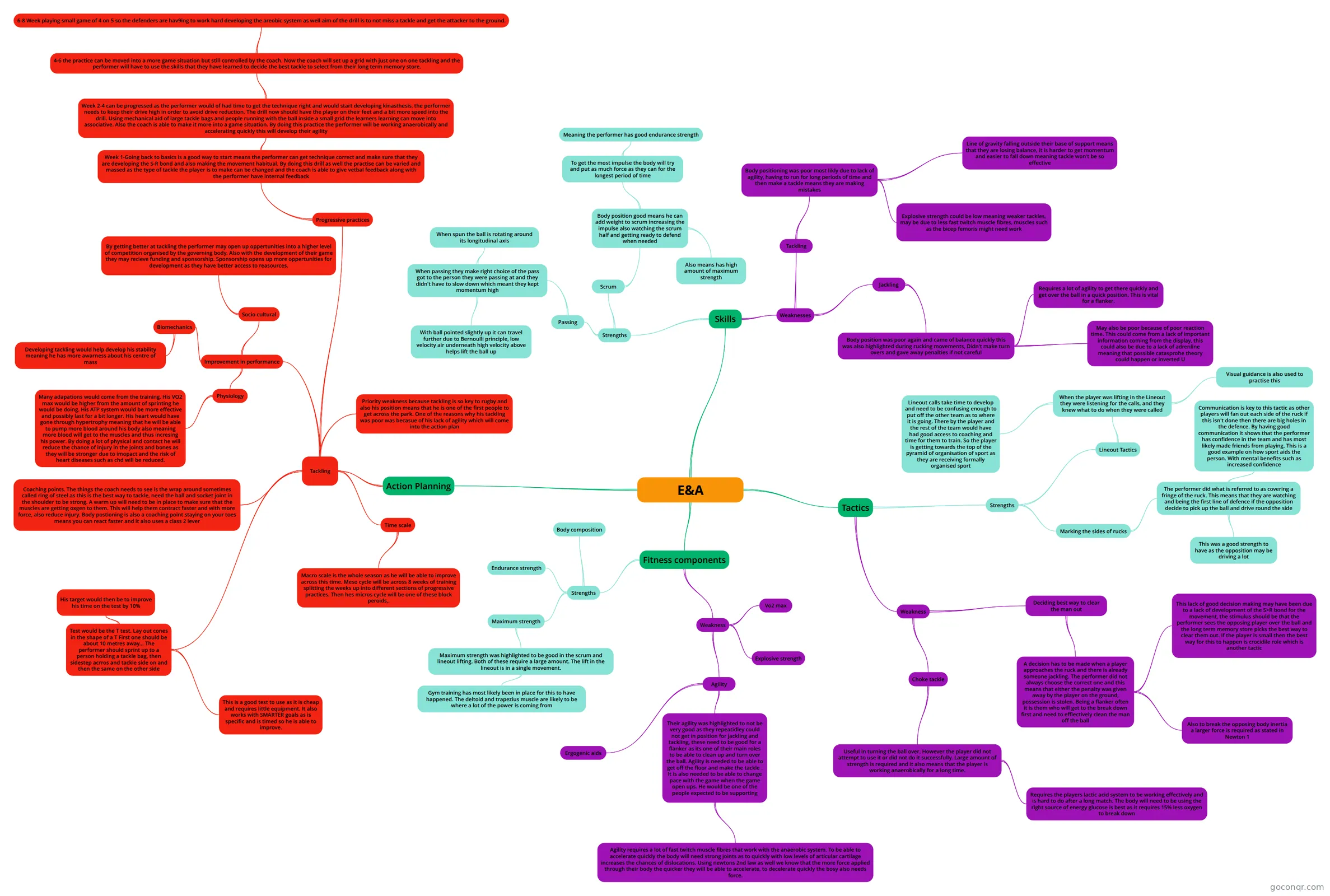
Mind map: E&A
Map content
E&A
Skills
- Strengths
- Passing
- When passing they make right choice of the pass got to the person they were passing at and they didn't have to slow down which meant they kept momentum high
- When spun the ball is rotating around its longitudinal axis
- With ball pointed slightly up it can travel further due to Bernoulli principle, low velocity air underneath high velocity above helps lift the ball up
- When passing they make right choice of the pass got to the person they were passing at and they didn't have to slow down which meant they kept momentum high
- Scrum
- Body position good means he can add weight to scrum increasing the impulse also watching the scrum half and getting ready to defend when needed
- To get the most impulse the body will try and put as much force as they can for the longest period of time
- Meaning the performer has good endurance strength
- Also means has high amount of maximum strength
- To get the most impulse the body will try and put as much force as they can for the longest period of time
- Body position good means he can add weight to scrum increasing the impulse also watching the scrum half and getting ready to defend when needed
- Passing
- Weaknesses
- Tackling
- Body positioning was poor most likly due to lack of agility, having to run for long periods of time and then make a tackle means they are making mistakes
- Line of gravity falling outside their base of support means that they are losing balance, it is harder to get momentum and easier to fall down meaning tackle won't be so effective
- Explosive strength could be low meaning weaker tackles, may be due to less fast twitch muscle fibres, muscles such as the bicep femoris might need work
- Body positioning was poor most likly due to lack of agility, having to run for long periods of time and then make a tackle means they are making mistakes
- Jackling
- Body position was poor again and came of balance quickly this was also highlighted during rucking movements, Didn't make turn overs and gave away penalties if not careful
- Requires a lot of agility to get there quickly and get over the ball in a quick position. This is vital for a flanker.
- May also be poor because of poor reaction time. This could come from a lack of important information coming from the display, this could also be due to a lack of adrenline meaning that possible catasprohe theory could happen or inverted U
- Body position was poor again and came of balance quickly this was also highlighted during rucking movements, Didn't make turn overs and gave away penalties if not careful
- Tackling
- Strengths
Tactics
- Strengths
- Lineout Tactics
- When the player was lifting in the Lineout they were listening for the calls, and they knew what to do when they were called
- Lineout calls take time to develop and need to be confusing enough to put off the other team as to where it is going. There by the player and the rest of the team would have had good access to coaching and time for them to train. So the player is getting towards the top of the pyramid of organisation of sport as they are receiving formally organised sport
- Visual guidance is also used to practise this
- When the player was lifting in the Lineout they were listening for the calls, and they knew what to do when they were called
- Marking the sides of rucks
- The performer did what is referred to as covering a fringe of the ruck. This means that they are watching and being the first line of defence if the opposition decide to pick up the ball and drive round the side
- This was a good strength to have as the opposition may be driving a lot
- Communication is key to this tactic as other players will fan out each side of the ruck if this isn't done then there are big holes in the defence. By having good communication it shows that the performer has confidence in the team and has most likely made friends from playing. This is a good example on how sport aids the person. With mental benefits such as increased confidence
- The performer did what is referred to as covering a fringe of the ruck. This means that they are watching and being the first line of defence if the opposition decide to pick up the ball and drive round the side
- Lineout Tactics
- Weakness
- Deciding best way to clear the man out
- A decision has to be made when a player approaches the ruck and there is already someone jackling. The performer did not always choose the correct one and this means that either the penalty was given away by the player on the ground, possession is stolen. Being a flanker often it is them who will get to the break down first and need to effiectively clean the man off the ball
- This lack of good decision making may have been due to a lack of development of the S>R bond for the movement, the stimulus should be that the performer sees the opposing player over the ball and the long term memory store picks the best way to clear them out. If the player is small then the best way for this to happen is crocidile role which is another tactic
- Also to break the opposing body inertia a larger force is required as stated in Newton 1
- A decision has to be made when a player approaches the ruck and there is already someone jackling. The performer did not always choose the correct one and this means that either the penalty was given away by the player on the ground, possession is stolen. Being a flanker often it is them who will get to the break down first and need to effiectively clean the man off the ball
- Choke tackle
- Useful in turning the ball over. However the player did not attempt to use it or did not do it successfully. Large amount of strength is required and it also means that the player is working anaerobically for a long time.
- Requires the players lactic acid system to be working effectively and is hard to do after a long match. The body will need to be using the right source of energy glucose is best as it requires 15% less oxygen to break down
- Useful in turning the ball over. However the player did not attempt to use it or did not do it successfully. Large amount of strength is required and it also means that the player is working anaerobically for a long time.
- Deciding best way to clear the man out
- Strengths
Fitness components
- Strengths
- Maximum strength
- Maximum strength was highlighted to be good in the scrum and lineout lifting. Both of these require a large amount. The lift in the lineout is in a single movement.
- Gym training has most likely been in place for this to have happened. The deltoid and trapezius muscle are likely to be where a lot of the power is coming from
- Maximum strength was highlighted to be good in the scrum and lineout lifting. Both of these require a large amount. The lift in the lineout is in a single movement.
- Endurance strength
- Body composition
- Maximum strength
- Weakness
- Agility
- Their agility was highlighted to not be very good as they repeatidley could not get in position for jackling and tackling, these need to be good for a flanker as its one of their main roles to be able to clean up and turn over the ball. Agility is needed to be able to get off the floor and make the tackle . It is also needed to be able to change pace with the game when the game open ups. He would be one of the people expected to be supporting
- Agility requires a lot of fast twitch muscle fibres that work with the anaerobic system. To be able to accelerate quickly the body will need strong joints as to quickly with low levels of articular cartilage increases the chances of dislocations. Using newtons 2nd law as well we know that the more force applied through their body the quicker they will be able to accelerate, to decelerate quickly the bosy also needs force.
- Ergogenic aids
- Their agility was highlighted to not be very good as they repeatidley could not get in position for jackling and tackling, these need to be good for a flanker as its one of their main roles to be able to clean up and turn over the ball. Agility is needed to be able to get off the floor and make the tackle . It is also needed to be able to change pace with the game when the game open ups. He would be one of the people expected to be supporting
- Explosive strength
- Vo2 max
- Agility
- Strengths
Action Planning
- Tackling
- Priority weakness because tackling is so key to rugby and also his position means that he is one of the first people to get across the park. One of the reasons why his tackling was poor was becasue of his lack of agility which will come into the action plan
- Test would be the T test. Lay out cones in the shape of a T First one should be about 10 metres away... The performer should sprint up to a person holding a tackle bag, then sidestep acrros and tackle side on and then the same on the other side
- This is a good test to use as it is cheap and requires little equipment. It also works with SMARTER goals as is specific and is timed so he is able to improve.
- His target would then be to improve his time on the test by 10%
- Time scale
- Macro scale is the whole season as he will be able to improve across this time. Meso cycle will be across 8 weeks of training splitting the weeks up into different sections of progressive practices. Then hes micros cycle will be one of these block peroids,.
- Coaching points. The things the coach needs to see is the wrap around sometimes called ring of steel as this is the best way to tackle, need the ball and socket joint in the shoulder to be strong. A warm up will need to be in place to make sure that the muscles are getting oxgen to them. This will help them contract faster and with more force, also reduce injury. Body postioning is also a coaching point staying on your toes means you can react faster and it also uses a class 2 lever
- Progressive practices
- Week 1-Going back to basics is a good way to start means the performer can get technique correct and make sure that they are developing the S-R bond and also making the movement habitual. By doing this drill as well the practise can be varied and massed as the type of tackle the player is to make can be changed and the coach is able to give vetbal feedback along with the performer have internal feedback
- Week 2-4 can be progressed as the performer would of had time to get the technique right and would start developing kinasthesis, the performer needs to keep their drive high in order to avoid drive reduction. The drill now should have the player on their feet and a bit more speed into the drill. Using mechanical aid of large tackle bags and people running with the ball inside a small grid the learners learning can move into associative. Also the coach is able to make it more into a game situation. By doing this practice the performer will be working anaerobically and accelerating quickly this will develop their agility
- 4-6 the practice can be moved into a more game situation but still controlled by the coach. Now the coach will set up a grid with just one on one tackling and the performer will have to use the skills that they have learned to decide the best tackle to select from their long term memory store.
- 6-8 Week playing small game of 4 on 5 so the defenders are hav9ing to work hard developing the areobic system as well aim of the drill is to not miss a tackle and get the attacker to the ground.
- 4-6 the practice can be moved into a more game situation but still controlled by the coach. Now the coach will set up a grid with just one on one tackling and the performer will have to use the skills that they have learned to decide the best tackle to select from their long term memory store.
- Week 2-4 can be progressed as the performer would of had time to get the technique right and would start developing kinasthesis, the performer needs to keep their drive high in order to avoid drive reduction. The drill now should have the player on their feet and a bit more speed into the drill. Using mechanical aid of large tackle bags and people running with the ball inside a small grid the learners learning can move into associative. Also the coach is able to make it more into a game situation. By doing this practice the performer will be working anaerobically and accelerating quickly this will develop their agility
- Week 1-Going back to basics is a good way to start means the performer can get technique correct and make sure that they are developing the S-R bond and also making the movement habitual. By doing this drill as well the practise can be varied and massed as the type of tackle the player is to make can be changed and the coach is able to give vetbal feedback along with the performer have internal feedback
- Improvement in performance
- Socio cultural
- By getting better at tackling the performer may open up oppertunities into a higher level of competition organised by the governing body. Also with the development of their game they may recieve funding and sponsorship. Sponsorship opens up more oppertunities for development as they have better access to reasources.
- Biomechanics
- Developing tackling would help develop his stability meaning he has more awarness about his centre of mass
- Physiology
- Many adapations would come from the training. His VO2 max would be higher from the amount of sprinting he would be doing. His ATP system would be more effective and possibly last for a bit longer. His heart would have gone through hypertrophy meaning that he will be able to pump more blood around his body also meaning more blood will get to the muscles and thus incresing his power. By doing a lot of physical and contact he will reduce the chance of injury in the joints and bones as they will be stronger due to imopact and the risk of heart diseases such as chd will be reduced.
- Socio cultural
- Tackling
Information
- Description
- A-Level PE Mind Map on E&A, created by Ross Newman on 02/03/2016.
- Created by
- Ross Newman
- Views
- 0
- Rating