
Mind map
Relationships
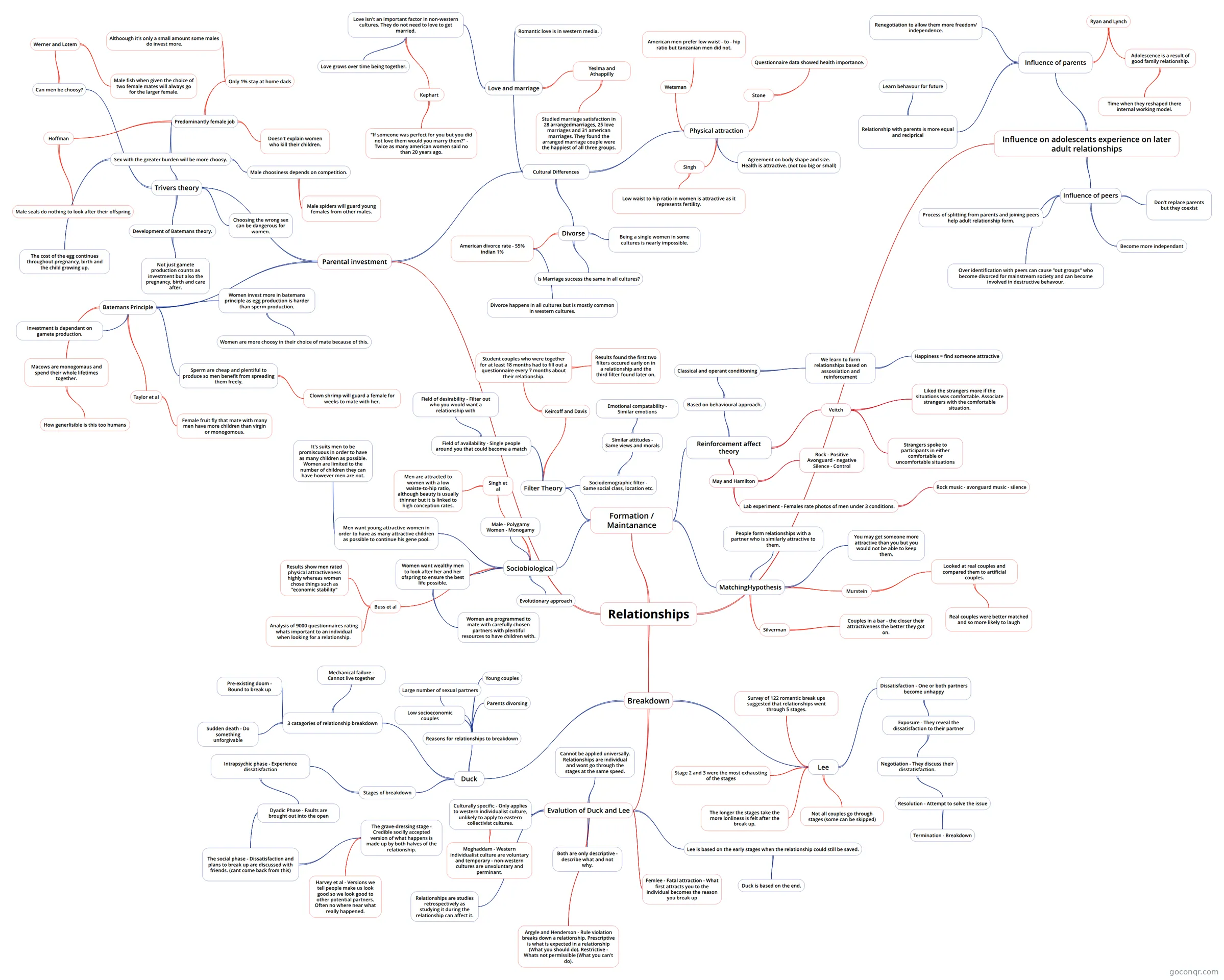
Mind map: Relationships psychology
Map content
Relationships
Formation / Maintanance
- Sociobiological
- Evolutionary approach
- Men want young attractive women in order to have as many attractive children as possible to continue his gene pool.
- It's suits men to be promiscuous in order to have as many children as possible. Women are limited to the number of children they can have however men are not.
- Women want wealthy men to look after her and her ofspring to ensure the best life possible.
- Women are programmed to mate with carefully chosen partners with plentiful resources to have children with.
- Male - Polygamy Women - Monogamy
- Buss et al
- Analysis of 9000 questionnaires rating whats important to an individual when looking for a relationship.
- Results show men rated physical attractiveness highly whereas women chose things such as "economic stability"
- Singh et al
- Men are attracted to women with a low waiste-to-hip ratio, although beauty is usually thinner but it is linked to high conception rates.
- Filter Theory
- Field of availability - Single people around you that could become a match
- Field of desirability - Filter out who you would want a relationship with
- Sociodemographic filter - Same social class, location etc.
- Similar attitudes - Same views and morals
- Emotional compatability - Similar emotions
- Similar attitudes - Same views and morals
- Keircoff and Davis
- Student couples who were together for at least 18 months had to fill out a questionnaire every 7 months about their relationship.
- Results found the first two filters occured early on in a relationship and the third filter found later on.
- Student couples who were together for at least 18 months had to fill out a questionnaire every 7 months about their relationship.
- Field of availability - Single people around you that could become a match
- MatchingHypothesis
- People form relationships with a partner who is similarly attractive to them.
- You may get someone more attractive than you but you would not be able to keep them.
- Murstein
- Looked at real couples and compared them to artificial couples.
- Real couples were better matched and so more likely to laugh
- Looked at real couples and compared them to artificial couples.
- Silverman
- Couples in a bar - the closer their attractiveness the better they got on.
- Reinforcement affect theory
- Based on behavioural approach.
- Classical and operant conditioning
- We learn to form relationships based on assossiation and reinforcement
- Happiness = find someone attractive
- We learn to form relationships based on assossiation and reinforcement
- Classical and operant conditioning
- May and Hamilton
- Lab experiment - Females rate photos of men under 3 conditions.
- Rock music - avonguard music - silence
- Rock - Positive Avonguard - negative Silence - Control
- Lab experiment - Females rate photos of men under 3 conditions.
- Veitch
- Strangers spoke to participants in either comfortable or uncomfortable situations
- Liked the strangers more if the situations was comfortable. Associate strangers with the comfortable situation.
- Based on behavioural approach.
- Sociobiological
Breakdown
- Duck
- Reasons for relationships to breakdown
- Young couples
- Low socioeconomic couples
- Large number of sexual partners
- Parents divorsing
- 3 catagories of relationship breakdown
- Pre-existing doom - Bound to break up
- Mechanical failure - Cannot live together
- Sudden death - Do something unforgivable
- Stages of breakdown
- Intrapsychic phase - Experience dissatisfaction
- Dyadic Phase - Faults are brought out into the open
- The social phase - Dissatisfaction and plans to break up are discussed with friends. (cant come back from this)
- The grave-dressing stage - Credible socilly accepted version of what happens is made up by both halves of the relationship.
- Harvey et al - Versions we tell people make us look good so we look good to other potential partners. Often no where near what really happened.
- The grave-dressing stage - Credible socilly accepted version of what happens is made up by both halves of the relationship.
- The social phase - Dissatisfaction and plans to break up are discussed with friends. (cant come back from this)
- Dyadic Phase - Faults are brought out into the open
- Intrapsychic phase - Experience dissatisfaction
- Reasons for relationships to breakdown
- Lee
- Survey of 122 romantic break ups suggested that relationships went through 5 stages.
- Dissatisfaction - One or both partners become unhappy
- Exposure - They reveal the dissatisfaction to their partner
- Negotiation - They discuss their disstatisfaction.
- Resolution - Attempt to solve the issue
- Termination - Breakdown
- Resolution - Attempt to solve the issue
- Negotiation - They discuss their disstatisfaction.
- Exposure - They reveal the dissatisfaction to their partner
- Stage 2 and 3 were the most exhausting of the stages
- Not all couples go through stages (some can be skipped)
- The longer the stages take the more lonliness is felt after the break up.
- Evalution of Duck and Lee
- Lee is based on the early stages when the relationship could still be saved.
- Duck is based on the end.
- Cannot be applied universally. Relationships are individual and wont go through the stages at the same speed.
- Culturally specific - Only applies to western individualist culture, unlikely to apply to eastern collectivist cultures.
- Moghaddam - Western individualist culture are voluntary and temporary - non-western cultures are unvoluntary and perminant.
- Relationships are studies retrospectively as studying it during the relationship can affect it.
- Both are only descriptive - describe what and not why.
- Femlee - Fatal attraction - What first attracts you to the individual becomes the reason you break up
- Argyle and Henderson - Rule violation breaks down a relationship. Prescriptive is what is expected in a relationship (What you should do). Restrictive - Whats not permissible (What you can't do).
- Lee is based on the early stages when the relationship could still be saved.
- Duck
Parental investment
- Batemans Principle
- Investment is dependant on gamete production.
- Women invest more in batemans principle as egg production is harder than sperm production.
- Women are more choosy in their choice of mate because of this.
- Sperm are cheap and plentiful to produce so men benefit from spreading them freely.
- Clown shrimp will guard a female for weeks to mate with her.
- Taylor et al
- Female fruit fly that mate with many men have more children than virgin or monogomous.
- Macows are monogomaus and spend their whole lifetimes together.
- How generlisible is this too humans
- Trivers theory
- Development of Batemans theory.
- Not just gamete production counts as investment but also the pregnancy, birth and care after.
- Sex with the greater burden will be more choosy.
- The cost of the egg continues throughout pregnancy, birth and the child growing up.
- Predominantly female job
- Hoffman
- Male seals do nothing to look after their offspring
- Only 1% stay at home dads
- Althoough it's only a small amount some males do invest more.
- Doesn't explain women who kill their children.
- Hoffman
- Male choosiness depends on competition.
- Male spiders will guard young females from other males.
- Choosing the wrong sex can be dangerous for women.
- Can men be choosy?
- Werner and Lotem
- Male fish when given the choice of two female mates will always go for the larger female.
- Werner and Lotem
- Development of Batemans theory.
- Cultural Differences
- Love and marriage
- Love isn't an important factor in non-western cultures. They do not need to love to get married.
- Love grows over time being together.
- Kephart
- "If someone was perfect for you but you did not love them would you marry them?" - Twice as many american women said no than 20 years ago.
- Romantic love is in western media.
- Yeslma and Athappilly
- Studied marriage satisfaction in 28 arrangedmarriages, 25 love marriages and 31 american marriages. They found the arranged marriage couple were the happiest of all three groups.
- Love isn't an important factor in non-western cultures. They do not need to love to get married.
- Divorse
- American divorce rate - 55% indian 1%
- Divorce happens in all cultures but is mostly common in western cultures.
- Being a single women in some cultures is nearly impossible.
- Is Marriage success the same in all cultures?
- American divorce rate - 55% indian 1%
- Physical attraction
- Agreement on body shape and size. Health is attractive. (not too big or small)
- Singh
- Low waist to hip ratio in women is attractive as it represents fertility.
- Wetsman
- American men prefer low waist - to - hip ratio but tanzanian men did not.
- Stone
- Questionnaire data showed health importance.
- Love and marriage
- Batemans Principle
Influence on adolescents experience on later adult relationships
- Influence of parents
- Relationship with parents is more equal and reciprical
- Learn behavour for future
- Renegotiation to allow them more freedom/ independence.
- Ryan and Lynch
- Adolescence is a result of good family relationship.
- Time when they reshaped there internal working model.
- Adolescence is a result of good family relationship.
- Relationship with parents is more equal and reciprical
- Influence of peers
- Become more independant
- Process of splitting from parents and joining peers help adult relationship form.
- Don't replace parents but they coexist
- Over identification with peers can cause "out groups" who become divorced for mainstream society and can become involved in destructive behavour.
- Influence of parents
Information
- Description
- A-Level Psychology Mind Map on Relationships, created by shelby cowell on 11/04/2016.
- Created by
- shelby cowell
- Views
- 0
- Rating