
Mind map
The evidence for natural selection
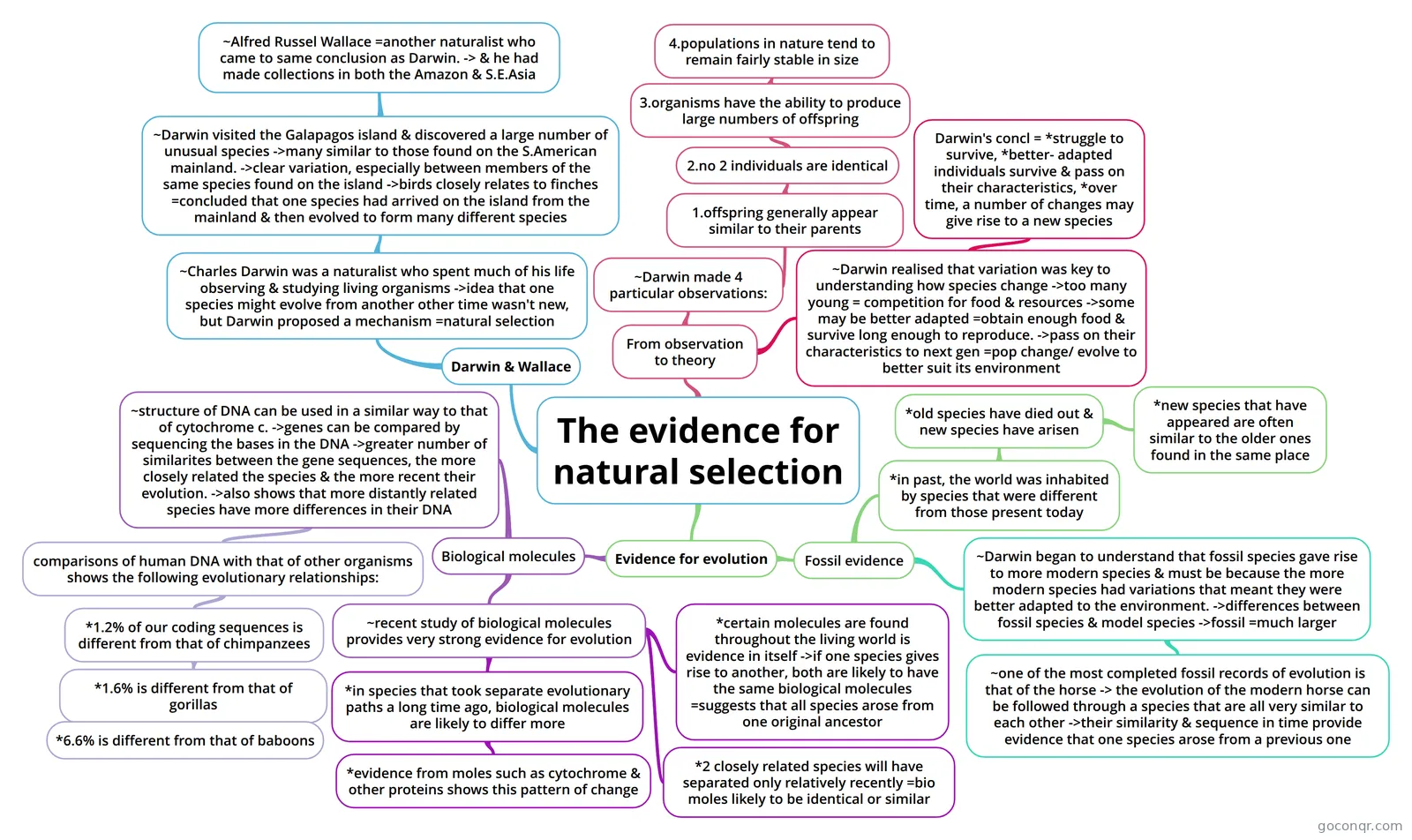
Mind map: The evidence for natural selection
Map content
The evidence for natural selection
Darwin & Wallace
- ~Charles Darwin was a naturalist who spent much of his life observing & studying living organisms ->idea that one species might evolve from another other time wasn't new, but Darwin proposed a mechanism =natural selection
- ~Darwin visited the Galapagos island & discovered a large number of unusual species ->many similar to those found on the S.American mainland. ->clear variation, especially between members of the same species found on the island ->birds closely relates to finches =concluded that one species had arrived on the island from the mainland & then evolved to form many different species
- ~Alfred Russel Wallace =another naturalist who came to same conclusion as Darwin. -> & he had made collections in both the Amazon & S.E.Asia
- ~Darwin visited the Galapagos island & discovered a large number of unusual species ->many similar to those found on the S.American mainland. ->clear variation, especially between members of the same species found on the island ->birds closely relates to finches =concluded that one species had arrived on the island from the mainland & then evolved to form many different species
- ~Charles Darwin was a naturalist who spent much of his life observing & studying living organisms ->idea that one species might evolve from another other time wasn't new, but Darwin proposed a mechanism =natural selection
From observation to theory
- ~Darwin made 4 particular observations:
- 1.offspring generally appear similar to their parents
- 2.no 2 individuals are identical
- 3.organisms have the ability to produce large numbers of offspring
- 4.populations in nature tend to remain fairly stable in size
- 3.organisms have the ability to produce large numbers of offspring
- 2.no 2 individuals are identical
- 1.offspring generally appear similar to their parents
- ~Darwin realised that variation was key to understanding how species change ->too many young = competition for food & resources ->some may be better adapted =obtain enough food & survive long enough to reproduce. ->pass on their characteristics to next gen =pop change/ evolve to better suit its environment
- Darwin's concl = *struggle to survive, *better- adapted individuals survive & pass on their characteristics, *over time, a number of changes may give rise to a new species
- ~Darwin made 4 particular observations:
Evidence for evolution
- Fossil evidence
- *in past, the world was inhabited by species that were different from those present today
- *old species have died out & new species have arisen
- *new species that have appeared are often similar to the older ones found in the same place
- *old species have died out & new species have arisen
- ~Darwin began to understand that fossil species gave rise to more modern species & must be because the more modern species had variations that meant they were better adapted to the environment. ->differences between fossil species & model species ->fossil =much larger
- ~one of the most completed fossil records of evolution is that of the horse -> the evolution of the modern horse can be followed through a species that are all very similar to each other ->their similarity & sequence in time provide evidence that one species arose from a previous one
- *in past, the world was inhabited by species that were different from those present today
- Biological molecules
- ~recent study of biological molecules provides very strong evidence for evolution
- *certain molecules are found throughout the living world is evidence in itself ->if one species gives rise to another, both are likely to have the same biological molecules =suggests that all species arose from one original ancestor
- *2 closely related species will have separated only relatively recently =bio moles likely to be identical or similar
- *in species that took separate evolutionary paths a long time ago, biological molecules are likely to differ more
- *evidence from moles such as cytochrome & other proteins shows this pattern of change
- ~structure of DNA can be used in a similar way to that of cytochrome c. ->genes can be compared by sequencing the bases in the DNA ->greater number of similarites between the gene sequences, the more closely related the species & the more recent their evolution. ->also shows that more distantly related species have more differences in their DNA
- comparisons of human DNA with that of other organisms shows the following evolutionary relationships:
- *1.2% of our coding sequences is different from that of chimpanzees
- *1.6% is different from that of gorillas
- *6.6% is different from that of baboons
- *1.6% is different from that of gorillas
- *1.2% of our coding sequences is different from that of chimpanzees
- comparisons of human DNA with that of other organisms shows the following evolutionary relationships:
- ~recent study of biological molecules provides very strong evidence for evolution
- Fossil evidence
Information
- Description
- AS - Level AS Biology Mind Map on The evidence for natural selection, created by S M on 11/04/2016.
- Created by
- S M
- Views
- 0
- Rating
More on Evidence for Evolution