
Mind map
Cofactors
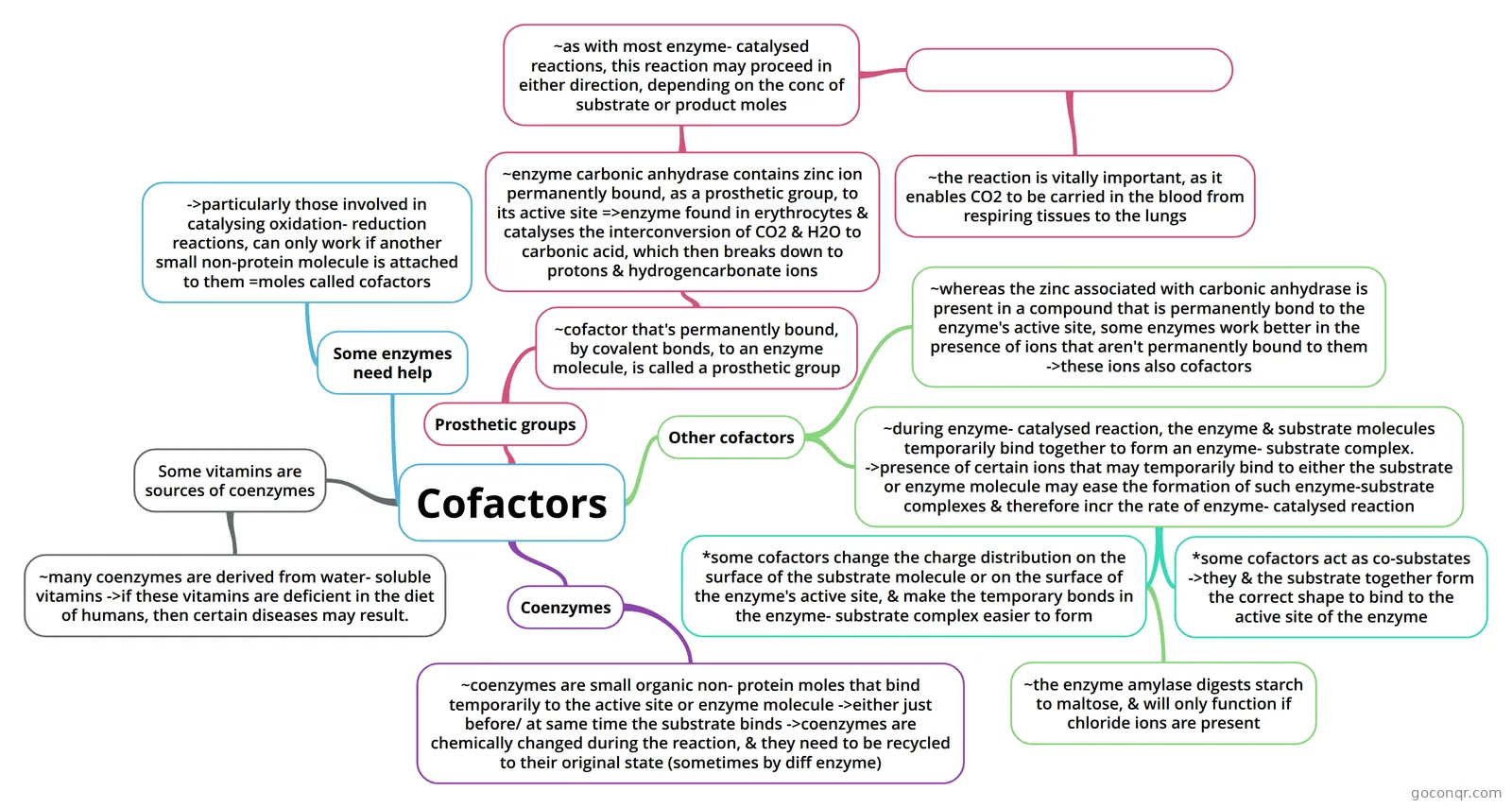
Mind map: Cofactors in enzyme activity
Map content
Cofactors
Some enzymes need help
- ->particularly those involved in catalysing oxidation- reduction reactions, can only work if another small non-protein molecule is attached to them =moles called cofactors
Prosthetic groups
- ~cofactor that's permanently bound, by covalent bonds, to an enzyme molecule, is called a prosthetic group
- ~enzyme carbonic anhydrase contains zinc ion permanently bound, as a prosthetic group, to its active site =>enzyme found in erythrocytes & catalyses the interconversion of CO2 & H2O to carbonic acid, which then breaks down to protons & hydrogencarbonate ions
- ~as with most enzyme- catalysed reactions, this reaction may proceed in either direction, depending on the conc of substrate or product moles
- ~the reaction is vitally important, as it enables CO2 to be carried in the blood from respiring tissues to the lungs
- ~as with most enzyme- catalysed reactions, this reaction may proceed in either direction, depending on the conc of substrate or product moles
- ~enzyme carbonic anhydrase contains zinc ion permanently bound, as a prosthetic group, to its active site =>enzyme found in erythrocytes & catalyses the interconversion of CO2 & H2O to carbonic acid, which then breaks down to protons & hydrogencarbonate ions
- ~cofactor that's permanently bound, by covalent bonds, to an enzyme molecule, is called a prosthetic group
Other cofactors
- ~whereas the zinc associated with carbonic anhydrase is present in a compound that is permanently bond to the enzyme's active site, some enzymes work better in the presence of ions that aren't permanently bound to them ->these ions also cofactors
- ~during enzyme- catalysed reaction, the enzyme & substrate molecules temporarily bind together to form an enzyme- substrate complex. ->presence of certain ions that may temporarily bind to either the substrate or enzyme molecule may ease the formation of such enzyme-substrate complexes & therefore incr the rate of enzyme- catalysed reaction
- *some cofactors act as co-substates ->they & the substrate together form the correct shape to bind to the active site of the enzyme
- *some cofactors change the charge distribution on the surface of the substrate molecule or on the surface of the enzyme's active site, & make the temporary bonds in the enzyme- substrate complex easier to form
- ~the enzyme amylase digests starch to maltose, & will only function if chloride ions are present
Coenzymes
- ~coenzymes are small organic non- protein moles that bind temporarily to the active site or enzyme molecule ->either just before/ at same time the substrate binds ->coenzymes are chemically changed during the reaction, & they need to be recycled to their original state (sometimes by diff enzyme)
Some vitamins are sources of coenzymes
- ~many coenzymes are derived from water- soluble vitamins ->if these vitamins are deficient in the diet of humans, then certain diseases may result.
Information
- Description
- AS - Level AS Biology Mind Map on Cofactors, created by S M on 16/04/2016.
- Created by
- S M
- Views
- 5
- Rating