
Mind map
Rewards/ Needs Satisfaction Theory
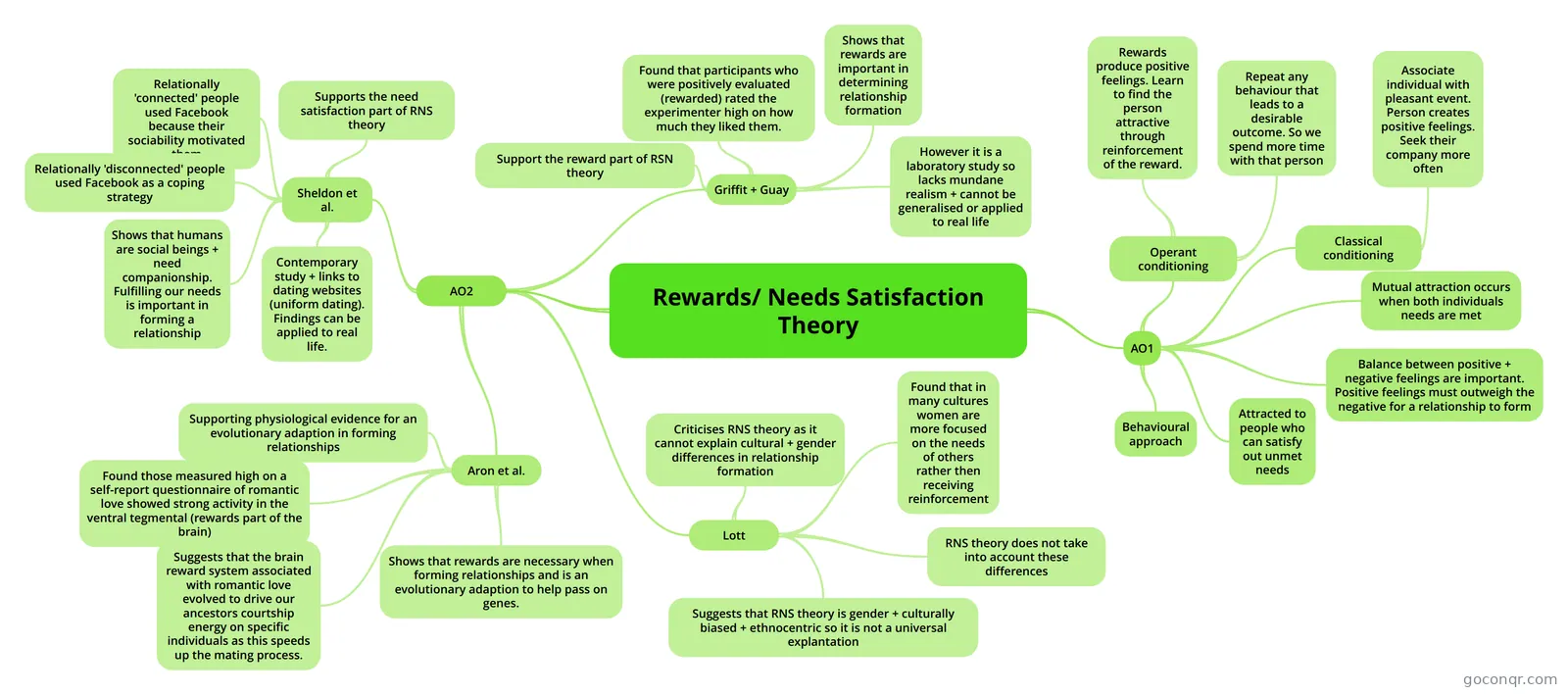
Mind map: Rewards/needs satisfaction theory
Map content
Rewards/ Needs Satisfaction Theory
AO1
- Behavioural approach
- Attracted to people who can satisfy out unmet needs
- Operant conditioning
- Rewards produce positive feelings. Learn to find the person attractive through reinforcement of the reward.
- Repeat any behaviour that leads to a desirable outcome. So we spend more time with that person
- Classical conditioning
- Associate individual with pleasant event. Person creates positive feelings. Seek their company more often
- Balance between positive + negative feelings are important. Positive feelings must outweigh the negative for a relationship to form
- Mutual attraction occurs when both individuals needs are met
AO2
- Griffit + Guay
- Support the reward part of RSN theory
- Found that participants who were positively evaluated (rewarded) rated the experimenter high on how much they liked them.
- Shows that rewards are important in determining relationship formation
- However it is a laboratory study so lacks mundane realism + cannot be generalised or applied to real life
- Sheldon et al.
- Supports the need satisfaction part of RNS theory
- Relationally 'connected' people used Facebook because their sociability motivated them
- Relationally 'disconnected' people used Facebook as a coping strategy
- Shows that humans are social beings + need companionship. Fulfilling our needs is important in forming a relationship
- Contemporary study + links to dating websites (uniform dating). Findings can be applied to real life.
- Aron et al.
- Supporting physiological evidence for an evolutionary adaption in forming relationships
- Found those measured high on a self-report questionnaire of romantic love showed strong activity in the ventral tegmental (rewards part of the brain)
- Suggests that the brain reward system associated with romantic love evolved to drive our ancestors courtship energy on specific individuals as this speeds up the mating process.
- Shows that rewards are necessary when forming relationships and is an evolutionary adaption to help pass on genes.
- Lott
- Criticises RNS theory as it cannot explain cultural + gender differences in relationship formation
- Found that in many cultures women are more focused on the needs of others rather then receiving reinforcement
- RNS theory does not take into account these differences
- Suggests that RNS theory is gender + culturally biased + ethnocentric so it is not a universal explantation
- Griffit + Guay