
Mind map
Loftus and Palmer
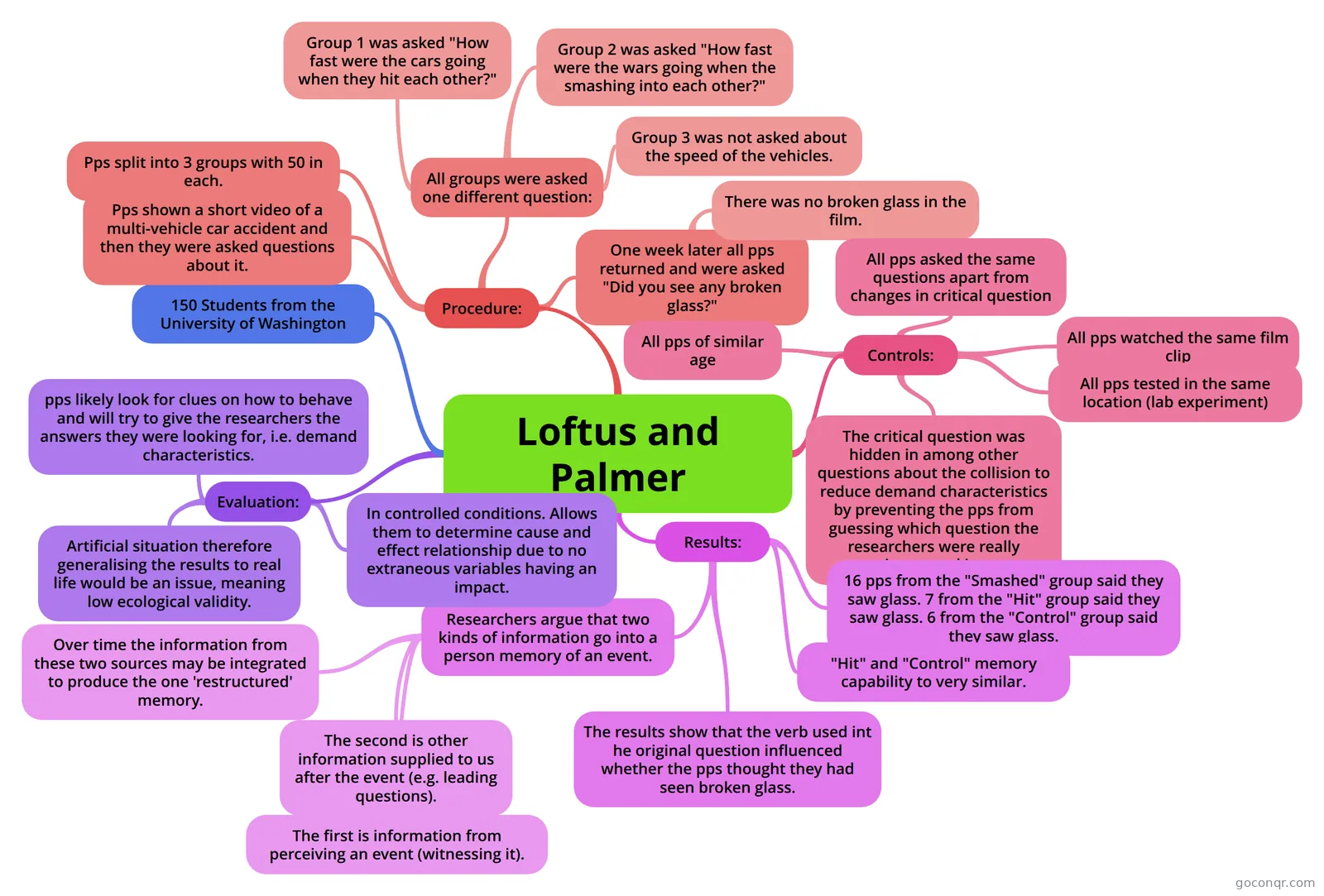
Mind map: Loftus and Palmer study
Map content
Loftus and Palmer
150 Students from the University of Washington
Procedure:
- Pps shown a short video of a multi-vehicle car accident and then they were asked questions about it.
- Pps split into 3 groups with 50 in each.
- All groups were asked one different question:
- Group 1 was asked "How fast were the cars going when they hit each other?"
- Group 2 was asked "How fast were the wars going when the smashing into each other?"
- Group 3 was not asked about the speed of the vehicles.
- One week later all pps returned and were asked "Did you see any broken glass?"
- There was no broken glass in the film.
Controls:
- All pps of similar age
- All pps asked the same questions apart from changes in critical question
- All pps watched the same film clip
- All pps tested in the same location (lab experiment)
- The critical question was hidden in among other questions about the collision to reduce demand characteristics by preventing the pps from guessing which question the researchers were really interested in.
Results:
- 16 pps from the "Smashed" group said they saw glass. 7 from the "Hit" group said they saw glass. 6 from the "Control" group said they saw glass.
- "Hit" and "Control" memory capability to very similar.
- The results show that the verb used int he original question influenced whether the pps thought they had seen broken glass.
- Researchers argue that two kinds of information go into a person memory of an event.
- The first is information from perceiving an event (witnessing it).
- The second is other information supplied to us after the event (e.g. leading questions).
- Over time the information from these two sources may be integrated to produce the one 'restructured' memory.
Evaluation:
- In controlled conditions. Allows them to determine cause and effect relationship due to no extraneous variables having an impact.
- Artificial situation therefore generalising the results to real life would be an issue, meaning low ecological validity.
- pps likely look for clues on how to behave and will try to give the researchers the answers they were looking for, i.e. demand characteristics.
Information
- Description
- Psychology (Cognitive Level Of Analysis) Mind Map on Loftus and Palmer, created by leonie1997 on 24/04/2014.
- Created by
- leonie1997
- Views
- 24
- Rating