
Mind map
Life in Weimar Germany
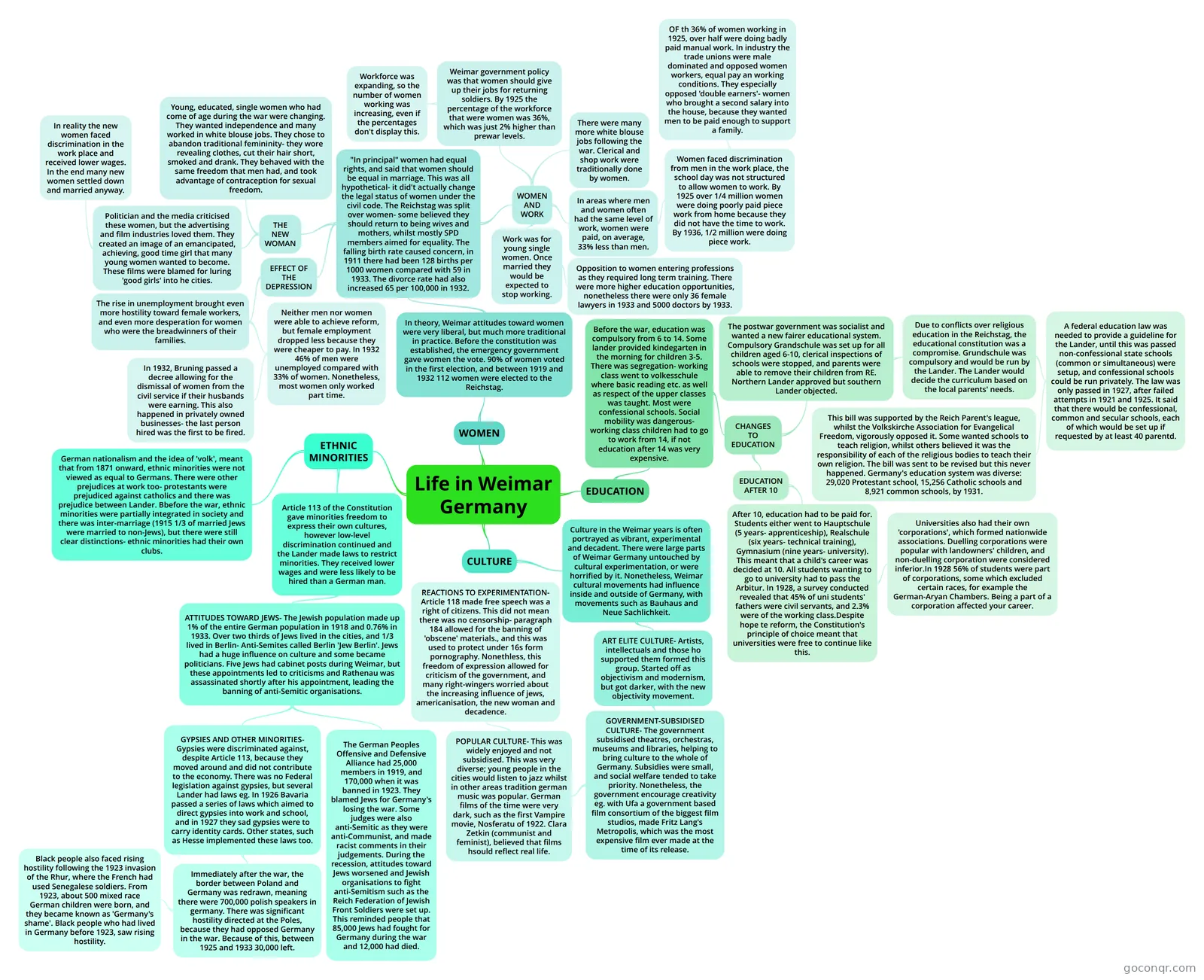
Mind map: Life in Weimar Germany
Map content
Life in Weimar Germany
WOMEN
- In theory, Weimar attitudes toward women were very liberal, but much more traditional in practice. Before the constitution was established, the emergency government gave women the vote. 90% of women voted in the first election, and between 1919 and 1932 112 women were elected to the Reichstag.
- "In principal" women had equal rights, and said that women should be equal in marriage. This was all hypothetical- it did't actually change the legal status of women under the civil code. The Reichstag was split over women- some believed they should return to being wives and mothers, whilst mostly SPD members aimed for equality. The falling birth rate caused concern, in 1911 there had been 128 births per 1000 women compared with 59 in 1933. The divorce rate had also increased 65 per 100,000 in 1932.
- WOMEN AND WORK
- Weimar government policy was that women should give up their jobs for returning soldiers. By 1925 the percentage of the workforce that were women was 36%, which was just 2% higher than prewar levels.
- Workforce was expanding, so the number of women working was increasing, even if the percentages don't display this.
- There were many more white blouse jobs following the war. Clerical and shop work were traditionally done by women.
- In areas where men and women often had the same level of work, women were paid, on average, 33% less than men.
- Women faced discrimination from men in the work place, the school day was not structured to allow women to work. By 1925 over 1/4 million women were doing poorly paid piece work from home because they did not have the time to work. By 1936, 1/2 million were doing piece work.
- OF th 36% of women working in 1925, over half were doing badly paid manual work. In industry the trade unions were male dominated and opposed women workers, equal pay an working conditions. They especially opposed 'double earners'- women who brought a second salary into the house, because they wanted men to be paid enough to support a family.
- Women faced discrimination from men in the work place, the school day was not structured to allow women to work. By 1925 over 1/4 million women were doing poorly paid piece work from home because they did not have the time to work. By 1936, 1/2 million were doing piece work.
- Work was for young single women. Once married they would be expected to stop working.
- Opposition to women entering professions as they required long term training. There were more higher education opportunities, nonetheless there were only 36 female lawyers in 1933 and 5000 doctors by 1933.
- Weimar government policy was that women should give up their jobs for returning soldiers. By 1925 the percentage of the workforce that were women was 36%, which was just 2% higher than prewar levels.
- THE NEW WOMAN
- Young, educated, single women who had come of age during the war were changing. They wanted independence and many worked in white blouse jobs. They chose to abandon traditional femininity- they wore revealing clothes, cut their hair short, smoked and drank. They behaved with the same freedom that men had, and took advantage of contraception for sexual freedom.
- Politician and the media criticised these women, but the advertising and film industries loved them. They created an image of an emancipated, achieving, good time girl that many young women wanted to become. These films were blamed for luring 'good girls' into he cities.
- In reality the new women faced discrimination in the work place and received lower wages. In the end many new women settled down and married anyway.
- EFFECT OF THE DEPRESSION
- The rise in unemployment brought even more hostility toward female workers, and even more desperation for women who were the breadwinners of their families.
- Neither men nor women were able to achieve reform, but female employment dropped less because they were cheaper to pay. In 1932 46% of men were unemployed compared with 33% of women. Nonetheless, most women only worked part time.
- In 1932, Bruning passed a decree allowing for the dismissal of women from the civil service if their husbands were earning. This also happened in privately owned businesses- the last person hired was the first to be fired.
- Neither men nor women were able to achieve reform, but female employment dropped less because they were cheaper to pay. In 1932 46% of men were unemployed compared with 33% of women. Nonetheless, most women only worked part time.
- The rise in unemployment brought even more hostility toward female workers, and even more desperation for women who were the breadwinners of their families.
- WOMEN AND WORK
- "In principal" women had equal rights, and said that women should be equal in marriage. This was all hypothetical- it did't actually change the legal status of women under the civil code. The Reichstag was split over women- some believed they should return to being wives and mothers, whilst mostly SPD members aimed for equality. The falling birth rate caused concern, in 1911 there had been 128 births per 1000 women compared with 59 in 1933. The divorce rate had also increased 65 per 100,000 in 1932.
- In theory, Weimar attitudes toward women were very liberal, but much more traditional in practice. Before the constitution was established, the emergency government gave women the vote. 90% of women voted in the first election, and between 1919 and 1932 112 women were elected to the Reichstag.
EDUCATION
- Before the war, education was compulsory from 6 to 14. Some lander provided kindegarten in the morning for children 3-5. There was segregation- working class went to volkesschule where basic reading etc. as well as respect of the upper classes was taught. Most were confessional schools. Social mobility was dangerous- working class children had to go to work from 14, if not education after 14 was very expensive.
- CHANGES TO EDUCATION
- The postwar government was socialist and wanted a new fairer educational system. Compulsory Grandschule was set up for all children aged 6-10, clerical inspections of schools were stopped, and parents were able to remove their children from RE. Northern Lander approved but southern Lander objected.
- Due to conflicts over religious education in the Reichstag, the educational constitution was a compromise. Grundschule was compulsory and would be run by the Lander. The Lander would decide the curriculum based on the local parents' needs.
- A federal education law was needed to provide a guideline for the Lander, until this was passed non-confessional state schools (common or simultaneous) were setup, and confessional schools could be run privately. The law was only passed in 1927, after failed attempts in 1921 and 1925. It said that there would be confessional, common and secular schools, each of which would be set up if requested by at least 40 parentd.
- This bill was supported by the Reich Parent's league, whilst the Volkskirche Association for Evangelical Freedom, vigorously opposed it. Some wanted schools to teach religion, whilst others believed it was the responsibility of each of the religious bodies to teach their own religion. The bill was sent to be revised but this never happened. Germany's education system was diverse: 29,020 Protestant school, 15,256 Catholic schools and 8,921 common schools, by 1931.
- A federal education law was needed to provide a guideline for the Lander, until this was passed non-confessional state schools (common or simultaneous) were setup, and confessional schools could be run privately. The law was only passed in 1927, after failed attempts in 1921 and 1925. It said that there would be confessional, common and secular schools, each of which would be set up if requested by at least 40 parentd.
- Due to conflicts over religious education in the Reichstag, the educational constitution was a compromise. Grundschule was compulsory and would be run by the Lander. The Lander would decide the curriculum based on the local parents' needs.
- EDUCATION AFTER 10
- After 10, education had to be paid for. Students either went to Hauptschule (5 years- apprenticeship), Realschule (six years- technical training), Gymnasium (nine years- university). This meant that a child's career was decided at 10. All students wanting to go to university had to pass the Arbitur. In 1928, a survey conducted revealed that 45% of uni students' fathers were civil servants, and 2.3% were of the working class.Despite hope te reform, the Constitution's principle of choice meant that universities were free to continue like this.
- Universities also had their own 'corporations', which formed nationwide associations. Duelling corporations were popular with landowners' children, and non-duelling corporation were considered inferior.In 1928 56% of students were part of corporations, some which excluded certain races, for example the German-Aryan Chambers. Being a part of a corporation affected your career.
- After 10, education had to be paid for. Students either went to Hauptschule (5 years- apprenticeship), Realschule (six years- technical training), Gymnasium (nine years- university). This meant that a child's career was decided at 10. All students wanting to go to university had to pass the Arbitur. In 1928, a survey conducted revealed that 45% of uni students' fathers were civil servants, and 2.3% were of the working class.Despite hope te reform, the Constitution's principle of choice meant that universities were free to continue like this.
- The postwar government was socialist and wanted a new fairer educational system. Compulsory Grandschule was set up for all children aged 6-10, clerical inspections of schools were stopped, and parents were able to remove their children from RE. Northern Lander approved but southern Lander objected.
- CHANGES TO EDUCATION
- Before the war, education was compulsory from 6 to 14. Some lander provided kindegarten in the morning for children 3-5. There was segregation- working class went to volkesschule where basic reading etc. as well as respect of the upper classes was taught. Most were confessional schools. Social mobility was dangerous- working class children had to go to work from 14, if not education after 14 was very expensive.
CULTURE
- Culture in the Weimar years is often portrayed as vibrant, experimental and decadent. There were large parts of Weimar Germany untouched by cultural experimentation, or were horrified by it. Nonetheless, Weimar cultural movements had influence inside and outside of Germany, with movements such as Bauhaus and Neue Sachlichkeit.
- ART ELITE CULTURE- Artists, intellectuals and those ho supported them formed this group. Started off as objectivism and modernism, but got darker, with the new objectivity movement.
- GOVERNMENT-SUBSIDISED CULTURE- The government subsidised theatres, orchestras, museums and libraries, helping to bring culture to the whole of Germany. Subsidies were small, and social welfare tended to take priority. Nonetheless, the government encourage creativity eg. with Ufa a government based film consortium of the biggest film studios, made Fritz Lang's Metropolis, which was the most expensive film ever made at the time of its release.
- POPULAR CULTURE- This was widely enjoyed and not subsidised. This was very diverse; young people in the cities would listen to jazz whilst in other areas tradition german music was popular. German films of the time were very dark, such as the first Vampire movie, Nosferatu of 1922. Clara Zetkin (communist and feminist), believed that films hsould reflect real life.
- REACTIONS TO EXPERIMENTATION- Article 118 made free speech was a right of citizens. This did not mean there was no censorship- paragraph 184 allowed for the banning of 'obscene' materials., and this was used to protect under 16s form pornography. Nonethless, this freedom of expression allowed for criticism of the government, and many right-wingers worried about the increasing influence of jews, americanisation, the new woman and decadence.
- POPULAR CULTURE- This was widely enjoyed and not subsidised. This was very diverse; young people in the cities would listen to jazz whilst in other areas tradition german music was popular. German films of the time were very dark, such as the first Vampire movie, Nosferatu of 1922. Clara Zetkin (communist and feminist), believed that films hsould reflect real life.
- GOVERNMENT-SUBSIDISED CULTURE- The government subsidised theatres, orchestras, museums and libraries, helping to bring culture to the whole of Germany. Subsidies were small, and social welfare tended to take priority. Nonetheless, the government encourage creativity eg. with Ufa a government based film consortium of the biggest film studios, made Fritz Lang's Metropolis, which was the most expensive film ever made at the time of its release.
- ART ELITE CULTURE- Artists, intellectuals and those ho supported them formed this group. Started off as objectivism and modernism, but got darker, with the new objectivity movement.
- Culture in the Weimar years is often portrayed as vibrant, experimental and decadent. There were large parts of Weimar Germany untouched by cultural experimentation, or were horrified by it. Nonetheless, Weimar cultural movements had influence inside and outside of Germany, with movements such as Bauhaus and Neue Sachlichkeit.
ETHNIC MINORITIES
- German nationalism and the idea of 'volk', meant that from 1871 onward, ethnic minorities were not viewed as equal to Germans. There were other prejudices at work too- protestants were prejudiced against catholics and there was prejudice between Lander. Bbefore the war, ethnic minorities were partially integrated in society and there was inter-marriage (1915 1/3 of married Jews were married to non-Jews), but there were still clear distinctions- ethnic minorities had their own clubs.
- Article 113 of the Constitution gave minorities freedom to express their own cultures, however low-level discrimination continued and the Lander made laws to restrict minorities. They received lower wages and were less likely to be hired than a German man.
- ATTITUDES TOWARD JEWS- The Jewish population made up 1% of the entire German population in 1918 and 0.76% in 1933. Over two thirds of Jews lived in the cities, and 1/3 lived in Berlin- Anti-Semites called Berlin 'Jew Berlin'. Jews had a huge influence on culture and some became politicians. Five Jews had cabinet posts during Weimar, but these appointments led to criticisms and Rathenau was assassinated shortly after his appointment, leading the banning of anti-Semitic organisations.
- The German Peoples Offensive and Defensive Alliance had 25,000 members in 1919, and 170,000 when it was banned in 1923. They blamed Jews for Germany's losing the war. Some judges were also anti-Semitic as they were anti-Communist, and made racist comments in their judgements. During the recession, attitudes toward Jews worsened and Jewish organisations to fight anti-Semitism such as the Reich Federation of Jewish Front Soldiers were set up. This reminded people that 85,000 Jews had fought for Germany during the war and 12,000 had died.
- GYPSIES AND OTHER MINORITIES- Gypsies were discriminated against, despite Article 113, because they moved around and did not contribute to the economy. There was no Federal legislation against gypsies, but several Lander had laws eg. In 1926 Bavaria passed a series of laws which aimed to direct gypsies into work and school, and in 1927 they sad gypsies were to carry identity cards. Other states, such as Hesse implemented these laws too.
- Immediately after the war, the border between Poland and Germany was redrawn, meaning there were 700,000 polish speakers in germany. There was significant hostility directed at the Poles, because they had opposed Germany in the war. Because of this, between 1925 and 1933 30,000 left.
- Black people also faced rising hostility following the 1923 invasion of the Rhur, where the French had used Senegalese soldiers. From 1923, about 500 mixed race German children were born, and they became known as 'Germany's shame'. Black people who had lived in Germany before 1923, saw rising hostility.
- Immediately after the war, the border between Poland and Germany was redrawn, meaning there were 700,000 polish speakers in germany. There was significant hostility directed at the Poles, because they had opposed Germany in the war. Because of this, between 1925 and 1933 30,000 left.
- ATTITUDES TOWARD JEWS- The Jewish population made up 1% of the entire German population in 1918 and 0.76% in 1933. Over two thirds of Jews lived in the cities, and 1/3 lived in Berlin- Anti-Semites called Berlin 'Jew Berlin'. Jews had a huge influence on culture and some became politicians. Five Jews had cabinet posts during Weimar, but these appointments led to criticisms and Rathenau was assassinated shortly after his appointment, leading the banning of anti-Semitic organisations.
Information
- Description
- A level History (Germany 1918-1989) Mind Map on Life in Weimar Germany, created by Beth Sykes on 11/03/2017.
- Created by
- Beth Sykes
- Views
- 4
- Rating