
Mind map
Blakemore and Cooper
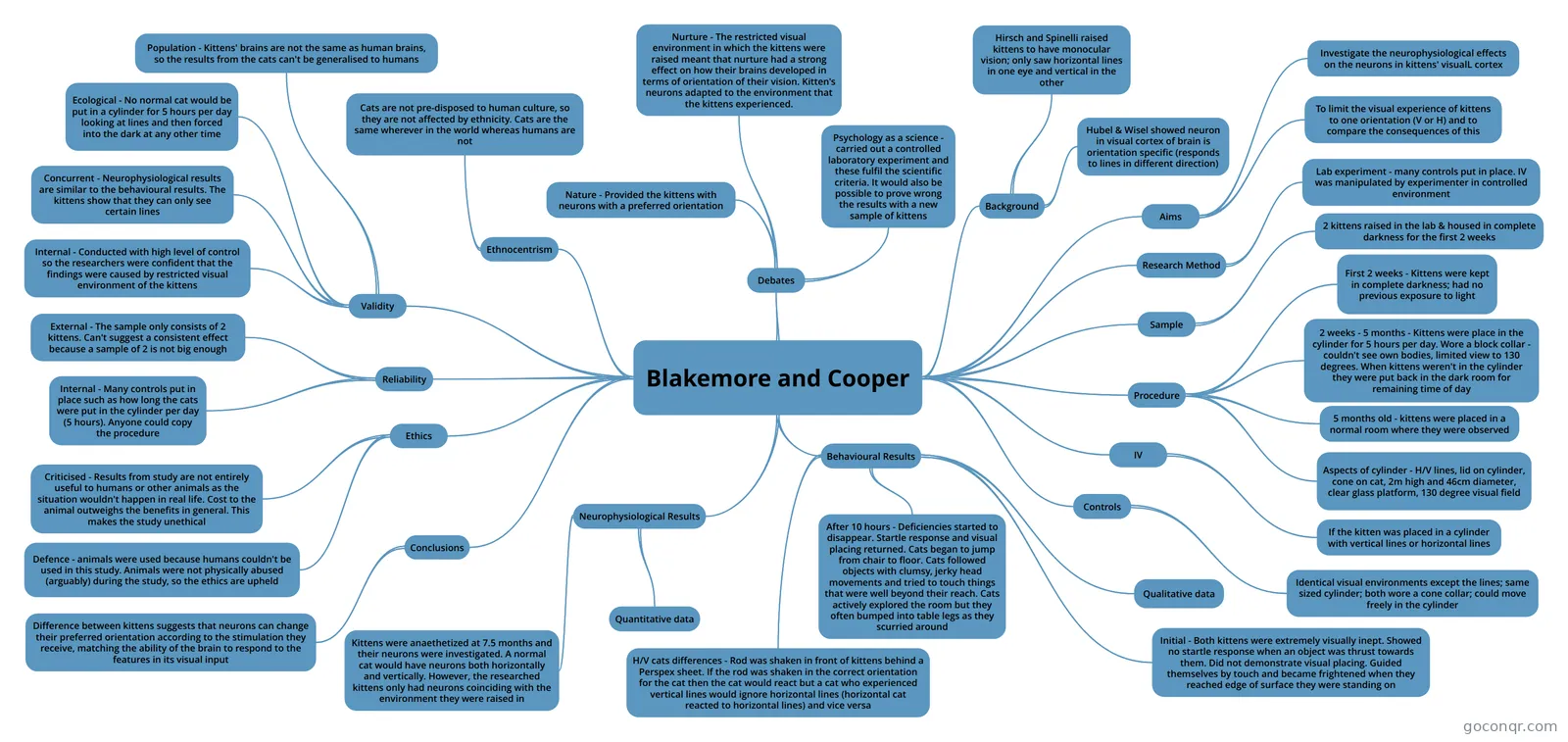
Mind map: Blakemore and Cooper study
Map content
Blakemore and Cooper
Background
- Hubel & Wisel showed neuron in visual cortex of brain is orientation specific (responds to lines in different direction)
- Hirsch and Spinelli raised kittens to have monocular vision; only saw horizontal lines in one eye and vertical in the other
Aims
- To limit the visual experience of kittens to one orientation (V or H) and to compare the consequences of this
- Investigate the neurophysiological effects on the neurons in kittens' visualL cortex
Research Method
- Lab experiment - many controls put in place. IV was manipulated by experimenter in controlled environment
Sample
- 2 kittens raised in the lab & housed in complete darkness for the first 2 weeks
Procedure
- First 2 weeks - Kittens were kept in complete darkness; had no previous exposure to light
- 2 weeks - 5 months - Kittens were place in the cylinder for 5 hours per day. Wore a block collar - couldn't see own bodies, limited view to 130 degrees. When kittens weren't in the cylinder they were put back in the dark room for remaining time of day
- 5 months old - kittens were placed in a normal room where they were observed
- Aspects of cylinder - H/V lines, lid on cylinder, cone on cat, 2m high and 46cm diameter, clear glass platform, 130 degree visual field
IV
- If the kitten was placed in a cylinder with vertical lines or horizontal lines
Controls
- Identical visual environments except the lines; same sized cylinder; both wore a cone collar; could move freely in the cylinder
Behavioural Results
- Initial - Both kittens were extremely visually inept. Showed no startle response when an object was thrust towards them. Did not demonstrate visual placing. Guided themselves by touch and became frightened when they reached edge of surface they were standing on
- After 10 hours - Deficiencies started to disappear. Startle response and visual placing returned. Cats began to jump from chair to floor. Cats followed objects with clumsy, jerky head movements and tried to touch things that were well beyond their reach. Cats actively explored the room but they often bumped into table legs as they scurried around
- H/V cats differences - Rod was shaken in front of kittens behind a Perspex sheet. If the rod was shaken in the correct orientation for the cat then the cat would react but a cat who experienced vertical lines would ignore horizontal lines (horizontal cat reacted to horizontal lines) and vice versa
- Qualitative data
Neurophysiological Results
- Kittens were anaethetized at 7.5 months and their neurons were investigated. A normal cat would have neurons both horizontally and vertically. However, the researched kittens only had neurons coinciding with the environment they were raised in
- Quantitative data
Conclusions
- Difference between kittens suggests that neurons can change their preferred orientation according to the stimulation they receive, matching the ability of the brain to respond to the features in its visual input
Ethics
- Defence - animals were used because humans couldn't be used in this study. Animals were not physically abused (arguably) during the study, so the ethics are upheld
- Criticised - Results from study are not entirely useful to humans or other animals as the situation wouldn't happen in real life. Cost to the animal outweighs the benefits in general. This makes the study unethical
Reliability
- Internal - Many controls put in place such as how long the cats were put in the cylinder per day (5 hours). Anyone could copy the procedure
- External - The sample only consists of 2 kittens. Can't suggest a consistent effect because a sample of 2 is not big enough
Validity
- Internal - Conducted with high level of control so the researchers were confident that the findings were caused by restricted visual environment of the kittens
- Concurrent - Neurophysiological results are similar to the behavioural results. The kittens show that they can only see certain lines
- Ecological - No normal cat would be put in a cylinder for 5 hours per day looking at lines and then forced into the dark at any other time
- Population - Kittens' brains are not the same as human brains, so the results from the cats can't be generalised to humans
Ethnocentrism
- Cats are not pre-disposed to human culture, so they are not affected by ethnicity. Cats are the same wherever in the world whereas humans are not
Debates
- Nature - Provided the kittens with neurons with a preferred orientation
- Nurture - The restricted visual environment in which the kittens were raised meant that nurture had a strong effect on how their brains developed in terms of orientation of their vision. Kitten's neurons adapted to the environment that the kittens experienced.
- Psychology as a science - carried out a controlled laboratory experiment and these fulfil the scientific criteria. It would also be possible to prove wrong the results with a new sample of kittens
Information
- Description
- AS level Psychology (Unit 2) Mind Map on Blakemore and Cooper, created by Charlotte Lodge on 12/03/2017.
- Created by
- Charlotte Lodge
- Views
- 21
- Rating