
Atypical Behaviour
Slides in this set (7)
-
- GCSE Psychology
- Also see - http://www.varndean.co.uk/wp-content/uploads/2013/11/End-of-Year-10-Revision-Atypical.pdf
-
- Buzzwords
- Typical Behaviour: Behaviour which is considered normal and applies to the majority of the population
- Atypical Behaviour: Behaviour which is considered abnormal and applies to the minority of the population
- AN EXAMPLE OF ATYPICAL BEHAVIOUR = PHOBIAS
- Phobias: Intense, persistent and irrational fears of contexts, activities or objects.
- DISCLAIMER: It is normal to experience fear BUT not intensely in non-threatening situations.
- Symptoms of phobias include:
- Heart Pounding
- Sweating
- Dizziness
- Sickness
- Loss of Concentration
- Examples of phobias
- Agoraphobia: Phobia of being in a place or situation that you cannot escape.
- Social Phobia: Phobia (or dread) of social situations, fear of being judged in particular. (Most sufferers realise they're being irrational)
- School Phobia: Phobia of attending school, heavily related to fear of leaving the home/parents. (Common in 11/12 y/o boys)
- Acrophobia: Phobia of heights, due to the fear of losing balance and falling.
- Arachnophobia: The (irrational) fear of spiders, fearing photos and words relating to spiders. (Common in women)
-
- The Alternative Theory, also known as the evolutionary theory, is as suggested, heavily rooted in the theory of evolution.
- It states that fear is instinctive and that we have evolved this way as it helps us to survive and so reproduce to pass on our genes.
- The theory also believes that we are born with a 'biological preparedness to fear certain situations and objects as they may pose a threat to our survival.
- And so, we are afraid most of animals which are most genetically dissimilar to us, as they are seen to be the most likely to attack us.
- Things that were not around during the evolutionary process eg. guns have not been around long enough for us to develop an innate 'fear' of them.
-
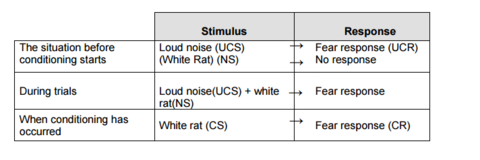
- 9 month 'Little Albert' was subjected to a range of neutral stimuli including a white rat as well as the unconditioned stimulus, a hammer striking a metal bar which brought him some degree of distress.
- At 11 months they brought him back to be conditioned to fear white rats.
- They carried out 7 trials over a period of 2 weeks, where whenever Albert tried to touch the rat, the metal bar was struck, this conditioned him to fear rats.
- Stimulus generalisation was evident when he feared other white objects days later.
- They had successfully conditioned a fear of rats.
- Caption: Diagram
-
- Phobia was artificially conditioned, and so the experiment lacks ecological validity as naturally occurring phobias only take one trial and other factors contribute to phobias.
- Only one child was conditioned and so we cannot generalise for the whole population, we do not know that everyone would react in the same way.
- And most obviously, the experiment was incredibly unethical, the experimenter's didn't try to help Albert afterwards, and it has been asked if the mother knew what she was consenting to.
-
Core Theory - Behaviourist Approach
- Phobias are seen as being learned through the negative association between and object and situation, which is an example of classical/operant conditioning.
- Buzzwords
- Classical Conditioning - Learning through association, so that certain stimuli trigger certain responses.
- Unconditioned Stimulus - Triggers a natural response.
- Unconditioned Response - A natural response, innate.
- Neutral Stimulus - Does not usually trigger a response.
- Conditioned Stimulus - Triggers a learnt response.
- Conditioned Response - Learnt through association.
- Stimulus Generalisation - Learnt response is triggered by similar stimuli to the original.
- Extinction - The conditioned stimulus no longer triggers the response.
- Spontaneous Recovery - Conditioned behaviour reappears.
- Operant Conditioning:
- Operant conditioning is learning through consequence, if we are rewarded (eg. chocolate) then we repeat the behaviour, but if we are punished (eg. detention) then we don't repeat the behaviour. Linking this to phobias, when a phobic person avoids their fear, they feel relief which acts as a reward and so they continue with their fear, when they encounter said stimulus, they feel dread and fear which acts as punishment.
- This theory explains why phobias continue.
-
- Ignores the thinking behind phobias -----> Ignores people react differently to scenarios, not everyone thinks in the same way.
- Ignores phobias caused by indirect experience -----> Phobias can develop through mimicking the behaviour of others.
- Ignores the role of nature -----> Some phobias are the result of evolution, as they help with our survival.
Information
- Description
- Revision slide show
- Created by
- Charlotte Knight · Aug 2015
- Updated
- Sep 17, 2016
- Views
- 77
- Tags
- Rating