
Notes
Origins of American Slavery
Content of the notes (1)
Page 1
Origins of American Slavery
Beginnings of Slavery in the Americas
Slavery in America began when the first African slaves were brought to the North American colony of Jamestown, Virginia, in 1619, to aid in the production of such lucrative crops as tobacco.
Slavery was practiced throughout the American colonies in the 17th and 18th centuries, and African-American slaves helped build the economic foundations of the new nation.
The invention of the cotton gin in 1793 solidified the central importance of slavery to the South’s economy. By the mid-19th century, America’s westward expansion, along with a growing abolition movement in the North, would provoke a great debate over slavery that would tear the nation apart in the bloody American Civil War (1861-65).
Though the Union victory freed the nation’s 4 million slaves, the legacy of slavery continued to influence American history, from the tumultuous years of Reconstruction (1865-77) to the civil rights movement that emerged in the 1960s, a century after emancipation.
1793 Invention of Cotton Gin - It's importance
In the late 18th century, with the land used to grow tobacco nearly exhausted, the South faced an economic crisis, and the continued growth of slavery in America seemed in doubt. Around the same time, the mechanization of the textile industry in England led to a huge demand for American cotton, a southern crop whose production was unfortunately limited by the difficulty of removing the seeds from raw cotton fibers by hand. In 1793, a young Yankee schoolteacher named Eli Whitney invented the cotton gin, a simple mechanized device that efficiently removed the seeds. His device was widely copied, and within a few years the South would transition from the large-scale production of tobacco to that of cotton, a switch that reinforced the region’s dependence on slave labor.
Slavery itself was never widespread in the North, though many of the region’s businessmen grew rich on the slave trade and investments in southern plantations. Between 1774 and 1804, all of the northern states abolished slavery, but the so-called “peculiar institution” remained absolutely vital to the South. Though the U.S. Congress outlawed the African slave trade in 1808, the domestic trade flourished, and the slave population in the U.S. nearly tripled over the next 50 years. By 1860 it had reached nearly 4 million, with more than half living in the cotton-producing states of the South.
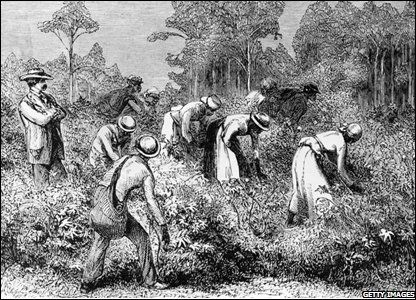
Foundations of Slavery in America
In the early 17th century, European settlers in North America turned to
African slaves as a cheaper, more plentiful labor source than indentured
servants (who were mostly poorer Europeans).
After 1619, when a Dutch
ship brought 20 Africans ashore at the British colony of Jamestown, Virginia
slavery spread throughout the American colonies.
Though it is
impossible to give accurate figures, some historians have estimated that
6 to 7 million slaves were imported to the New World during the 18th
century alone, depriving the African continent of some of its healthiest
and ablest men and women.
Information
- Description
- Note on Origins of American Slavery
- Created by
- Deleted user · Oct 2016
- Updated
- Jan 4, 2017
- Views
- 14
- Tags
- History
-
- Created by j. stu · Mar 24, 2015
- Copied by Robert Apter · Oct 12, 2016
- Rating