
Quiz
MO18 Other Important Reactions
This quiz has question types that open in the usual player.
Questions in this quiz (7)
1Electrophilic aromatic substitution occurs when a drug with an aromatic ring has a [blank_start]hydrogen[blank_end] substituted for [blank_start]another group[blank_end]. The aromatic ring is the [blank_start]nucleophile[blank_end] and the species it reacts with is the [blank_start]electrophile[blank_end]. During the reaction mechanism, the [blank_start]positive[blank_end] charge on the aromatic ring is ‘shared’ in resonance.
- Ahydrogen
- Banother group
- Cnucleophile
- Delectrophile
- Epositive
- Fnegative
2In electrophilic aromatic substitution, the electrophile needs a formal positive charge.
- ATrue
- BFalse
3Choose the best definition for dealkylation.
- AReplacement of an alkyl group (often a methyl group) with a hydrogen
- BReplacement of an alkyl group (often a methyl group) with another group
- CReplacement of an alkyl group (often a methyl group) with an alcohol (hydroxide)
4Name these reactions.
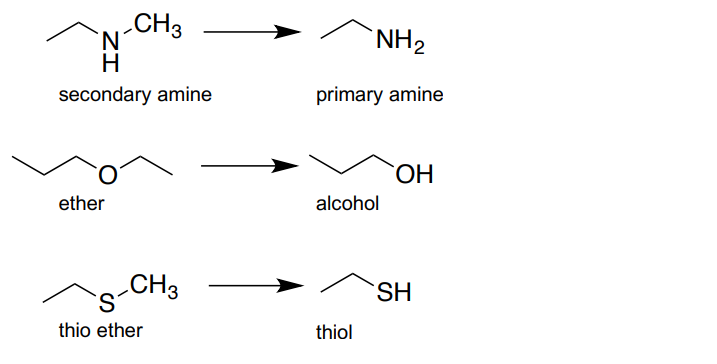
- AN-demethylation
- BO-dealkylation
- CS-demethylation
5Dealkylation is:
- Aa substitution reaction
- Ban elimination reaction
6Which of these is NOT a prefix used in the naming terminology of dealkylated drugs?
- Adesmethyl
- Bdemthyl
- Cnor
- Dnos
7Alkylation, acylation, and oxidation all form new covalent bonds.
Alkylation is transfer of an alkyl group to e.g. a C, N, O or S. The drug acts as the [blank_start]electrophile[blank_end] and the biological partner acts as the [blank_start]nucleophile[blank_end] ie the C, N, O or S is part of the biologic. This means it could have an [blank_start]alcohol, amine, or thiol[blank_end] which is alkylated. The electrophile is usually a carbon with a [blank_start]positive charge[blank_end] or an [blank_start]electron poor[blank_end] carbon.
Acylation is transfer of an acyl group to a molecule ie an [blank_start]ethyl ester[blank_end]. Amines become [blank_start]amides[blank_end], alcohols become [blank_start]esters[blank_end], and thiols become [blank_start]thioesters[blank_end]. Again, the [blank_start]drug[blank_end] acts as the electrophile and the [blank_start]biological partner[blank_end] acts as the nucleophile. The difference to drug alkylation of a biological target is the drug electrophile is the [blank_start]carbonyl carbon[blank_end] of an acyl group.- Aelectrophile
- Bnucleophile
- Calcohol, amine, or thiol
- Dpositive charge
- Enegative charge
- Felectron poor
- Gelectron rich
- Hethyl ester
- Iamides
- Jesters
- Kthioesters
- Ldrug
- Mbiological partner
- Ncarbonyl carbon
Information
- Description
- PHCY211 (Molecules) Quiz on MO18 Other Important Reactions, created by Mer Scott on 13/04/2018.
- Author
- Mer Scott
- Language
- English
- Views
- 4
- Tags
- Rating
- No ratings yet Rate this quiz