
Flashcards
PA WEEK 9: Assessment of Substance Use
Cards in this deck (16)
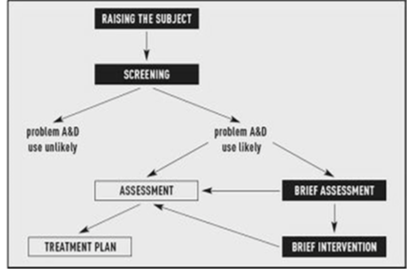
- 1Draw the model of assessment in substance use
- 2List the major screening tools designed to detect alcohol problems in the general populationAlcohol use disorders identification test (AUDIT)
ASSIST (WHO for drug use)
Michigan alcohol screening test (MAST)
CAGE questionnaire
Adolescent alcohol involvement scale
Drug use screening inventory
biological screening measures - 3What are the properties of the alcohol use disorders identification test (AUDIT)• Developed by WHO to identify adults whose alcohol consumption has become hazardous or harmful to their health
• Ten items with good psychometric properties
• Assesses CURRENT as well as PAST use
• Measures QUANTITY and PROBLEMS
• Scores: - 8+ = hazardous drinking
- 15+ = possible dependence - 4What is the purpose of screening instruments?designed to detect substance use problems in the general population
- 5If a problem is detected during screening what is the next step?a more comprehensive evaluation (assessment) followed by a diagnosis and treatment plan
OR
a brief assessment leading to a comprehensive assessment or brief intervention, then comprehensive assessment, diagnosis, and treatment plan - 6What are the diagnostic tools and process that are applied once a substance-use problem has been identified?Structured interviews
semi-structured interviews
clinical interviews (unstructured)
Timeline follow back for pattern of use
screen for depression/anxiety
Mental state exam
ABI screening
?neuropsych assessment - 7What are the core concepts in assessment of substance use?Motivation to change
assessing risk
functional assessment
skills and barriers to change - 8Why is motivation important in addiction?Treatment of addiction is as successful as other chronic conditions
e.g. diabetes, asthma (40-60%)
Good outcomes depend on people staying in treatment, 50% exit after first contact
Motivational Interviewing shown to enhance engagement and retention in treatment - 9How do you assess motivation?Broadly: How ready is this person to make changes? How much have they planned it? What are they prepared to give up/endure for change?
Target treatment based on stage of change; typically 5 stages: Pre-contemplative, Contemplative, Action, Maintenance, Relapse - 10What is the core principle of motivational interviewing?Responsibility and capacity for change lie within the client, Therapist task is to create a set of conditions to enhance client’s intrinsic motivation for change and their natural helping relationships
- 11How do you assess risk?Broadly: Is the person at risk while using?
If they stop? What are your duty of care and reporting requirements?
• Health/medical risks: Seizures & death through withdrawal, liver failure, overdose, blood borne viruses, acquired brain injury, thiamine deficiency
• Behaviour/mental state whilst intoxicated or during withdrawal: Suicide, assault, illegal activities, sexual activity
• Psychosocial Context: Domestic Violence, Impacts on children, Gang associations - 12How do you assess functions of use?Broadly: What does the person gain or avoid through their use?
• In assessment consider
a) Antecedents/triggers (“high risk situations”) and
b) Consequences/maintaining factors
• Look for internal changes e.g. Physiological state, psychological distress as well as external variables
e.g. safety from DV, money, social status
Dependency
poly-substance use
symptom management
psychosocial context: status, safety, money, cultural norms - 13How do you assess coping skills/barriers to changeBroadly: If the person stops alcohol/drug use, what resources do they have to cope? How likely is relapse? Degree of support is a significant factor in treatment retention
• Lack of alternative skills /behaviours: Social skills, frustration tolerance, relaxation, stress management, delaying gratification, problem solving
• Lifestyle: presence of non-using peers, unemployment, exposure to alternative leisure activities, recovery environment (access to substances and level of support) - 14What is the timeline follow back method?Attempts to obtain detailed drinking information via the use of memory aids
1. Calendar
2. Important dates
3. Significant periods of light or heavy days
4. Anchor points
5. Exaggeration technique - 15How do you implement the timeline follow back method?With a calendar ask the client to mark off events on the calendar (birthdays, appointments, paydays, drug purchase, stressful situations etc.)
Mark drug free periods on the calendar
Mark typical use on the calendar
Mark non-typical drug use days and amounts on the calendar
Each day should have used/not used and how much - 16How does a substance use clinical interview differ from other clinical interviews?Long interview
Comprehensive risk assessment
not sure?? watched the lecture, went through the slides, couldn't find anything! any suggestions would be welcomed :)
Information
- Description
- University Honours in Psychology (PA) Flashcards on PA WEEK 9: Assessment of Substance Use, created by jfielke on 05/10/2015.
- Created by
- jfielke
- Views
- 98
- Rating