
Business Finance and Investment Appraisal
20 resources created by 20 users
This Business Finance and Investment Appraisal page on GoConqr gathers community-made quizzes, mind maps, flashcards, notes and slides, from revenue, cost and profit to ratio analysis, working capital and capital budgeting. It's built for school students, university students and professional candidates revising a topic, plus teachers after ready-made material. There are over 190 resources here, including more than 10 quizzes, over 80 mind maps and over 80 flashcard decks. Pick a topic, try a quiz to find your gaps, then build your own sets.
Top Business Finance and Investment Appraisal resources
-
100 questionsCMA- GLEIM MCQ - Part 1 (1st Batch) [1] Gleim #: 1.1.1 -- Source: CMA 691 3-2 Each organization plans and budgets its operations for slightly d...
-
104 questionsACC 102 Midterm Review Questions When compound interest is used, interest accumulates less quickly than when simple interest is used.
-
 Mind map Revenue , Cost and Profit This resource is Public, meaning it can be discovered via search or in the Library. Become a Premium Creato...
-
5 questionsFinancial Management 101 - Module 1 What are the three types of chargeable cost objects discussed in Module 1, Topic 1?
-
40 cardsChapter 15 Cost Accounting accounting rate of return (ARR)
-
Mind map 6.4 - Analysing Financial Performance
-
27 cardsSources of Finance capital needed by an entrepreneur to set up a business
-
41 cardsAccounting and Finance Advantages and disadvantages of a sole trader
Quizzes
-
100 questionsCMA- GLEIM MCQ - Part 1 (1st Batch) [1] Gleim #: 1.1.1 -- Source: CMA 691 3-2 Each organization plans and budgets its operations for slightly d...
-
104 questionsACC 102 Midterm Review Questions When compound interest is used, interest accumulates less quickly than when simple interest is used.
-
5 questionsFinancial Management 101 - Module 1 What are the three types of chargeable cost objects discussed in Module 1, Topic 1?
-
6 questionsBusiness 5 Debts that must be paid soon
Mind maps
-
Revenue , Cost and Profit This resource is Public, meaning it can be discovered via search or in the Library. Become a Premium Creato...
-
6.4 - Analysing Financial Performance
-
Chapter 22 - Cash This covers chapter 22, (the first sub-topic of the Finance Section) with regards to the CIE IGCSE Business...
-
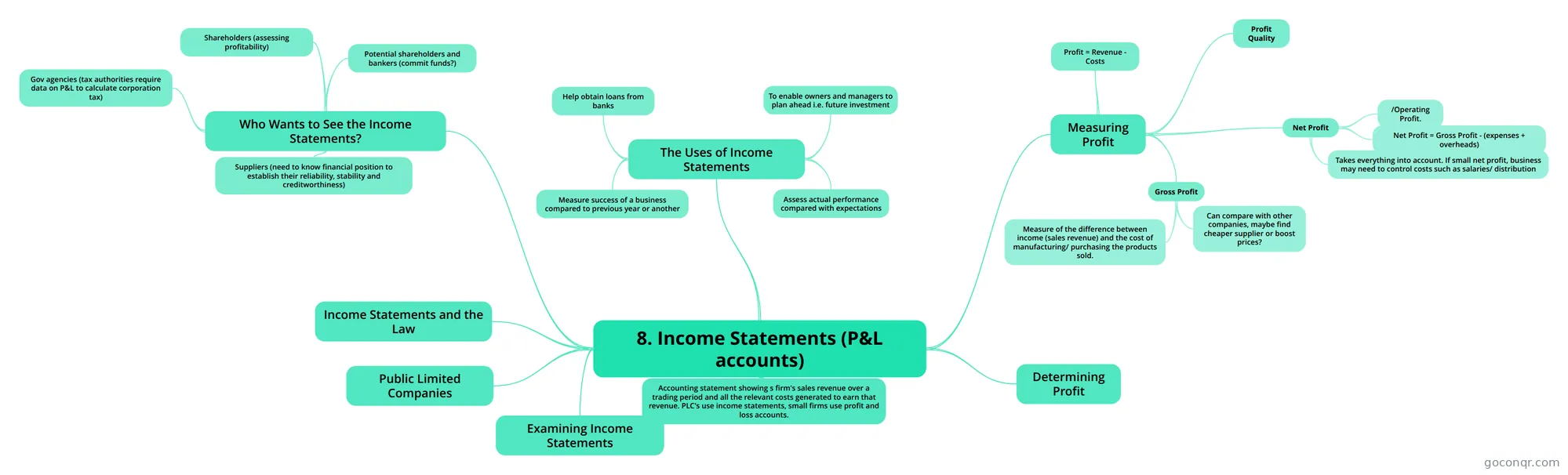 8. Income Statements (P&L accounts)
-
Chapter 14 - Capital Budgeting Decisions Chapter 14 - Capital Budgeting Decisions
Flashcards
See all 10 flashcards-
40 cardsChapter 15 Cost Accounting accounting rate of return (ARR)
-
27 cardsSources of Finance capital needed by an entrepreneur to set up a business
-
41 cardsAccounting and Finance Advantages and disadvantages of a sole trader
-
29 cardsTHEME 2 : Managing Finance Profit and Liquidity
-
27 cardsBusiness Lvl 3 formula's To help with memorising all potentially relevant formula for Year 1 level 3 BTEC Business
-
21 cardsKey Terms BTEC Business studies Unit 2 Finance
-
8 cardsFinance equations Gross Profit Margin
-
7 cardsBS3 Formulas Profitability, Liquidity Formulas
Notes
More Accounting and auditing topics
About Business Finance and Investment Appraisal
GoConqr OriginalWhat this unit covers
The resources follow business finance from the basics to investment decisions. The Revenue, Cost and Profit mind map starts with simple ideas: selling price times sales volume gives revenue, while variable costs change with output and fixed costs do not. Others move on to income statements, the statement of financial position and final accounts.
Ratio work is a big strand. The Ratio Analysis mind map sets out profitability, with gross profit as a percentage of sales. The flashcard decks Bus Man - Ratios and Ratio Calculations group formulas under profitability, liquidity, risk and efficiency.
Where to start
- Read a short mind map such as Revenue, Costs and Profit to fix the vocabulary.
- Learn the terms with the Key Terms flashcards, which cover objectives, financial strategies and the main statements.
- Move to ratios with financial statements ratios and Ratio Calculations.
- Look at working capital, receivables and payables, and sources of finance.
- Finish with investment appraisal, such as the Accounting Rate of Return quiz and the notes on capital expenditure decisions.
Using quizzes and maps together
Read a map first, then test yourself. Quizzes such as Business formulae and key data and Short assessment - cash flow show quickly what you have not yet absorbed. Some quizzes are written for professional candidates, such as the CMA Gleim multiple-choice set on planning and budgeting. Go back to the map for any topic you missed, then retry the quiz.
Flashcards suit formulas best. Several decks hold only equations, so they are handy for short, repeated sessions. Many resources are labelled for GCSE, A-level, BTEC or IB Business courses, while others come from university accounting modules.
Where it sits
This unit belongs to the Finance strand of Accounting and auditing. It leans on the accounting basics but adds decisions about funding and investment.
Choose one topic today, open a map or a deck, and see which resource suits how you like to study.
Frequently asked questions
Which resource should I open first?
Start with the Revenue, Cost and Profit mind map. It explains revenue, variable costs and fixed costs with a simple cupcake example. Then move to the Ratio Analysis mind map, and use the Key Terms flashcards alongside to pick up the vocabulary as you go.
What do the ratio resources cover?
They cover profitability, liquidity, risk and efficiency. The flashcard decks list gross profit and net profit percentages, return on capital employed, current ratio, acid test, gearing, stock turnover and asset turnover. The Ratio Analysis mind map explains profitability in more detail.
Is there anything on investment appraisal?
Yes. Look at the Accounting Rate of Return quiz, the Chapter 14 mind map on capital budgeting decisions, the flashcards for capital investment appraisal, and the notes on capital expenditure decisions. They sit alongside the cash flow and working capital material.
Which levels and exams do these suit?
Most resources suit school students, and the listed ones mention GCSE Business, A-level Business, GCSE Business Studies, BTEC Business and IB. There is also university-level accounting material and some quizzes for professional candidates, such as the CMA Gleim set.
Are the resources free, and who made them?
Every resource here is free to open, study and take, with no account needed. They were made by GoConqr users, not by GoConqr. A free account also saves your quiz scores and lets you make your own quizzes, mind maps, flashcards and notes.
What if I cannot find a topic I need?
Try a nearby title first. Receivables, payables, cash and bank finance each have their own maps or notes. If the topic is still missing, you can build your own mind map or flashcard deck from your class notes.