
Mapa mental
Learning Theory
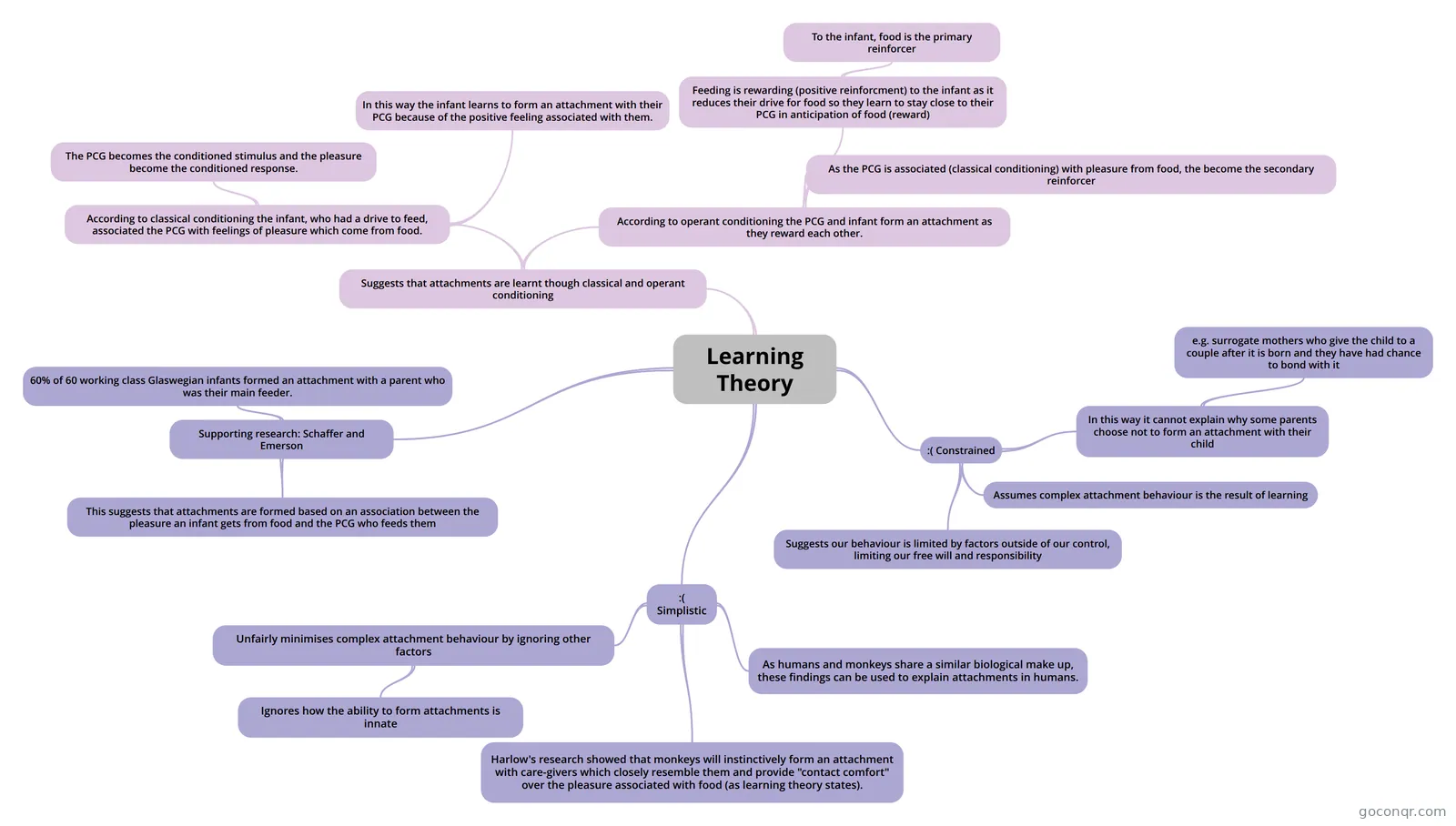
Mind map: Learning theory of attachment
Contenido del mapa
Learning Theory
Suggests that attachments are learnt though classical and operant conditioning
- According to classical conditioning the infant, who had a drive to feed, associated the PCG with feelings of pleasure which come from food.
- The PCG becomes the conditioned stimulus and the pleasure become the conditioned response.
- In this way the infant learns to form an attachment with their PCG because of the positive feeling associated with them.
- According to operant conditioning the PCG and infant form an attachment as they reward each other.
- Feeding is rewarding (positive reinforcment) to the infant as it reduces their drive for food so they learn to stay close to their PCG in anticipation of food (reward)
- To the infant, food is the primary reinforcer
- As the PCG is associated (classical conditioning) with pleasure from food, the become the secondary reinforcer
- Feeding is rewarding (positive reinforcment) to the infant as it reduces their drive for food so they learn to stay close to their PCG in anticipation of food (reward)
- According to classical conditioning the infant, who had a drive to feed, associated the PCG with feelings of pleasure which come from food.
Supporting research: Schaffer and Emerson
- 60% of 60 working class Glaswegian infants formed an attachment with a parent who was their main feeder.
- This suggests that attachments are formed based on an association between the pleasure an infant gets from food and the PCG who feeds them
:( Simplistic
- Unfairly minimises complex attachment behaviour by ignoring other factors
- Ignores how the ability to form attachments is innate
- Harlow's research showed that monkeys will instinctively form an attachment with care-givers which closely resemble them and provide "contact comfort" over the pleasure associated with food (as learning theory states).
- As humans and monkeys share a similar biological make up, these findings can be used to explain attachments in humans.
- Unfairly minimises complex attachment behaviour by ignoring other factors
:( Constrained
- Suggests our behaviour is limited by factors outside of our control, limiting our free will and responsibility
- Assumes complex attachment behaviour is the result of learning
- In this way it cannot explain why some parents choose not to form an attachment with their child
- e.g. surrogate mothers who give the child to a couple after it is born and they have had chance to bond with it
Información
- Descripción
- A-level (PSYA1) Psychology Mapa Mental sobre Learning Theory, creado por sarahsmiles el 03/05/2015.
- Creado por
- sarahsmiles
- Visitas
- 40
- Etiquetas
- Valoración