
Mapa mental
Attachment
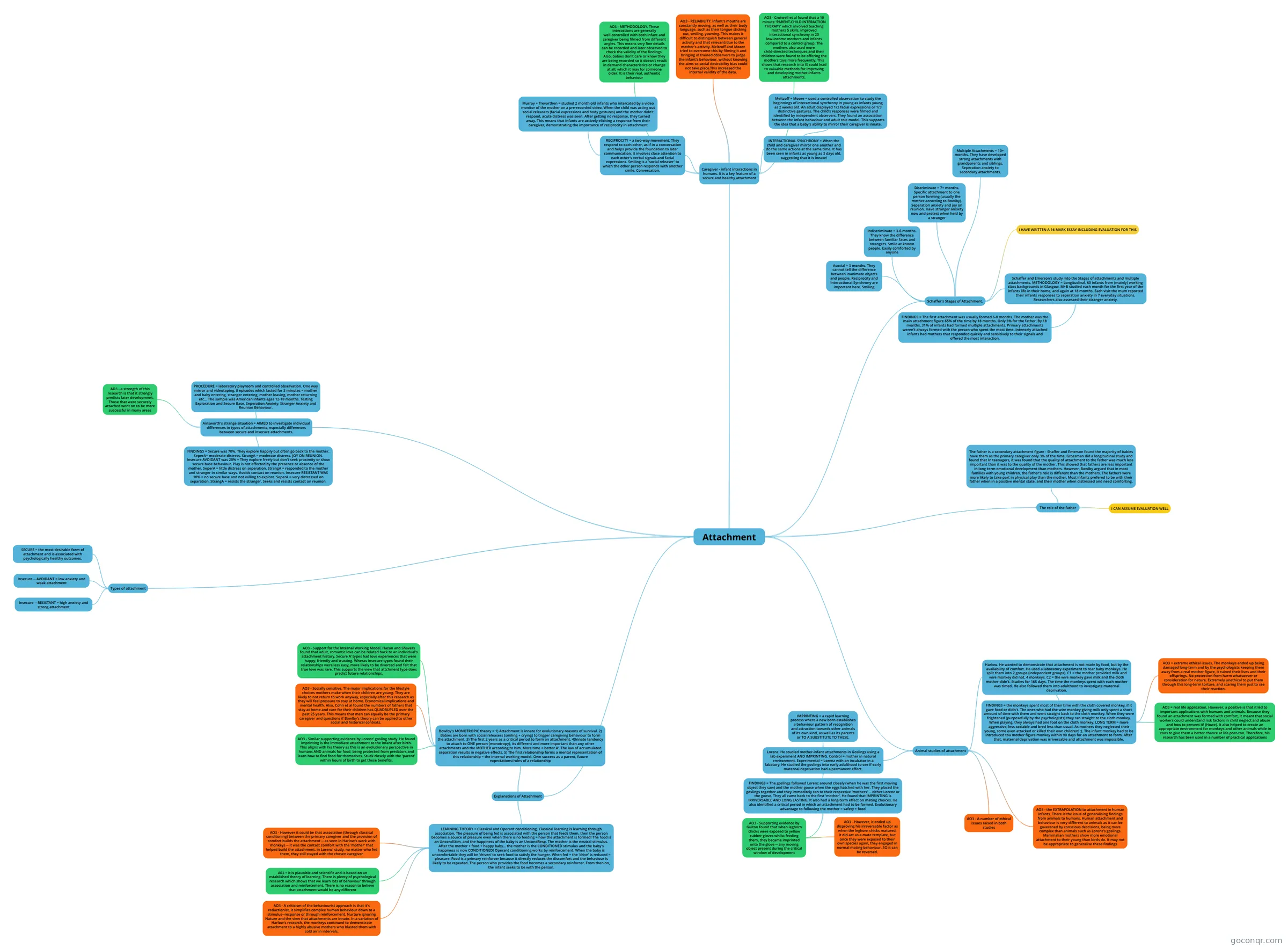
Mind map: Attachment psychology
Contenido del mapa
Attachment
Caregiver - infant interactions in humans. It is a key feature of a secure and healthy attachment
- RECIPROCITY = a two-way movement. They respond to each other, as if in a conversation and helps provide the foundation to later communication. It involves close attention to each other's verbal signals and facial expressions. Smiling is a 'social releaser' to which the other person responds with another smile. Conversation.
- Murray + Trevarthen = studied 2 month old infants who intercated by a video monitor of the mother on a pre-recorded video. When the child was acting out social releasers (facial expressions and body gestures) and the mother didn't respond, acute distress was seen. After getting no response, they turned away. This means that infants are actively eliciting a response from their caregiver, demonstrating the importance of reciprocity in attachment
- INTERACTIONAL SYNCHRONY = When the child and caregiver mirror one another and do the same actions at the same time. It has been seen in infants as young as 3 days old, suggesting that it is innate!
- Meltzoff + Moore = used a controlled observation to study the beginnings of interactional synchrony in young as infants young as 2 weeks old. An adult displayed 1/3 facial expressions or 1/3 distinctive gestures. The child's responses were filmed and identified by independent observers. They found an association between the infant behaviour and adult role model. This supports the idea that a baby's ability to mirror their caregiver is innate.
- AO3 - METHODOLOGY. These interactions are generally well-controlled with both infant and caregiver being filmed from different angles. This means very fine details can be recorded and later observed to check the validity of the findings. Also, babies don't care or know they are being recorded so it doesn't result in demand characteristics or change at all, which it may for someone older. It is their real, authentic behaviour
- AO3 - RELIABILITY. Infant's mouths are constantly moving, as well as their body language, such as their tongue sticking out, smiling, yawning. This makes it difficult to distinguish between general activity and that relevant/due to the mother's activity. Meltzoff and Moore tried to overcome this by filming it and bringing in trained observers to judge the infant's behaviour, without knowing the aims so social desirability bias could not take place.This increased the internal validity of the data.
- AO3 - Crotwell et al found that a 10 minute 'PARENT-CHILD INTERACTION THERAPY' which involved teaching mothers 5 skills, improved interactional synchrony in 20 low-income mothers and infants compared to a control group. The mothers also used more child-directed techniques and their children were found to be offering the mothers toys more frequently. This shows that research into IS could lead to valuable methods for improving and developing mother-infants attachments.
- RECIPROCITY = a two-way movement. They respond to each other, as if in a conversation and helps provide the foundation to later communication. It involves close attention to each other's verbal signals and facial expressions. Smiling is a 'social releaser' to which the other person responds with another smile. Conversation.
Schaffer's Stages of Attachment.
- Asocial = 3 months. They cannot tell the difference between inanimate objects and people. Reciprocity and Interactional Synchrony are important here. Smiling
- Multiple Attachments = 10+ months. They have developed strong attachments with grandparents and siblings. Seperation anxiety to secondary attachments.
- Indiscriminate = 3-6 months. They know the difference between familiar faces and strangers. Smile at known people. Easily comforted by anyone
- Discriminate = 7+ months. Specific attachment to one person forming (usually the mother according to Bowlby). Seperation anxiety and joy on reunion. Have stranger anxiety now and protest when held by a stranger
- Schaffer and Emerson's study into the Stages of attachments and multiple attachments. METHODOLOGY = Longitudinal. 60 infants from (mainly) working class backgrounds in Glasgow. M+B studied each month for the first year of the infants life in their home, and again at 18 months. Each visit the mum reported their infants responses to seperation anxiety in 7 everyday situations. Researchers also assessed their stranger anxiety.
- FINDINGS = The first attachment was usually formed 6-8 months. The mother was the main attachment figure 65% of the time by 18 months. Only 3% for the father. By 18 months, 31% of infants had formed multiple attachments. Primary attachments weren't always formed with the person who spent the most time. Intensely attached infants had mothers that responded quickly and sensitively to their signals and offered the most interaction.
- I HAVE WRITTEN A 16 MARK ESSAY INCLUDING EVALUATION FOR THIS
Ainsworth's strange situation = AIMED to investigate individual differences in types of attachments, especially differences between secure and insecure attachments.
- PROCEDURE = laboratory playroom and controlled observation. One way mirror and videotaping. 8 episodes which lasted for 3 minutes = mother and baby entering, stranger entering, mother leaving, mother returning etc... The sample was American infants ages 12-18 months. Testing Exploration and Secure Base, Seperation Anxiety, Stranger Anxiety and Reunion Behaviour.
- FINDINGS = Secure was 70%. They explore happily but often go back to the mother. SeperA= moderate distress. StrangA = moderate distress. JOY ON REUNION. Insecure AVOIDANT was 20% = They explore freely but don't seek proximity or show secure base behaviour. Play is not effected by the presence or absence of the mother. SeperA = little distress on seperation. StrangA = responded to the mother and stranger in similar ways. Avoids contact on reunion. Insecure RESISTANT WAS 10% = no secure base and not willing to explore. SeperA = very distressed on separation. StrangA = resists the stranger. Seeks and resists contact on reunion.
- AO3 - a strength of this research is that it strongly predicts later development. Those that were securely attached went on to be more successful in many areas
Explanations of Attachment
- Bowlby's MONOTROPIC theory = 1) Attachment is innate for evolutionary reasons of survival. 2) Babies are born with social releasers (smiling + crying) to trigger caregiving behaviour to form the attachment. 3) The first 2 years as a critical period to form an attachment. 4)Innate tendency to attach to ONE person (monotropy), its different and more important than any other attachments and the MOTHER according to him. More time = better A'. The law of accumulated separation results in negative effects. 5) The first relationship forms a mental representation of this relationship = the internal working model. Own success as a parent, future expectations/rules of a relationship
- AO3 - Similar supporting evidence by Lorenz' gosling study. He found imprinting is the immediate attachment to the infant after birth. This aligns with his theory as this is an evolutionary perspective in humans AND animals for food, being protected from predators and learn how to find food for themselves. Stuck closely with the 'parent' within hours of birth to get these benefits.
- AO3 - Socially sensitive. The major implications for the lifestyle choices mothers make when their children are young. They are likely to not return to work anyway, especially after this research as they will feel pressure to stay at home. Economical implications and mental health. Also, Cohn et al found the numbers of fathers that stay at home and care for their children has QUADRUPLED over the past 25 years. This means that men can equally be the primary caregiver and questions if Bowlby's theory can be applied to other social and historical contexts.
- AO3 - Support for the Internal Working Model. Hazan and Shavers found that adult, romantic love can be related back to an individual's attachment history. Secure A' types had love experiences that were happy, friendly and trusting. Wheras insecure types found their relationships were less easy, more likely to be divorced and felt that true love was rare. This supports the view that attchment type does predict future relationships.
- LEARNING THEORY = Classical and Operant conditioning. Classical learning is learning through association. The pleasure of being fed is associated with the person that feeds them, then the person becomes a source of pleasure even when there is no feeding = how the attachment is formed! The food is an UncondStim, and the happiness of the baby is an UncondResp. The mother is the neutral stimulus. After the mother + food + happy baby... the mother is the CONDITIONED stimulus and the baby's happiness is now CONDITIONED! Operant conditioning works by reinforcement. When the baby is uncomfortable they will be 'driven' to seek food to satisfy the hunger. When fed = the 'drive' is reduced = pleasure. Food is a primary reinforcer because it directly reduces the discomfort and the behaviour is likely to be repeated. The person who provides the food becomes a secondary reinforcer. From then on, the infant seeks to be with the person.
- A03 = it is plausible and scientific and is based on an established theory of learning. There is plenty of psychological research which shows that we learn lots of behaviour through association and reinforcement. There is no reason to believe that attachment would be any different
- AO3 - However it could be that association (through classical conditoning) between the primary caregiver and the provision of comfort builds the attachment -- as seen in Harlow's work with monkeys -- it was the contact comfort with the 'mother' that helped build the attachment. In Lorenz' study, no matter who fed them, they still stayed with the chosen caregiver
- AO3 - A criticism of the behaviourist approach is that it's reductionist, it simplifies complex human behaviour down to a stimulus--response or through reinforcement. Nurture ignoring Nature and the view that attachments are innate. In a variation of Harlow's research, the monkeys continued to demonstrate attachment to a highly abusive mothers who blasted them with cold air in intervals.
- Bowlby's MONOTROPIC theory = 1) Attachment is innate for evolutionary reasons of survival. 2) Babies are born with social releasers (smiling + crying) to trigger caregiving behaviour to form the attachment. 3) The first 2 years as a critical period to form an attachment. 4)Innate tendency to attach to ONE person (monotropy), its different and more important than any other attachments and the MOTHER according to him. More time = better A'. The law of accumulated separation results in negative effects. 5) The first relationship forms a mental representation of this relationship = the internal working model. Own success as a parent, future expectations/rules of a relationship
The role of the father
- The father is a secondary attachment figure - Shaffer and Emerson found the majority of babies have them as the primary caregiver only 3% of the time. Grossman did a longitudinal study and found that In teenagers, it was found that the quality of attachment to the father was much less important than it was to the quality of the mother. This showed that fathers are less important in long-term emotional development than mothers. However, Bowlby argued that in most families with young children, the father's role is different than the mothers. The fathers were more likely to take part in physical play than the mother. Most infants prefered to be with their father when in a positive mental state, and their mother when distressed and need comforting.
- I CAN ASSUME EVALUATION WELL
Animal studies of attachment
- Lorenz. He studied mother-infant attachments in Goslings using a lab experiment AND IMPRINTING. Control = mother in natural environment. Experimental = Lorenz with an incubator in a labatory. He studied the goslings into early adulthood to see if early maternal deprivation had a permanent effect.
- IMPRINTING = a rapid learning process where a new born establishes a behaviour pattern of recognition and attraction towards other animals of its own kind, as well as its parents or TO A SUBSTITUTE TO THESE.
- FINDINGS = The goslings followed Lorenz around closely (when he was the first moving object they saw) and the mother goose when the eggs hatched with her. They placed the goslings together and they immeditely ran to their respective 'mothers' -- either Lorenz or the goose. They all came back to the first 'mother'. He found that IMPRINTING is IRRIVERSABLE AND LONG LASTING. It also had a long-term effect on mating choices. He also identified a critical period in which an attachment had to be formed. Evolutionary advantage to following the mother = safety + food
- AO3 - Supporting evidence by Guiton found that when leghorn chicks were exposed to yellow rubber gloves whilst feeding them, they became imprinted onto the glove -- any moving object present during the critical window of development
- AO3 - However, it ended up disproving his irreversable factor as when the leghorn chicks matured, it did act as a mate template, but once they were exposed to their own species again, they engaged in normal mating behaviour. SO it can be reversed.
- AO3 - Supporting evidence by Guiton found that when leghorn chicks were exposed to yellow rubber gloves whilst feeding them, they became imprinted onto the glove -- any moving object present during the critical window of development
- Harlow. He wanted to demonstrate that attachment is not made by food, but by the availability of comfort. He used a laboratory experiment to rear baby monkeys. He split them into 2 groups (independent groups). C1 = the mother provided milk and wire monkey did not. 4 monkeys. C2 = the wire monkey gave milk and the cloth mother didn't. Studies for 165 days. The time the monkeys spent with each mother was timed. He also followed them into adulthood to investigate maternal deprivation.
- FINDINGS = the monkeys spent most of their time with the cloth covered monkey, if it gave food or didn't. The ones who had the wire monkey giving milk only spent a short amount of time with them and went straight back to the cloth monkey. When they were frightened (purposefully by the psychologists) they ran straight to the cloth monkey. When playing, they always had one foot on the cloth monkey. LONG TERM = more aggressive, less sociable and bred less than usual. As mothers they neglected their young, some even attacked or killed their own children! :(. The infant monkey had to be introduced toa mother figure monkey within 90 days for an attachment to form. After that, maternal deprivation was irriversable and attachment was impossible.
- AO3 = extreme ethical issues. The monkeys ended up being damaged long-term and by the psychologists keeping them away from a real mother figure, it ruined their lives and their offsprings. No protection from harm whatsoever or consideration for nature. Extremely unethical to put them through this long-term torture, and scaring them just to see their reaction.
- AO3 = real life application. However, a positive is that it led to important applications with humans and animals. Because they found an attachment was formed with comfort, it meant that social workers could understand risk factors in child neglect and abuse and how to prevent it! (Howe). It also helped to create an appropriate environment for monkeys and other animals while in zoos to give them a better chance at life post-zoo. Therefore, his research has been used in a number of practical applications
- FINDINGS = the monkeys spent most of their time with the cloth covered monkey, if it gave food or didn't. The ones who had the wire monkey giving milk only spent a short amount of time with them and went straight back to the cloth monkey. When they were frightened (purposefully by the psychologists) they ran straight to the cloth monkey. When playing, they always had one foot on the cloth monkey. LONG TERM = more aggressive, less sociable and bred less than usual. As mothers they neglected their young, some even attacked or killed their own children! :(. The infant monkey had to be introduced toa mother figure monkey within 90 days for an attachment to form. After that, maternal deprivation was irriversable and attachment was impossible.
- AO3 - the EXTRAPOLATION to attachment in human infants. There is the issue of generalising findings from animals to humans. Human attachment and behaviour is very different to animals as it can be goverened by conscious descisions, being more complex than animals such as Lorenz's goslings. Mammalian mothers show more emotional attachment to their young than birds do. It may not be appropriate to generalise these findings
- AO3 - A number of ethical issues raised in both studies
- Lorenz. He studied mother-infant attachments in Goslings using a lab experiment AND IMPRINTING. Control = mother in natural environment. Experimental = Lorenz with an incubator in a labatory. He studied the goslings into early adulthood to see if early maternal deprivation had a permanent effect.
Types of attachment
- SECURE = the most desirable form of attachment and is associated with psychologically healthy outcomes.
- Insecure -- AVOIDANT = low anxiety and weak attachment
- Insecure -- RESISTANT = high anxiety and strong attachment
Información
- Descripción
- Mapa Mental sobre Attachment, creado por Ella _ el 01/05/2026.
- Creado por
- Ella _
- Visitas
- 0
- Valoración