
Mapa mental
Lecture 5 - Language Development
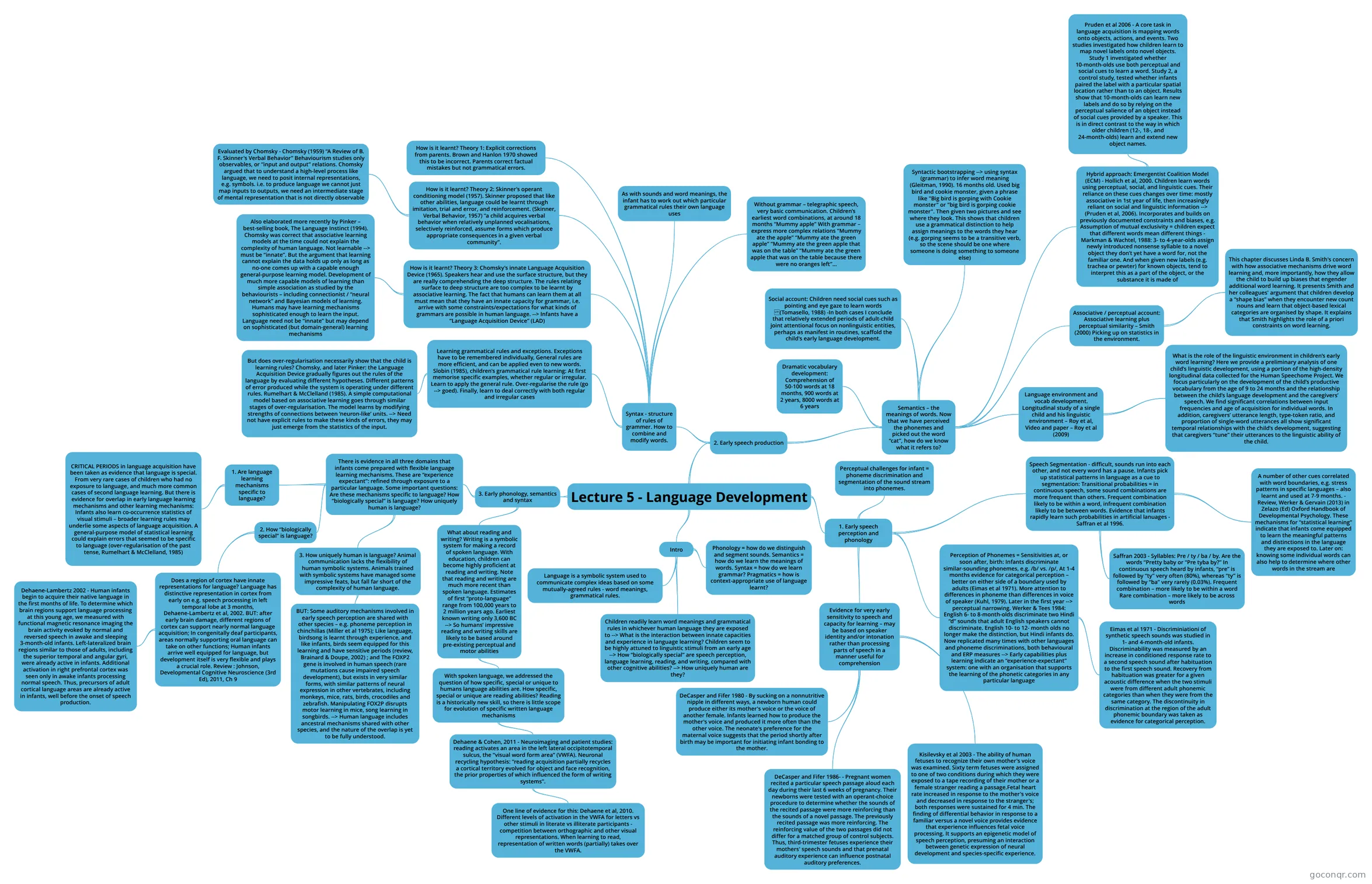
Mind map: Language development
Contenido del mapa
Lecture 5 - Language Development
Intro
- Language is a symbolic system used to communicate complex ideas based on some mutually-agreed rules - word meanings, grammatical rules.
- Children readily learn word meanings and grammatical rules in whichever human language they are exposed to --> What is the interaction between innate capacities and experience in language learning? Children seem to be highly attuned to linguistic stimuli from an early age --> How “biologically special” are speech perception, language learning, reading, and writing, compared with other cognitive abilities? --> How uniquely human are they?
- Phonology = how do we distinguish and segment sounds. Semantics = how do we learn the meanings of words. Syntax = how do we learn grammar? Pragmatics = how is context-appropriate use of language learnt?
1. Early speech perception and phonology
- Evidence for very early sensitivity to speech and capacity for learning – may be based on speaker identity and/or intonation rather than processing parts of speech in a manner useful for comprehension
- DeCasper and Fifer 1980 - By sucking on a nonnutritive nipple in different ways, a newborn human could produce either its mother's voice or the voice of another female. Infants learned how to produce the mother's voice and produced it more often than the other voice. The neonate's preference for the maternal voice suggests that the period shortly after birth may be important for initiating infant bonding to the mother.
- DeCasper and Fifer 1986- - Pregnant women recited a particular speech passage aloud each day during their last 6 weeks of pregnancy. Their newborns were tested with an operant-choice procedure to determine whether the sounds of the recited passage were more reinforcing than the sounds of a novel passage. The previously recited passage was more reinforcing. The reinforcing value of the two passages did not differ for a matched group of control subjects. Thus, third-trimester fetuses experience their mothers' speech sounds and that prenatal auditory experience can influence postnatal auditory preferences.
- Kisilevsky et al 2003 - The ability of human fetuses to recognize their own mother's voice was examined. Sixty term fetuses were assigned to one of two conditions during which they were exposed to a tape recording of their mother or a female stranger reading a passage.Fetal heart rate increased in response to the mother's voice and decreased in response to the stranger's; both responses were sustained for 4 min. The finding of differential behavior in response to a familiar versus a novel voice provides evidence that experience influences fetal voice processing. It supports an epigenetic model of speech perception, presuming an interaction between genetic expression of neural development and species-specific experience.
- Perceptual challenges for infant = phoneme discrimination and segmentation of the sound stream into phonemes.
- Perception of Phonemes = Sensitivities at, or soon after, birth: Infants discriminate similar-sounding phonemes, e.g. /b/ vs. /p/, At 1-4 months evidence for categorical perception – better on either side of a boundary used by adults (Eimas et al 1971). More attention to differences in phoneme than differences in voice of speaker (Kuhl, 1979). Later in the first year --> perceptual narrowing. Werker & Tees 1984: English 6- to 8-month-olds discriminate two Hindi “d” sounds that adult English speakers cannot discriminate. English 10- to 12- month olds no longer make the distinction, but Hindi infants do. Now replicated many times with other languages and phoneme discriminations, both behavioural and ERP measures --> Early capabilities plus learning indicate an “experience-expectant” system: one with an organisation that supports the learning of the phonetic categories in any particular language
- Eimas et al 1971 - Discriminiationi of synthetic speech sounds was studied in 1- and 4-month-old infants. Discriminability was measured by an increase in conditioned response rate to a second speech sound after habituation to the first speech sound. Recovery from habituation was greater for a given acoustic difference when the two stimuli were from different adult phonemic categories than when they were from the same category. The discontinuity in discrimination at the region of the adult phonemic boundary was taken as evidence for categorical perception.
- Speech Segmentation - difficult, sounds run into each other, and not every word has a pause. Infants pick up statistical patterns in language as a cue to segmentation: Transitional probabilities = in continuous speech, some sound combinations are more frequent than others. Frequent combination likely to be within a word, infrequent combination likely to be between words. Evidence that infants rapidly learn such probabilities in artificial lanuages - Saffran et al 1996.
- Saffran 2003 - Syllables: Pre / ty / ba / by. Are the words “Pretty baby or “Pre tyba by?” In continuous speech heard by infants, “pre” is followed by “ty” very often (80%), whereas “ty” is followed by “ba” very rarely (0.03%). Frequent combination – more likely to be within a word Rare combination – more likely to be across words
- A number of other cues correlated with word boundaries, e.g. stress patterns in specific languages – also learnt and used at 7-9 months. - Review, Werker & Gervain (2013) in Zelazo (Ed) Oxford Handbook of Developmental Psychology. These mechanisms for “statistical learning” indicate that infants come equipped to learn the meaningful patterns and distinctions in the language they are exposed to. Later on: knowing some individual words can also help to determine where other words in the stream are
- Evidence for very early sensitivity to speech and capacity for learning – may be based on speaker identity and/or intonation rather than processing parts of speech in a manner useful for comprehension
2. Early speech production
- Semantics – the meanings of words. Now that we have perceived the phonemes and picked out the word “cat”, how do we know what it refers to?
- Dramatic vocabulary development: Comprehension of 50-100 words at 18 months, 900 words at 2 years, 8000 words at 6 years
- Associative / perceptual account: Associative learning plus perceptual similarity – Smith (2000) Picking up on statistics in the environment.
- This chapter discusses Linda B. Smith's concern with how associative mechanisms drive word learning and, more importantly, how they allow the child to build up biases that engender additional word learning. It presents Smith and her colleagues' argument that children develop a “shape bias” when they encounter new count nouns and learn that object-based lexical categories are organised by shape. It explains that Smith highlights the role of a priori constraints on word learning.
- Social account: Children need social cues such as pointing and eye gaze to learn words (Tomasello, 1988) -In both cases I conclude that relatively extended periods of adult-child joint attentional focus on nonlinguistic entities, perhaps as manifest in routines, scaffold the child's early language development.
- Syntactic bootstrapping --> using syntax (grammar) to infer word meaning (Gleitman, 1990). 16 months old. Used big bird and cookie monster, given a phrase like "Big bird is gorping with Cookie monster" or "big bird is gorping cookie monster". Then given two pictures and see where they look. This shows that children use a grammatical distinction to help assign meanings to the words they hear (e.g. gorping seems to be a transitive verb, so the scene should be one where someone is doing something to someone else)
- Language environment and vocab development. Longitudinal study of a single child and his linguistic environment – Roy et al, Video and paper – Roy et al (2009)
- What is the role of the linguistic environment in children’s early word learning? Here we provide a preliminary analysis of one child’s linguistic development, using a portion of the high-density longitudinal data collected for the Human Speechome Project. We focus particularly on the development of the child’s productive vocabulary from the age of 9 to 24 months and the relationship between the child’s language development and the caregivers’ speech. We find significant correlations between input frequencies and age of acquisition for individual words. In addition, caregivers’ utterance length, type-token ratio, and proportion of single-word utterances all show significant temporal relationships with the child’s development, suggesting that caregivers “tune” their utterances to the linguistic ability of the child.
- Hybrid approach: Emergentist Coalition Model (ECM) - Hollich et al, 2000. Children learn words using perceptual, social, and linguistic cues. Their reliance on these cues changes over time: mostly associative in 1st year of life, then increasingly reliant on social and linguistic information --> (Pruden et al, 2006). Incorporates and builds on previously documented constraints and biases, e.g. Assumption of mutual exclusivity = children expect that different words mean different things - Markman & Wachtel, 1988: 3- to 4-year-olds assign newly introduced nonsense syllable to a novel object they don’t yet have a word for, not the familiar one. And when given new labels (e.g. trachea or pewter) for known objects, tend to interpret this as a part of the object, or the substance it is made of
- Pruden et al 2006 - A core task in language acquisition is mapping words onto objects, actions, and events. Two studies investigated how children learn to map novel labels onto novel objects. Study 1 investigated whether 10-month-olds use both perceptual and social cues to learn a word. Study 2, a control study, tested whether infants paired the label with a particular spatial location rather than to an object. Results show that 10-month-olds can learn new labels and do so by relying on the perceptual salience of an object instead of social cues provided by a speaker. This is in direct contrast to the way in which older children (12-, 18-, and 24-month-olds) learn and extend new object names.
- Syntax - structure of rules of grammer. How to combine and modify words.
- Without grammar – telegraphic speech, very basic communication. Children’s earliest word combinations, at around 18 months “Mummy apple” With grammar – express more complex relations “Mummy ate the apple” “Mummy ate the green apple” “Mummy ate the green apple that was on the table” “Mummy ate the green apple that was on the table because there were no oranges left”…
- As with sounds and word meanings, the infant has to work out which particular grammatical rules their own language uses
- How is it learnt? Theory 1: Explicit corrections from parents. Brown and Hanlon 1970 showed this to be incorrect. Parents correct factual mistakes but not grammatical errors.
- How is it learnt? Theory 2: Skinner’s operant conditioning model (1957). Skinner proposed that like other abilities, language could be learnt through imitation, trial and error, and reinforcement. (Skinner, Verbal Behavior, 1957) “a child acquires verbal behavior when relatively unplanned vocalisations, selectively reinforced, assume forms which produce appropriate consequences in a given verbal community”.
- Evaluated by Chomsky - Chomsky (1959) “A Review of B. F. Skinner's Verbal Behavior” Behaviourism studies only observables, or “input and output” relations. Chomsky argued that to understand a high-level process like language, we need to posit internal representations, e.g. symbols. i.e. to produce language we cannot just map inputs to outputs, we need an intermediate stage of mental representation that is not directly observable
- How is it learnt? Theory 3: Chomsky’s innate Language Acquisition Device (1965). Speakers hear and use the surface structure, but they are really comprehending the deep structure. The rules relating surface to deep structure are too complex to be learnt by associative learning. The fact that humans can learn them at all must mean that they have an innate capacity for grammar, i.e. arrive with some constraints/expectations for what kinds of grammars are possible in human language. --> Infants have a “Language Acquisition Device” (LAD)
- Also elaborated more recently by Pinker – best-selling book, The Language Instinct (1994). Chomsky was correct that associative learning models at the time could not explain the complexity of human language. Not learnable --> must be “innate”. But the argument that learning cannot explain the data holds up only as long as no-one comes up with a capable enough general-purpose learning model. Development of much more capable models of learning than simple association as studied by the behaviourists – including connectionist / “neural network” and Bayesian models of learning. Humans may have learning mechanisms sophisticated enough to learn the input. Language need not be “innate” but may depend on sophisticated (but domain-general) learning mechanisms
- Learning grammatical rules and exceptions. Exceptions have to be remembered individually, General rules are more efficient, and can be applied even to new words. Slobin (1985), children’s grammatical rule learning: At first memorise specific examples, whether regular or irregular. Learn to apply the general rule. Over-regularise the rule (go --> goed). Finally, learn to deal correctly with both regular and irregular cases
- But does over-regularisation necessarily show that the child is learning rules? Chomsky, and later Pinker: the Language Acquisition Device gradually figures out the rules of the language by evaluating different hypotheses. Different patterns of error produced while the system is operating under different rules. Rumelhart & McClelland (1985). A simple computational model based on associative learning goes through similar stages of over-regularisation. The model learns by modifying strengths of connections between ‘neuron-like’ units. --> Need not have explicit rules to make these kinds of errors, they may just emerge from the statistics of the input.
- Semantics – the meanings of words. Now that we have perceived the phonemes and picked out the word “cat”, how do we know what it refers to?
3. Early phonology, semantics and syntax
- There is evidence in all three domains that infants come prepared with flexible language learning mechanisms. These are “experience expectant”: refined through exposure to a particular language. Some important questions: Are these mechanisms specific to language? How “biologically special” is language? How uniquely human is language?
- 1. Are language learning mechanisms specific to language?
- CRITICAL PERIODS in language acquisition have been taken as evidence that language is special. From very rare cases of children who had no exposure to language, and much more common cases of second language learning. But there is evidence for overlap in early language learning mechanisms and other learning mechanisms: Infants also learn co-occurrence statistics of visual stimuli – broader learning rules may underlie some aspects of language acquisition. A general-purpose model of statistical learning could explain errors that seemed to be specific to language (over-regularisation of the past tense, Rumelhart & McClelland, 1985)
- 2. How “biologically special” is language?
- Does a region of cortex have innate representations for language? Language has distinctive representation in cortex from early on e.g. speech processing in left temporal lobe at 3 months, Dehaene-Lambertz et al, 2002. BUT: after early brain damage, different regions of cortex can support nearly normal language acquisition; In congenitally deaf participants, areas normally supporting oral language can take on other functions; Human infants arrive well equipped for language, but development itself is very flexible and plays a crucial role. Review : Johnson, Developmental Cognitive Neuroscience (3rd Ed), 2011, Ch 9
- Dehaene-Lambertz 2002 - Human infants begin to acquire their native language in the first months of life. To determine which brain regions support language processing at this young age, we measured with functional magnetic resonance imaging the brain activity evoked by normal and reversed speech in awake and sleeping 3-month-old infants. Left-lateralized brain regions similar to those of adults, including the superior temporal and angular gyri, were already active in infants. Additional activation in right prefrontal cortex was seen only in awake infants processing normal speech. Thus, precursors of adult cortical language areas are already active in infants, well before the onset of speech production.
- Does a region of cortex have innate representations for language? Language has distinctive representation in cortex from early on e.g. speech processing in left temporal lobe at 3 months, Dehaene-Lambertz et al, 2002. BUT: after early brain damage, different regions of cortex can support nearly normal language acquisition; In congenitally deaf participants, areas normally supporting oral language can take on other functions; Human infants arrive well equipped for language, but development itself is very flexible and plays a crucial role. Review : Johnson, Developmental Cognitive Neuroscience (3rd Ed), 2011, Ch 9
- 3. How uniquely human is language? Animal communication lacks the flexibility of human symbolic systems. Animals trained with symbolic systems have managed some impressive feats, but fall far short of the complexity of human language.
- BUT: Some auditory mechanisms involved in early speech perception are shared with other species – e.g. phoneme perception in chinchillas (Miller et al 1975); Like language, birdsong is learnt through experience, and like infants, birds seem equipped for this learning and have sensitive periods (review, Brainard & Doupe, 2002) ; and The FOXP2 gene is involved in human speech (rare mutations cause impaired speech development), but exists in very similar forms, with similar patterns of neural expression in other vertebrates, including monkeys, mice, rats, birds, crocodiles and zebrafish. Manipulating FOX2P disrupts motor learning in mice, song learning in songbirds. --> Human language includes ancestral mechanisms shared with other species, and the nature of the overlap is yet to be fully understood.
- 1. Are language learning mechanisms specific to language?
- What about reading and writing? Writing is a symbolic system for making a record of spoken language. With education, children can become highly proficient at reading and writing. Note that reading and writing are much more recent than spoken language. Estimates of first “proto-language” range from 100,000 years to 2 million years ago. Earliest known writing only 3,600 BC --> So humans’ impressive reading and writing skills are likely to be based around pre-existing perceptual and motor abilities
- With spoken language, we addressed the question of how specific, special or unique to humans language abilities are. How specific, special or unique are reading abilities? Reading is a historically new skill, so there is little scope for evolution of specific written language mechanisms
- Dehaene & Cohen, 2011 - Neuroimaging and patient studies: reading activates an area in the left lateral occipitotemporal sulcus, the “visual word form area” (VWFA). Neuronal recycling hypothesis: “reading acquisition partially recycles a cortical territory evolved for object and face recognition, the prior properties of which influenced the form of writing systems”.
- One line of evidence for this: Dehaene et al, 2010. Different levels of activation in the VWFA for letters vs other stimuli in literate vs illiterate participants - competition between orthographic and other visual representations. When learning to read, representation of written words (partially) takes over the VWFA.
- Dehaene & Cohen, 2011 - Neuroimaging and patient studies: reading activates an area in the left lateral occipitotemporal sulcus, the “visual word form area” (VWFA). Neuronal recycling hypothesis: “reading acquisition partially recycles a cortical territory evolved for object and face recognition, the prior properties of which influenced the form of writing systems”.
- With spoken language, we addressed the question of how specific, special or unique to humans language abilities are. How specific, special or unique are reading abilities? Reading is a historically new skill, so there is little scope for evolution of specific written language mechanisms
- There is evidence in all three domains that infants come prepared with flexible language learning mechanisms. These are “experience expectant”: refined through exposure to a particular language. Some important questions: Are these mechanisms specific to language? How “biologically special” is language? How uniquely human is language?
Información
- Descripción
- Uni Year 2 Developmental Psychology Mapa Mental sobre Lecture 5 - Language Development, creado por Issy de Silva el 19/04/2016.
- Creado por
- Issy de Silva
- Visitas
- 2
- Valoración
Más sobre Language Development