
Mapa mental
Research Methods-Part 1
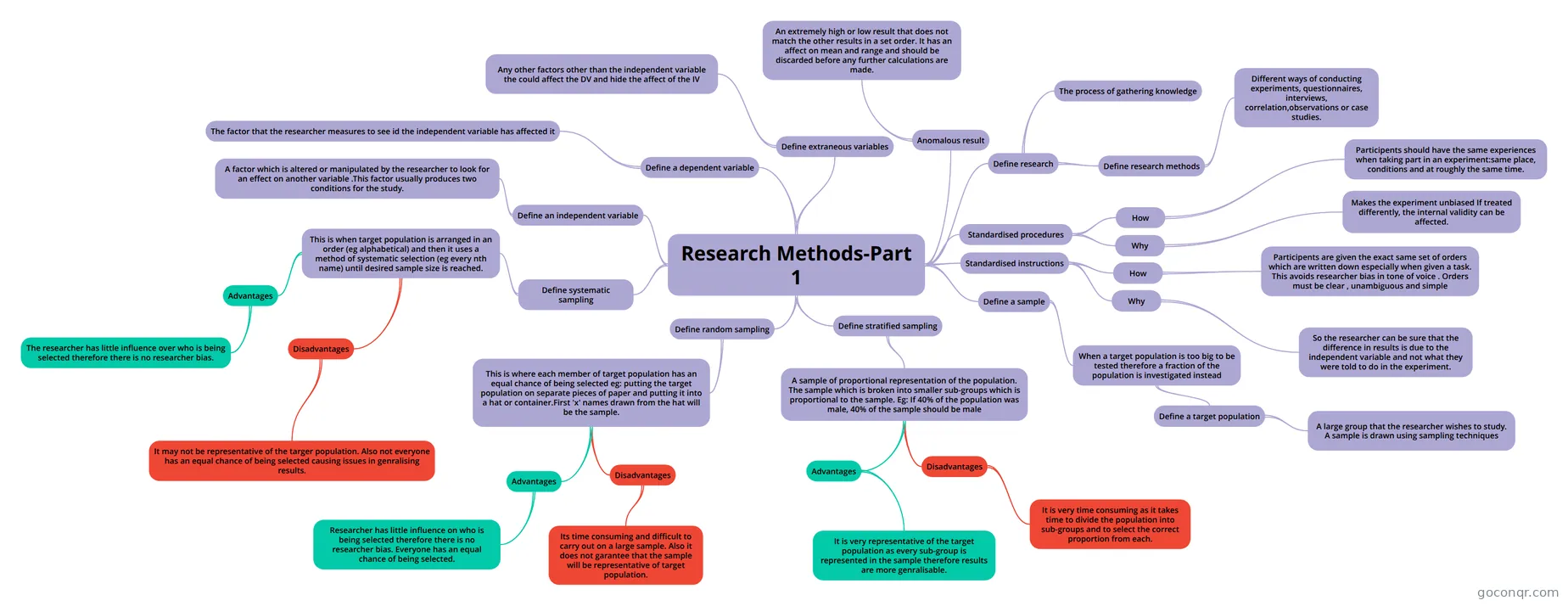
Mind map: research methods definitions
Contenido del mapa
Research Methods-Part 1
Define research
- The process of gathering knowledge
- Define research methods
- Different ways of conducting experiments, questionnaires, interviews, correlation,observations or case studies.
Define a sample
- When a target population is too big to be tested therefore a fraction of the population is investigated instead
- Define a target population
- A large group that the researcher wishes to study. A sample is drawn using sampling techniques
- Define a target population
- When a target population is too big to be tested therefore a fraction of the population is investigated instead
Define stratified sampling
- A sample of proportional representation of the population. The sample which is broken into smaller sub-groups which is proportional to the sample. Eg: If 40% of the population was male, 40% of the sample should be male
- Advantages
- It is very representative of the target population as every sub-group is represented in the sample therefore results are more genralisable.
- Disadvantages
- It is very time consuming as it takes time to divide the population into sub-groups and to select the correct proportion from each.
- Advantages
- A sample of proportional representation of the population. The sample which is broken into smaller sub-groups which is proportional to the sample. Eg: If 40% of the population was male, 40% of the sample should be male
Define random sampling
- This is where each member of target population has an equal chance of being selected eg: putting the target population on separate pieces of paper and putting it into a hat or container.First 'x' names drawn from the hat will be the sample.
- Advantages
- Researcher has little influence on who is being selected therefore there is no researcher bias. Everyone has an equal chance of being selected.
- Disadvantages
- Its time consuming and difficult to carry out on a large sample. Also it does not garantee that the sample will be representative of target population.
- Advantages
- This is where each member of target population has an equal chance of being selected eg: putting the target population on separate pieces of paper and putting it into a hat or container.First 'x' names drawn from the hat will be the sample.
Define systematic sampling
- This is when target population is arranged in an order (eg alphabetical) and then it uses a method of systematic selection (eg every nth name) until desired sample size is reached.
- Advantages
- The researcher has little influence over who is being selected therefore there is no researcher bias.
- Disadvantages
- It may not be representative of the targer population. Also not everyone has an equal chance of being selected causing issues in genralising results.
- Advantages
- This is when target population is arranged in an order (eg alphabetical) and then it uses a method of systematic selection (eg every nth name) until desired sample size is reached.
Define an independent variable
- A factor which is altered or manipulated by the researcher to look for an effect on another variable .This factor usually produces two conditions for the study.
Define a dependent variable
- The factor that the researcher measures to see id the independent variable has affected it
Define extraneous variables
- Any other factors other than the independent variable the could affect the DV and hide the affect of the IV
Anomalous result
- An extremely high or low result that does not match the other results in a set order. It has an affect on mean and range and should be discarded before any further calculations are made.
Standardised procedures
- How
- Participents should have the same experiences when taking part in an experiment:same place, conditions and at roughly the same time.
- Why
- Makes the experiment unbiased If treated differently, the internal validity can be affected.
- How
Standardised instructions
- How
- Participents are given the exact same set of orders which are written down especially when given a task. This avoids researcher bias in tone of voice . Orders must be clear , unambiguous and simple
- Why
- So the researcher can be sure that the difference in results is due to the independent variable and not what they were told to do in the experiment.
- How
Información
- Descripción
- GCSE (Unit 1) Psychology Mapa Mental sobre Research Methods-Part 1, creado por Lucy Andrews el 31/05/2016.
- Creado por
- Lucy Andrews
- Visitas
- 23
- Etiquetas
- Valoración